 By st20113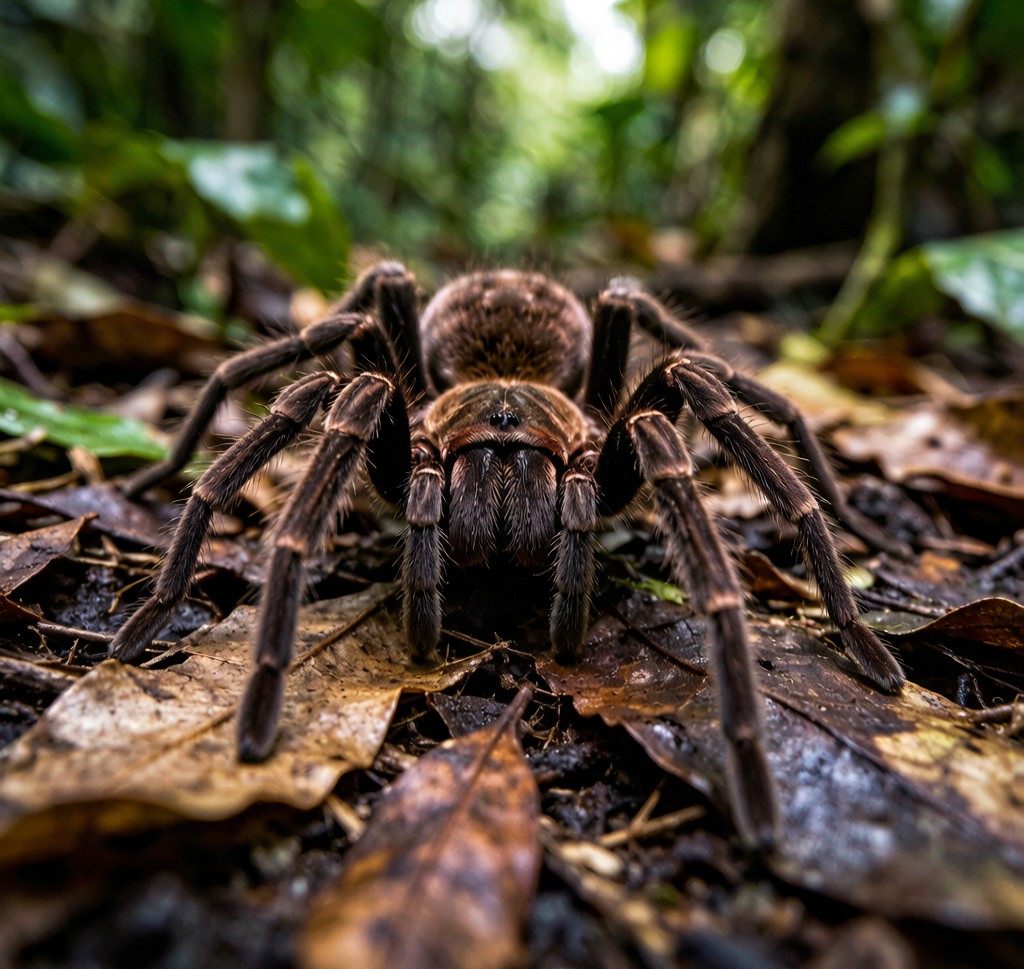
A Goliath Birdeater Tarantula (Theraphosa blondi) resting on the Amazon rainforest floor, showing its enormous leg span and hairy body
Overview
The Goliath Birdeater (Theraphosa blondi) holds the distinction of being the largest spider in the world by mass and leg span. Found in the rainforests of northern South America, particularly in the Amazon basins of Brazil, Venezuela, Guyana, Suriname, and French Guiana, the Goliath Birdeater can reach a leg span of up to 28 to 30 centimeters and weigh up to 175 grams. Despite its intimidating name and appearance – enormous, hairy, and equipped with two-inch fangs – the Goliath Birdeater is largely harmless to humans, its bite comparable in severity to a wasp sting and its venom causing only localized pain and discomfort.
The species’ common name is something of a misnomer: while it is theoretically capable of killing and eating small birds (its maximum prey size is limited only by its own strength), its diet in the wild consists primarily of large insects, worms, and other arthropods, as well as small vertebrates including frogs, mice, and lizards. The name is thought to originate from an 18th-century engraving by Maria Sibylla Merian showing the spider eating a hummingbird – an unusual but documented behavior that captured European imagination and gave the species its enduring common name.
Habitat and Distribution
The Goliath Birdeater inhabits the humid tropical rainforests of the Amazon and Guiana regions of northern South America, where it lives in deep burrows in the forest floor, typically excavated beneath roots, logs, or rocks. These burrows – which can extend up to one meter into the soil – provide the spider with protection from predators, a stable microclimate, and a secure location from which to ambush passing prey. The species occurs in primary and old-growth rainforest, where the deep, humid soil and abundant cover provide ideal habitat conditions.
The Goliath Birdeater’s dependence on primary rainforest makes it highly vulnerable to deforestation. As the Amazon rainforest is cleared for agriculture, cattle ranching, and infrastructure development, the spider’s habitat is destroyed, and populations become isolated in remaining forest fragments. The species’ large size and low reproductive rate – females produce only one egg sac per year containing approximately 100 to 200 spiderlings – mean that populations recover very slowly from habitat disturbance. In areas where forest has been heavily degraded or cleared, Goliath Birdeaters disappear entirely, making them an indicator species for forest health in their range.
Biology and Defense
The Goliath Birdeater’s most impressive feature is its sheer size – but this comes with remarkable physical adaptations. The spider’s body is covered in urticating hairs (bristles) that can be flicked from the abdomen in a cloud when the spider feels threatened. These microscopic, barbed hairs are incredibly irritating to skin and mucous membranes, and can cause significant discomfort if inhaled. The spider uses this mechanism as a first line of defense against predators including mammals and other spiders.
When threatened beyond the range of urticating hair defense, the Goliath Birdeater will rear up on its hind legs and display its large, needle-like fangs – which can exceed 2.5 centimeters in length – in a threat display. Despite their fearsome appearance, the spider’s venom is relatively mild for a tarantula of its size, causing only localized pain, swelling, and redness in most cases. The spider’s primary natural predators are large tarantula hawk wasps – which specialize in hunting tarantulas and can reach the size of a hummingbird – as well as certain snake species and large mammals that can dig into burrows.
Reproduction and Life Cycle
Goliath Birdeaters have one of the longest lifespans of any spider, with females living up to 25 to 30 years in the wild – considerably longer than males, which typically live 3 to 6 years and die shortly after reaching sexual maturity. The male’s short lifespan is driven by the physical demands of reproduction: after mating, males typically wander in search of females and are highly vulnerable to predation and starvation. Males approaching maturity undergo a significant physical transformation, developing hook-like structures on their front legs that are used to hold the female’s fangs during mating.
Females produce a large egg sac containing approximately 100 to 200 eggs, which they carry in their burrow and guard aggressively until the spiderlings hatch approximately 6 to 8 weeks later. The spiderlings disperse into the surrounding forest, each constructing its own small burrow. The enormous investment females make in each reproductive event – producing only one egg sac per year – means that populations grow very slowly, even under ideal conditions. This reproductive strategy makes the Goliath Birdeater highly vulnerable to any additional sources of mortality, including the pet trade, where juvenile Goliath Birdeaters command high prices as exotic pets despite the significant challenges of keeping such large, long-lived animals in captivity.