 By st20113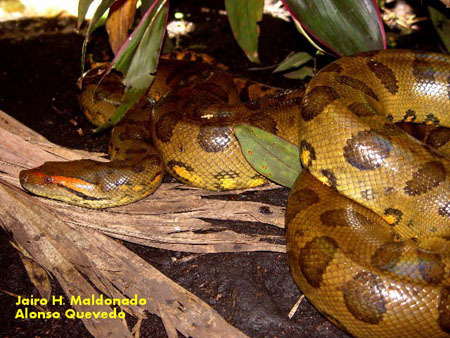
Introduction
The green anaconda is the heaviest snake in the world and one of the largest reptiles on Earth. A semi-aquatic constrictor of South America, it lives in the rivers, swamps, and flooded forests of the Amazon and Orinoco basins. Although it shares its range with giant boas and crocodilians, the anaconda’s sheer bulk sets it apart, with large females capable of reaching lengths beyond five meters and weights rivaling those of a small adult human.
Taxonomy
The green anaconda belongs to the family Boidae, the true boas, and to the genus Eunectes, which means “good swimmer.” Four species of anaconda are recognized, including the yellow anaconda and the Bolivian anaconda. The species was described by Carl Linnaeus in 1758. As boas, anacondas are more closely related to the boa constrictor than to pythons, from which they differ in giving birth to live young and in possessing small claw-like spurs near the tail, the remnants of hind limbs.
Physical Characteristics
Anacondas display extreme sexual dimorphism: females are far larger than males, commonly reaching 4 to 5 meters and more than 60 kilograms, with unverified reports of specimens exceeding 8 meters. The body is thick and muscular, olive-green with black blotches along the back and sides, and a yellowish belly. The eyes and nostrils sit high on the head so the snake can breathe and watch while nearly submerged. Although not venomous, the anaconda kills by coiling around prey and tightening with each exhale, causing rapid circulatory arrest rather than suffocation.
Habitat
The green anaconda is found in slow-moving rivers, oxbow lakes, marshes, and seasonally flooded forests across the Amazon and Orinoco basins, as well as on the island of Trinidad. It is rarely found far from water, which provides both refuge and hunting grounds. During the dry season, when pools shrink, anacondas may bury themselves in mud or retreat to deeper channels, sometimes becoming dormant until the rains return and flood the forest once more, reopening a vast submerged hunting territory.
Diet
Anacondas are ambush predators that seize prey near the water’s edge, drag it underwater, and kill it by constriction. The diet includes fish, birds, turtles, and caimans, along with deer, peccaries, and capybaras, which are among their favorite meals. Large prey may take weeks to digest, and an adult anaconda can survive for months between meals. Cannibalism is well documented, as females occasionally consume smaller males, while hatchlings fall prey to many predators before reaching adulthood.
Reproduction
Breeding occurs during the dry season, when a single female may attract a “breeding ball” of up to a dozen males that remain coiled around her for weeks. The anaconda is ovoviviparous, giving birth to live young rather than laying eggs. After a gestation of about six months, the female produces between 20 and 40 young, each roughly 60 centimeters long, although litters of more than 80 have been recorded. The newborns are independent immediately, receive no parental care, and must fend for themselves in a world full of predators.
Conservation
The green anaconda is classified as Least Concern by the IUCN, reflecting its wide distribution across a vast and relatively inaccessible range. Nevertheless, it faces mounting pressure from habitat destruction, particularly deforestation and dam construction in the Amazon, as well as hunting for its skin, meat, and the pet trade. Even its chief natural enemies are few; young snakes fall to caimans and large birds, while adult anacondas occasionally fall victim to jaguars. Because it reproduces slowly, local populations recover slowly from overcollection.
Fun Facts
The green anaconda is the heaviest snake but not the longest; the reticulated python holds the length record. It can stay submerged for up to ten minutes while hunting. The name “anaconda” is thought to come from a Sinhalese word for a large snake. Although movies portray anacondas as man-eaters, attacks on humans are extremely rare, and these giants generally flee into the water at the first sign of danger.