 By st20113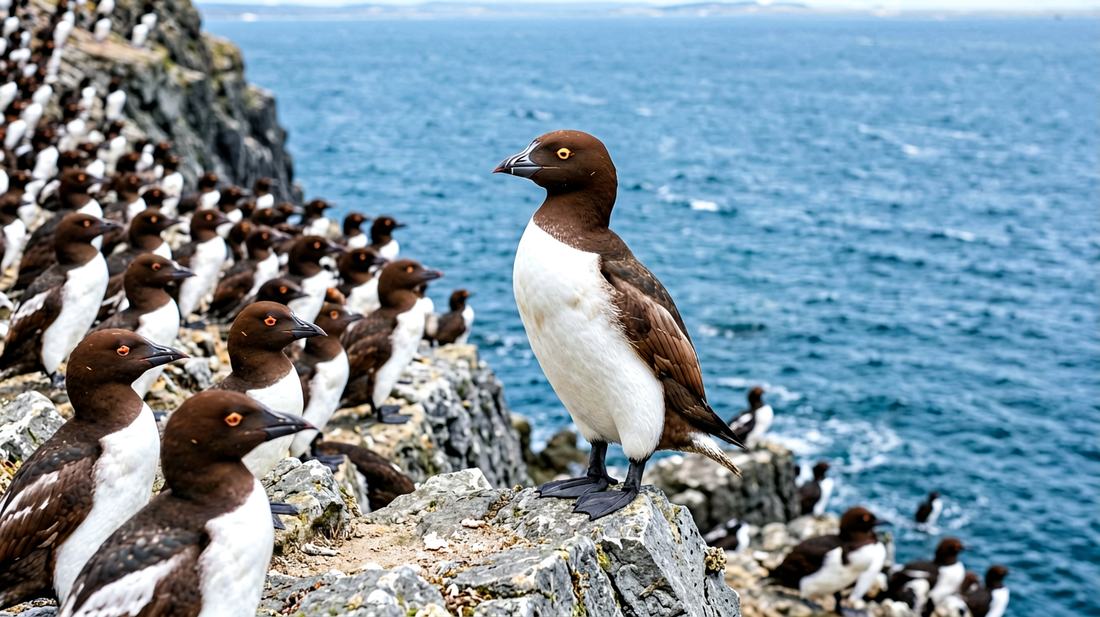
Uria aalge | Common Guillemot
Species Profile · Alcidae
Common Guillemot
A seabird that looks like a small penguin, nests in crowded ranks on bare ledges and jumps to the sea at about twenty days old, before it can fly.
IUCN: Least Concern
Range
Length
Weight
Incubation
Fledge
The penguin of the north
The common guillemot
The common guillemot is called the common murre in North America. It is a slim black-and-white seabird. It nests in some of the densest colonies on earth. Tens of thousands of pairs pack one headland.
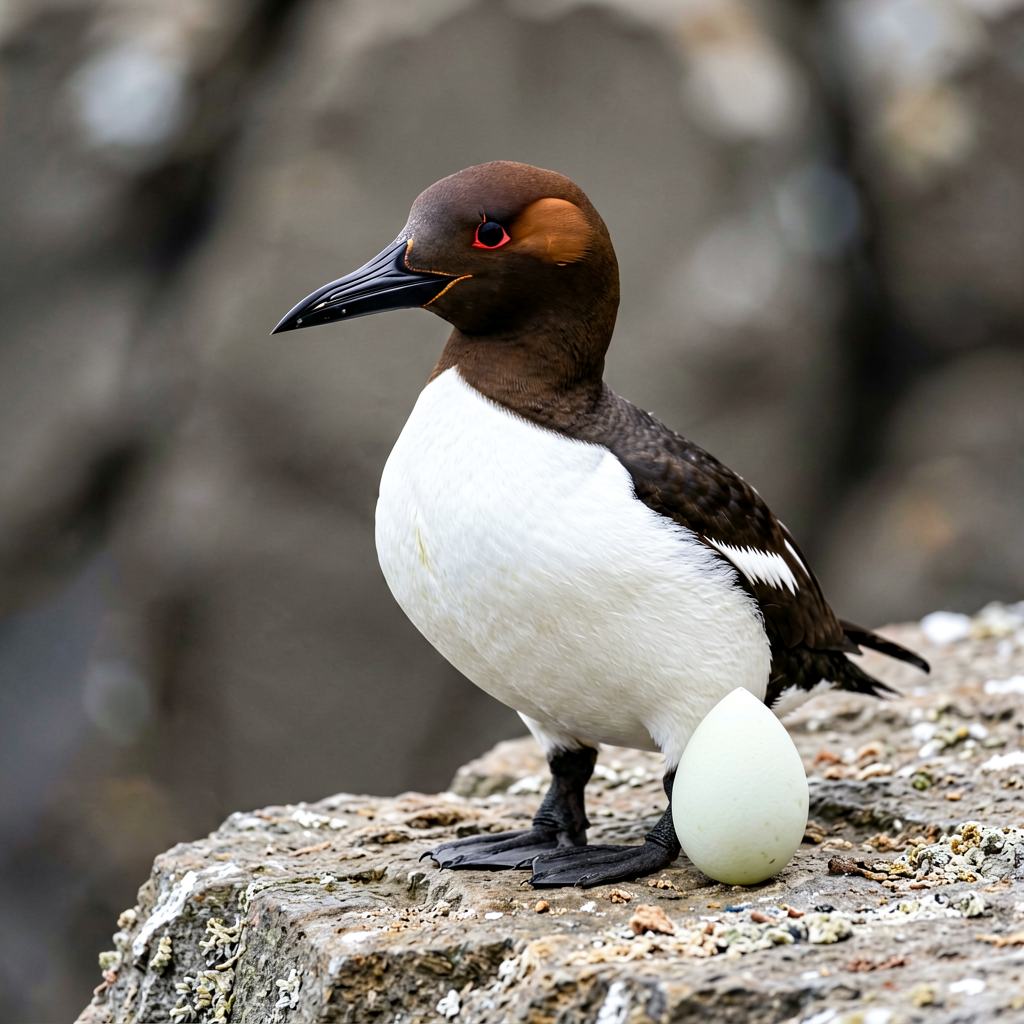
It looks like a small penguin. It uses its wings to fly through water, not air. Its one egg is the most pointed, pear-shaped egg of any bird. It rolls in a tight circle instead of falling off the ledge.
This shape with a tight bond to one rock patch lets it nest on ledges too narrow for any other auk. For food it dives from the surface and chases sandeels, sprats and other small fish. It reaches well over a hundred metres deep on one breath. Its chicks leave the cliff at three weeks old, before they can fly, gliding to the sea at dusk with their fathers.
Family tree
Kin of the razorbill and the puffin
The common guillemot is in the order Charadriiformes. It is in the family Alcidae. Its genus is Uria. It shares that genus with just one other species, Brünnich’s guillemot of the high Arctic. Its well-known kin in European waters is the Great Cormorant. The cormorant is large, hook-billed and fish-eating. But it is only distantly related, in a different family.
The cormorant is a heavy, low-buoyancy diver. It hunts with its whole body. It must dry its wings after. The guillemot is a small, wing-driven diver. It stays under far longer. It flies with the same wings it uses underwater. The family Alcidae has about twenty-five species.
They include puffins, razorbills, black guillemots and the extinct great auk. All have short wings, dense waterproof plumage and dive-built bodies. The great auk was hunted to extinction in the 1800s. It was the only flightless member of the family. Its fate shows how frail colonial seabirds are. The common guillemot was described by Pontoppidan in 1763. It is one of the most common northern seabirds.
Upright, narrow and dark
A bird built for diving
An adult common guillemot is 38 to 46 cm long. Its wingspan is 61 to 73 cm. It weighs 850 to 1,100 g. In breeding plumage the head, neck, back and wings are deep chocolate brown, black from afar. The underparts are white. A sharp line runs down the side of the neck and chest. The bill is long, thin, pointed and black.
The legs and feet are dark and set far back, making walking on land hard but swimming easy. In the north some birds show the bridled form. A thin white line runs back from the eye, which is ringed with white. Bridled and plain birds share the same colonies. The share of bridled birds grows toward the Arctic. In winter the face and throat turn white and the dark neck line goes away. The short, stiff wings have such high wing load that the bird flies fast and straight only.
It cannot soar or hover. Underwater the wings beat several times a second, pushing the bird at up to two m a second. The plumage is dense and waterproof. It has more feathers per square cm than any other European bird. A thick layer of fat lies under the skin.
1
2
3
Sea cliffs and cold water
Where it nests
The common guillemot breeds on both sides of the North Atlantic and North Pacific. Its range runs from Britain, Ireland, Iceland and Norway to eastern Canada, Greenland and New England. In the Pacific it runs from Japan and Kamchatka north to the Bering Strait. It nests on open sea cliffs and rocky islands. It favours narrow ledges on steep faces and the flat tops of sea stacks. It avoids cliffs where mammals can reach the nests.
Colonies sit on offshore islands or the outer coast. One site may hold many thousands of pairs. Away from breeding the species lives all at sea. It feeds in coastal waters and drifts beyond the shelf. It is rarely seen from land outside the breeding months. In winter its range follows its prey.
Large numbers gather in near-shore waters where sandeels and sprats school. It is not a long-range migrant like a tern. But birds ringed in Britain were found in Norway, France, Spain and the western Mediterranean. Because colonies cluster in few spots, one event can hit a large part of a region’s population. This makes the species very open to oil spills, pollution and disease.
What it eats
Diving after sandeels
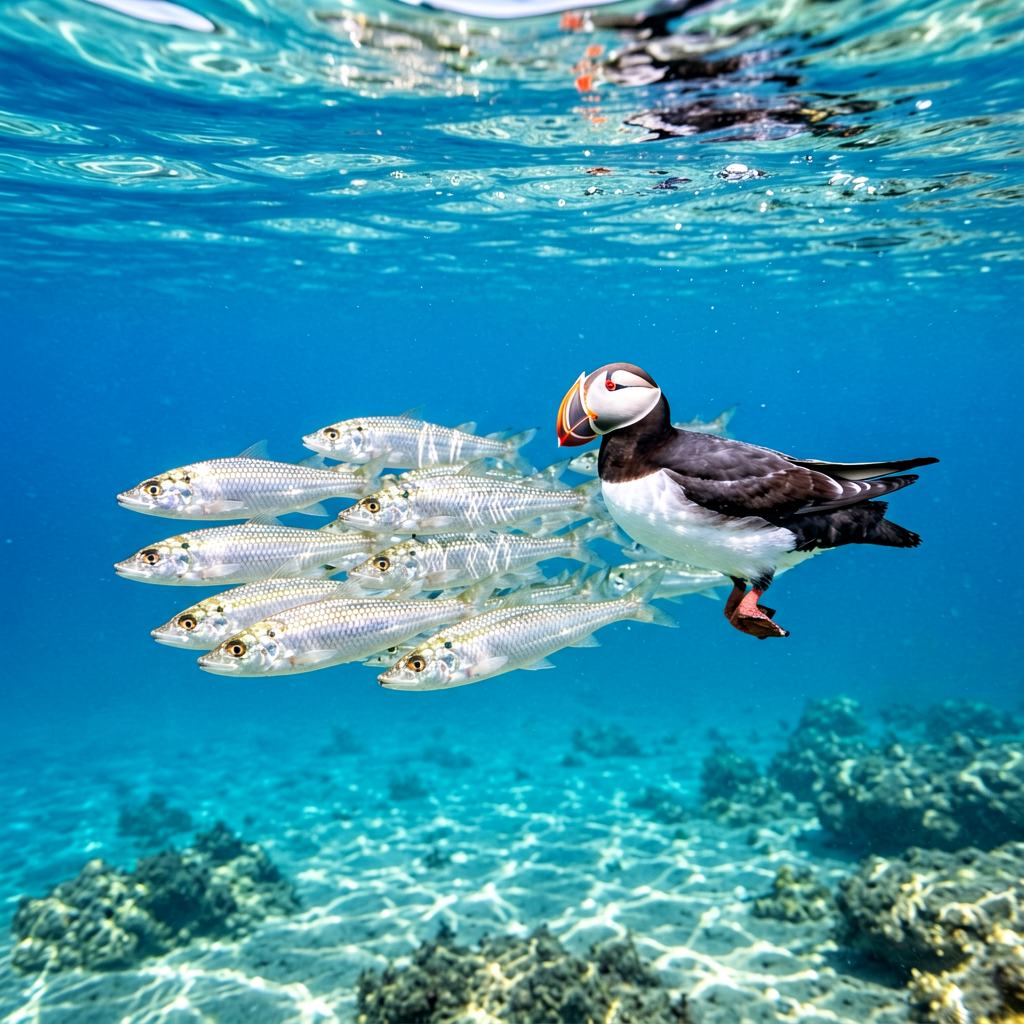
Common guillemots eat almost only small fish, diving from the surface to swim after schools. Sandeels are the main food in Britain and Ireland. Elsewhere the diet includes sprats, herring, capelin, young cod, haddock and whiting. Crustaceans, squid and marine worms are eaten when fish are scarce. Birds usually dive 20 to 60 m in the breeding season. They can reach 180 m or more and stay under for over a minute.
Deeper dives are seen in winter. The wings drive it and the feet steer. The body is streamlined. The bird flies underwater as others fly in air. Prey is carried back in the bill. A chick is usually fed one fish at a time.
This is why the species cannot use prey far from the colony. Guillemots are eaten by great skuas, white-tailed eagles, peregrine falcons and large gulls. Ravens, crows and gulls take their eggs and chicks on the ledges. When food is scarce, adults leave a breeding attempt rather than starve. Such failures can hit a whole colony in one season.
A jump from the ledge
Eggs and chicks
Common guillemots return to colonies in late winter and early spring. They are loyal to the site and to their mate. They often re-form the same pair bond year after year. They use the same few cm of ledge. Courtship involves bowing, bill-touching and mutual preening. The birds are packed so tight that neighbours are within pecking distance. No nest is built.
The female lays one egg straight on the rock. This is usually in late April or May. The pointed shape means an egg nudged by a neighbour pivots on its narrow end. It does not roll off the ledge. Both parents incubate in turns of 12 to 24 hours. Incubation lasts about 30 to 35 days. The egg rests on top of the feet under a fold of belly feathers.
The chick is fed by both parents and does not fledge in the usual way. At about 20 days it leaves the ledge at dusk, gliding down to the sea before it can fly well. Its father guides it. He stays with it at sea for several weeks while it learns to dive and feed. The mother visits briefly, then stops. Guillemots first breed at four or five years old. Ringed birds have lived past thirty years.
Bird flu and empty ledges
A seabird under pressure
The common guillemot is not globally threatened. It is one of the most common seabirds in the North Atlantic. Yet several populations have dropped sharply since the 1990s. The species faces growing pressure. The worst is the state of its food. Sandeel stocks in the North Sea have fallen sharply.
Warmer seas likely hurt the plankton they eat. Guillemots respond by breeding later and raising fewer chicks. In the worst years they leave colonies. Warmer winters may have moved prey from old fishing grounds. Oil pollution stays a major threat. Large numbers drown each year in gillnets set for other fish.
Colonies cluster at sea in winter. In 2022 and 2023 bird flu killed very large numbers. It hit colonies in Britain, Ireland, Iceland and Norway. The outbreak took a large share of breeding adults at the worst sites. Overfishing, bother from climbers and photographers, and sea litter are further worries. Care includes protected areas, gillnet limits, some sandeel-fishing bans, and long-term monitoring.
Quick hits
Five things to remember
- Its pointed egg is the most pear-shaped of any bird, and it pivots in a tight circle rather than rolling off the ledge.
- A guillemot flies underwater with the same wings it uses in the air, reaching depths of more than 180 m.
- Chicks jump from the cliff at about three weeks old, long before they can fly, and are escorted to sea by their fathers.
- Birds return to the same tiny patch of rock and usually to the same mate, year after year.
- Some northern guillemots show a white bridled eye-stripe, and the share of bridled birds increases towards the Arctic.