 By st20113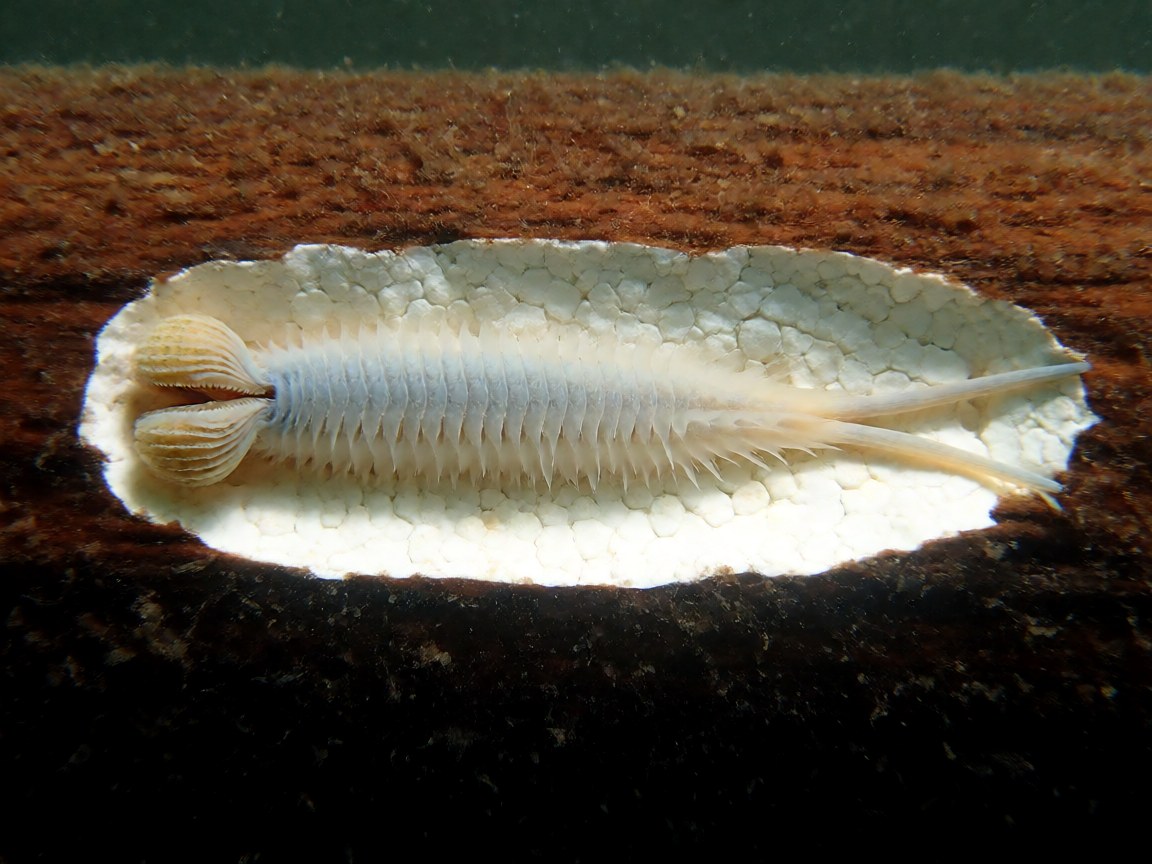
Teredo navalis | Shipworm
Introduction
The shipworm (Teredo navalis) is not a worm at all but a bivalve mollusc, and one of the most destructive animals in human history. It bores long tunnels through any wood left in the sea—ships’ hulls, piers, pilings, driftwood—reducing solid timber to a honeycomb from the inside while two tiny shell valves do the drilling. For centuries it sank fleets and wrecked harbour works, and it is the reason wooden vessels have always needed copper, tar, or paint.
Taxonomy
Teredo navalis is a marine bivalve mollusc in the family Teredinidae, the shipworms. It belongs to the same class as the common mussel, Mytilus edulis, sharing the two-valved shell, the muscular foot, and the filter-feeding habit, but it has taken the bivalve body to an extreme: the shell is reduced to a tiny pair of ridged plates at the front of a long, worm-like body that lives permanently inside its own tunnel in wood.
Physical Characteristics
The animal is elongate and soft, whitish and grub-like, and can reach thirty to fifty centimetres in length despite living inside wood. At the front end are two small, globular, finely ridged shell valves, only about a centimetre across, which are used as a drill rather than as protection. At the rear end extend two long, thin, fused siphons, which reach back out of the burrow mouth to the open water. A pair of hard, paddle-shaped pallets sits at the base of the siphons and can seal the entrance.
Habitat
It lives inside wood submerged in the sea: ships’ hulls, wooden piers, jetties, groynes, piling, and driftwood, as well as the roots and trunks of trees washed into estuaries. It occurs in temperate seas worldwide, including around Britain and Ireland and throughout northern Europe. It needs salt water—it cannot survive in fresh water for long—and it flourishes in sheltered harbours and estuaries where wooden structures stand in clean, oxygenated seawater.
Diet
Shipworms bore into wood for food as well as for shelter. They rasp away the timber with their ridged shell valves, swallowing the particles, and—unlike almost any other animal—they can digest cellulose, helped by specialised bacteria kept in a separate organ of the gut. They also filter plankton and organic particles from the water drawn in through the siphons, so they feed two ways at once.
Reproduction
Individuals are protandrous hermaphrodites, maturing first as males and later becoming female. Sperm is released into the water and drawn into the burrow of another individual by its siphons, and the fertilised eggs are brooded inside the parent’s gills for a short time before the larvae are released. The larvae swim in the plankton for two or three weeks, then settle onto bare wood and immediately begin to bore, using the tiny shell to start the tunnel.
Conservation
The species is widespread, abundant, and in no need of protection; if anything it is one of the most damaging marine borers known. Historically it destroyed enormous numbers of wooden ships and harbour structures, and it still attacks wooden marine construction wherever such structures remain. Modern hulls are no longer made of wood, but piers, groynes, and historic wooden wrecks remain at risk, and the animal is closely studied by those conserving underwater archaeology.
Fun Facts
- Despite the name it is a clam, not a worm—a bivalve with a worm-shaped body.
- It can digest cellulose thanks to bacteria living in a special organ in its gut.
- Two tiny ridged shell valves at the front do the drilling; the body never leaves the tunnel.
- Shipworms have sunk fleets and forced the use of copper sheathing on wooden ships.
- The tunnels it leaves are lined with chalky material, turning the wood into a honeycomb.
[…] animal shares the family with the Shipworm. The family holds a few dozen species. All of them bore tunnels in […]