 By st20113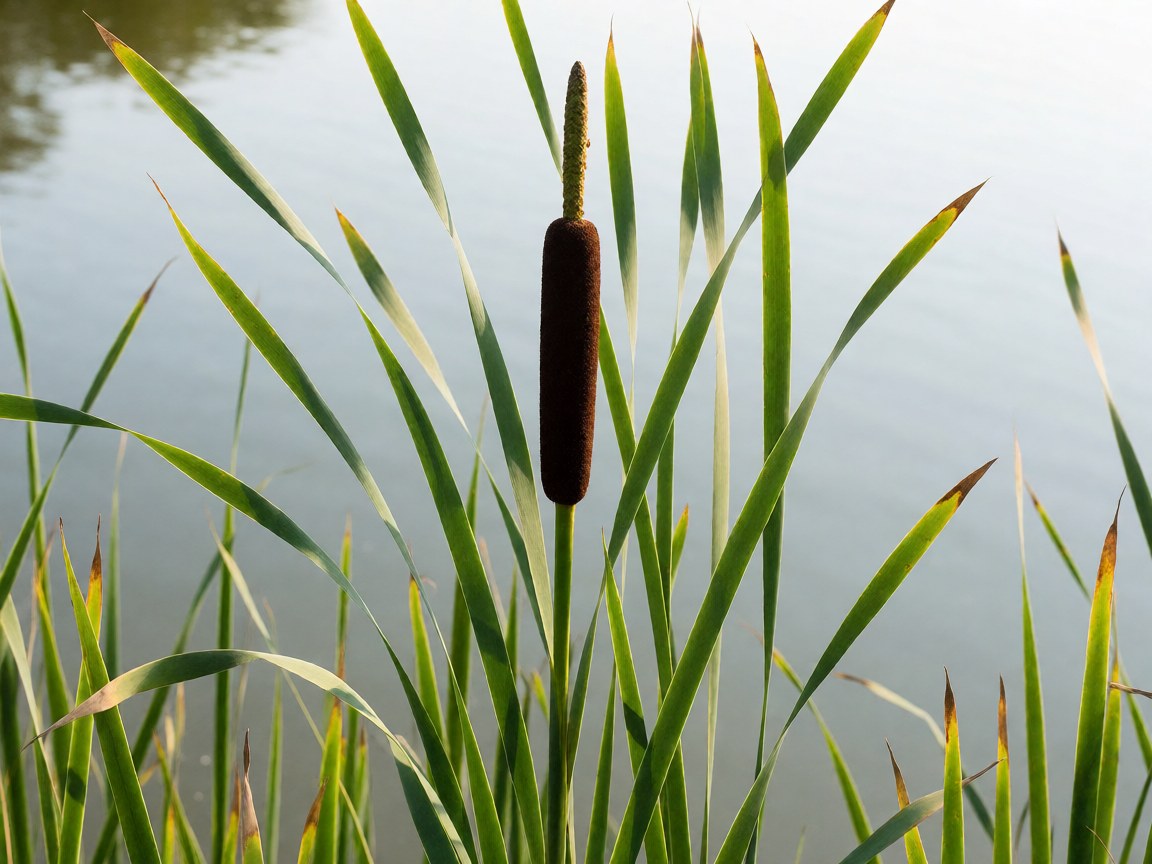
Typha latifolia | Bulrush
Introduction
The bulrush (Typha latifolia), known in North America as the common cattail, is the tall reed-mace of marshes, pond edges, and ditches, instantly recognisable by its dark brown, sausage-shaped flower spike. Rising one to three metres from shallow water, it forms dense, clonal stands that fringe almost every piece of standing fresh water across the northern hemisphere, and it is often the single most conspicuous plant of a wetland. Few species are as widespread, as productive, or as useful: bulrushes have provided food, fuel, thatch, matting, paper, and insulation, and today they are deliberately planted in constructed wetlands to strip pollutants from wastewater. The plant flowers in midsummer, and by late summer the familiar velvety spike begins to break apart into white down that carries the seeds away on the wind, so that a stand that looked solid and dark in July is a cloud of white fluff by October. Beneath the water, a stout creeping rhizome stores starch at a density that has made the plant a staple food for thousands of years in parts of its range, and the same starchy rootstock is what allows it to survive fire, drought, and ice and to come back stronger the following spring.
Taxonomy
Typha latifolia is a member of the family Typhaceae, the cattail family, a small group that in modern classification also includes the bur-reeds. It is a monocot, more closely related to grasses, sedges, and rushes than to the true reeds with which it is often confused, and it is readily separated from common reed by its flat, strap-shaped leaves, its solid unbranched stems, and its distinctive two-part flower spike. The genus contains around thirty species worldwide, several of which hybridise with one another where they meet, producing intermediates that can be difficult to name. As a green plant it depends on Photosynthesis, and it is one of the most productive temperate plants known, converting summer sunlight into biomass at a rate that rivals the fastest-growing agricultural crops and far exceeding most natural wetland vegetation.
Physical Characteristics
The plant grows one to three metres tall from a thick, starchy, branching rhizome that creeps horizontally through the mud just below the surface, and from which the flowering stems rise at intervals. The leaves are long, flat, and strap-shaped, one to two centimetres wide and often overtopping the flowering stem, grey-green to blue-green, sheathing the stem at the base and arranged in two ranks; in cross-section they are thick and spongy, with large air channels running their length. The stem itself is stout, erect, unbranched, and round, and it dies back in winter but persists as pale, straw-coloured standing dead stems that rattle and creak in the wind. The flowers are borne in a dense terminal spike divided into two clearly separate parts: a short, slender, pale male portion at the top, and below it a much thicker, cylindrical female portion, five to twenty centimetres long and two to four centimetres across, which at first is green and later turns velvety dark brown. Each tiny female flower produces a single seed surrounded by a tuft of fine white hairs, and it is the mass of these hairs, packed together, that gives the ripe spike its furry, cigar-like appearance and its Latin name of “reed-mace”.
Habitat
Bulrushes grow in shallow standing water and saturated soil: pond and lake margins, marshes, fens, ditches, canals, gravel pits, sewage lagoons, and slow-flowing river backwaters, typically in water up to about half a metre deep, though they will persist in deeper water for a time and on merely damp ground at the edges. They tolerate a very wide range of nutrient conditions but do best in open, sunny, nutrient-rich sites, and they are often the first large plant to colonise a newly flooded, dredged, or otherwise disturbed wetland. The species occurs across Europe, temperate and tropical Asia, North and South America, and parts of Africa, and it has been introduced to New Zealand and elsewhere. Because it spreads by rhizome, a single clone can eventually occupy a huge area, and pure stands exclude most other plants by shading them out and by the sheer density of their roots and decaying litter, which is why a mature bulrush bed is often a near-monoculture.
Diet
The plant is entirely autotrophic and exceptionally productive. Its tall canopy of broad leaves intercepts a great deal of sunlight through the long growing season, and the sugars produced are moved down into the rhizome, where they are stored as starch at concentrations comparable to a root crop. Nutrients are taken up from the sediment, and—unusually—the plant actively pumps oxygen down from the leaves through the air channels in its tissues and leaks some of it into the surrounding mud. This oxygen release lets bacteria thrive around the roots in what would otherwise be an oxygen-free, stagnant sediment, and it is precisely why bulrushes are so effective at breaking down pollutants: the plant absorbs nitrogen and phosphorus in large quantities, and its root zone becomes a busy treatment works, degrading organic waste and even locking up heavy metals.
Reproduction
Flowering takes place from June to August. The male portion of the spike sheds enormous quantities of wind-borne pollen, which can be seen drifting off the stands on still mornings, and then withers and falls away, leaving a bare stem tip above the female spike. Once pollinated, the flowers of the female spike develop into thousands of tiny, hairy seeds, and by late summer and autumn the whole spike disintegrates, releasing them to drift on the wind and float on water until they find bare, wet mud to germinate on. Seedling establishment requires open, saturated ground with plenty of light, which is why bulrushes surge into freshly cleared or flooded sites and then hold them. Vegetative spread is at least as important: the rhizome branches vigorously, producing dense clonal patches, and broken fragments can float to new locations and take root, so a single clone can march outward year after year and, in favourable conditions, dominate a whole wetland.
Conservation
Globally the species is abundant and of no conservation concern; if anything it is expanding as nutrient enrichment and wetland disturbance create more of the conditions it likes. In parts of North America it is treated as a nuisance where it forms dense monocultures, blocks ditches and irrigation channels, and reduces open water, and control usually means lowering water levels and repeatedly cutting or flooding the shoots rather than simply pulling up stems, which only stimulates the rhizome. Its greater value is as the engineer of reedswamp habitat: bulrush stands shelter bitterns, water rails, and reed warblers, provide perching and nesting structure, and slow water flow enough to trap sediment and build up the marsh. Where wetland drainage has removed such habitat, re-creating shallow, nutrient-rich water margins is often enough to bring it back of its own accord.
Fun Facts
- The ripe brown spike is made up of thousands of seeds, each with its own tuft of white down.
- The male and female flower zones are clearly separated on the same spike, with the male part on top.
- The plant pumps oxygen down into the mud around its roots, which is why it is used to clean wastewater.
- Its starchy rhizome has been eaten as a vegetable and ground into flour for thousands of years.
- The fluffy seed down was used to stuff pillows and life jackets, and as tinder for starting fires.
[…] plant shares the family with the Bulrush. That plant has broad leaves. Its flower spike has no gap in the middle. Our plant has narrow […]