 By st20113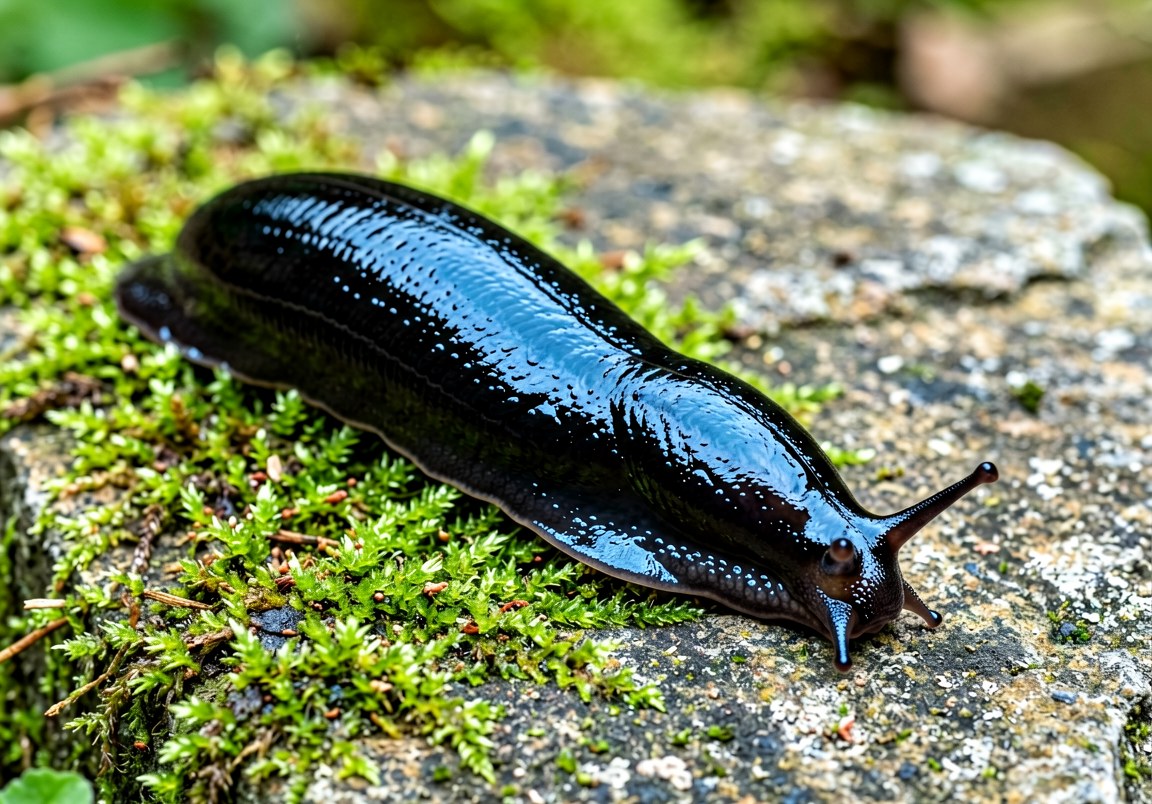
Arion ater | Black Slug
Introduction
The Black Slug (Arion ater) is the large, glossy slug, often jet black but sometimes brown, orange or grey, that hauls itself across paths and flower beds after rain. Reaching fifteen centimetres in length when fully stretched, it is one of the biggest slugs of European gardens and woodlands, and a familiar sight to anyone who gardens in the damp climate of Britain.
Despite its size and its taste for seedlings, it is a useful recycler as much as a pest, feeding largely on dead and rotting plant matter and returning it to the soil. It is also a staple of the night-time food web, taken by hedgehogs, frogs, toads and birds, and its copious slime and ready ability to retreat into cover make it a survivor in the busiest of gardens.
Taxonomy
The Black Slug is a pulmonate gastropod mollusc in the family Arionidae, described by the Swedish naturalist Carl Linnaeus in 1758. It is a close relative of the Cornu aspersum and other land snails, but it has lost the large shell of its ancestors, keeping only a small internal plate of chalky granules. The genus Arion holds many of the common European slugs, several of them garden dwellers.
The species is variable in colour, and the name “black slug” refers to the commonest form in Britain; on the continent orange and brown individuals are frequent. What unites them is the large size, the rounded back and the blunt, ridged tail, features that separate Arion ater from the smaller, keeled slugs of gardens.
Physical Characteristics
The body is a long, rounded, muscular foot topped by a mantle that covers the front third and conceals the vestigial shell. The colour ranges from deep black through dark brown to brick-red and orange, often with a paler sole beneath, and the skin is finely wrinkled with a central ridge down the back. Two pairs of retractable tentacles carry the eyes on the upper, longer pair.
The animal moves on a sheet of mucus that it continually secretes, leaving the familiar glistening trail, and it can swell its body with water to stay supple. When disturbed it contracts and may sway, and it seals itself to a surface with extra mucus. The slime is unpleasant to many predators and helps the slug slide over rough ground and cling to vertical surfaces.
Habitat
Black Slugs favour damp, shaded places: woodland floors, hedgerows, gardens, parks and the wet corners of fields, especially where there is leaf litter, dead wood and lush low growth. They are nocturnal and weather-dependent, emerging in numbers after rain and in mild, humid nights, and retreating by day under stones, logs, mulch and dense foliage.
They are found across Britain and temperate Europe and tolerate a wide range of habitats, from city gardens to remote woodland. In dry or bright conditions they aestivate in shelter, and in hard winters they burrow into the soil, so a population can lie hidden for long stretches and then reappear with the first wet weather.
Diet
The diet is broad and opportunistic: dead and decaying leaves, rotting fruit and fungi, and also living plants, seedlings, tender shoots and the occasional fallen petal. In a vegetable garden it can nip the tops of young plants and score leaves, which is why it is counted a pest, but much of its feeding is on material already dead.
Its slime and size make it less easy prey than smaller slugs, yet it is still heavily hunted. The common-hedgehog-erinusaceus-europaeus, along with frogs, toads and ground-feeding birds, takes slugs readily, and the Black Slug’s abundance helps fuel these predators through the warm part of the year.
Reproduction
Like other slugs the Black Slug is a hermaphrodite, carrying both sexes, and two individuals mate by aligning and exchanging sperm, after which each lays a cluster of large, translucent, rounded eggs in the soil or under cover. The eggs hatch into small slugs that already resemble the adults, and there is no free-living larval stage.
Eggs are laid through the milder months, often in several batches, and the young grow through the season. Being long-lived for a slug, an individual may survive more than a year, and populations build up where damp cover is plentiful and predators are few.
Conservation
The Black Slug is abundant and of no conservation concern, and it is one of the slug species most likely to turn up in a British garden. Its numbers are held in check by weather, predators and, in cultivated ground, by control measures aimed at protecting seedlings.
Ecologically it matters as both recycler and prey. A garden that supports a few slugs also supports the hedgehogs, frogs and thrushes that eat them, so the Black Slug sits in the middle of a small food web that links the soil to the birds and mammals above it, and its presence is a sign of a functioning, lived-in garden.
Fun Facts
- Though called black, it can just as easily be brown, orange or grey, and the colour is not a separate species.
- It has almost no shell, only a tiny internal plate of chalky grains under the mantle.
- It is a hermaphrodite, so any two adults can mate and both then lay eggs.
- It slides on a continuous ribbon of mucus that it must constantly produce to move and to cling to surfaces.
- It is a key prey of hedgehogs, frogs and toads, linking the soil to the animals that hunt it.