 By st20113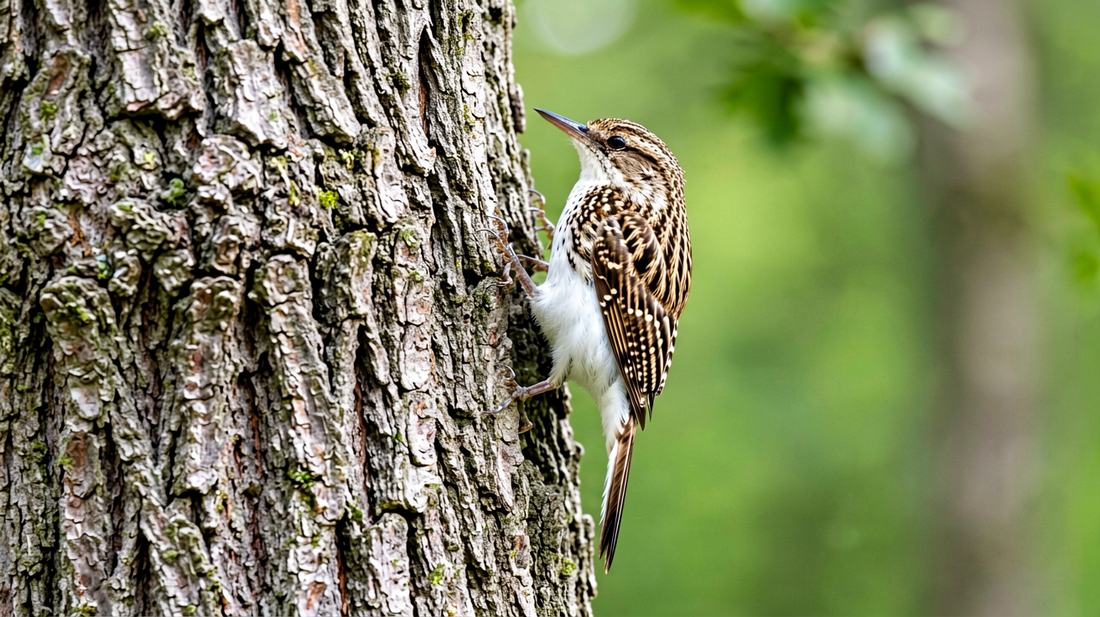
Certhia familiaris | Eurasian Treecreeper
Species Profile · Certhiidae
Eurasian Treecreeper
A tiny bark specialist that lands at the foot of a trunk, spirals upward with its stiff tail braced, then drops to the next tree and starts all over again.
IUCN: Least Concern
Range
Length
Weight
Bill
Tail
The bark climber
One bird, one job
The Eurasian treecreeper is a very small, brown, mottled bird. It is one of the most specialised songbirds in Europe. Its whole way of life is built around a single kind of foraging. The bird lands at the base of a trunk. It climbs upwards in short hops. Its stiffened tail presses against the bark to support it. It works around the trunk and up the main branches in a spiral. Its fine, curved bill probes the crevices of the bark. There it finds the small insects and spiders that shelter in them.
At the top it flies down to the foot of the next tree. Then it begins again. No other European woodland bird feeds in quite this way. The plumage is a fine mix of brown, buff and white streaks and spots. Those marks cover the back and the wings. The belly is white. A white eyebrow runs from the bill to the nape. A patch of pale buff sits on the shoulder. Against the bark of an oak, an ash or a larch this pattern works well.
It can hide the bird even from 2 or 3 metres away. The species is resident through most of its range. It is largely sedentary, and it copes badly with hard weather. In a cold spell the birds of a wood may join mixed flocks. Tits and other small birds roam the winter woodland in those flocks. It is one of the least conspicuous breeding birds of Britain. Yet it lives in almost every mature wood, park and hedgerow tree.
Family tree
Certhia, the treecreepers
The Eurasian treecreeper sits in the family Certhiidae, the treecreepers. This is a small group of 9 or 10 species of small, bark-foraging birds. They live in the temperate and mountain forests of the Palaearctic and the Oriental regions. They share a set of characters. The tail is extremely long, curved and stiff-tipped. The bill is long and slender and curves downwards. The plumage is cryptic brown. And the birds climb tree trunks in an upwards spiral. The species is a striking example of one problem producing one solution in 2 unrelated lines.
The same niche is filled in the woods of Europe and Asia by the nuthatch, Sitta europaea. The nuthatch belongs to the family Sittidae. It also searches the bark of trunks and branches for insects. It also uses its tail as a prop. But it is compact, with a short tail and a short bill. Its back is blue-grey and it has a black eye stripe. Its underbody is buff-orange. And it can walk down a trunk head first. No treecreeper can do that.
Within the genus the Eurasian treecreeper belongs to a group of very similar species. Molecular work has clarified their relationships. Some forms were once treated as subspecies of the present bird. The short-toed treecreeper of southern and central Europe is now a species in its own right. So is Hume’s treecreeper of the Himalayas and south-west China. The British population is separated as the subspecies britannica. It is slightly smaller and slightly darker and greyer than the birds of the continent. It has been isolated from them since the last glaciation.
Bill, claws and a braced tail
How to identify one
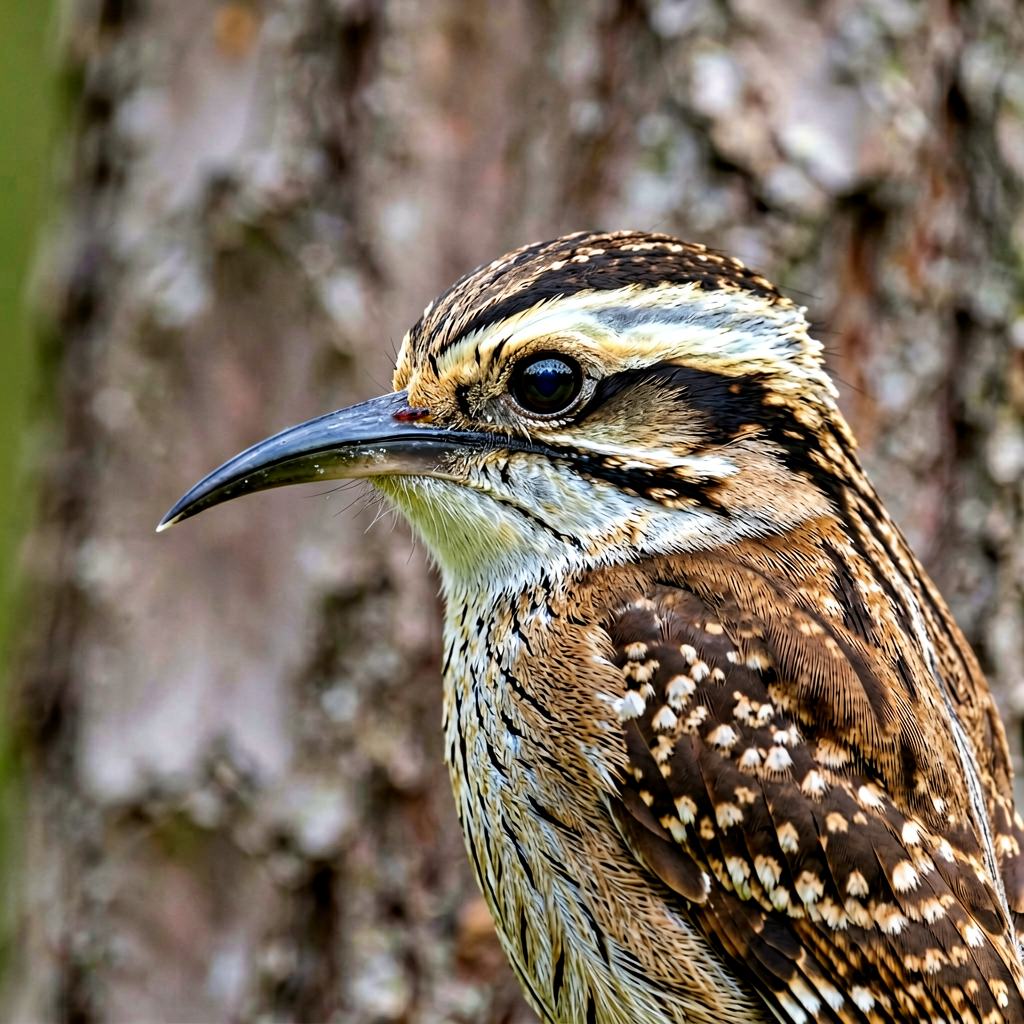
The Eurasian treecreeper is a tiny, compact bird. It is rather hunched. It measures between 12.5 and 14 centimetres in length. Its wingspan is between 17 and 21 centimetres. Its very fine bill curves downwards and is between 14 and 18 millimetres long. Its long, stiff, pointed tail is about 6 centimetres long. Its body mass is between 7 and 11 grams. The whole body of the bird is built for working over bark. The legs are short. The toes carry long, sharp, curved claws. Those claws hook over the uneven surface of the bark. The tail feathers have stiffened shafts and blunt, worn tips. Those tips brace the rear of the body against the trunk.
The bill is fine and curved. So it reaches crevices that are too narrow for a stouter bill. The upper parts carry a fine pattern of dark brown, buff, white and grey. Pale spots and streaks on a dark ground produce it. A pale, buffish-white eyebrow runs over the eye. A darker line borders it below. There is a pale patch on the shoulder. The throat and breast are whitish. In good light they look almost silvery. The belly and flanks are white, tinged with buff towards the rear. The tail and the wings are barred with dark and pale. The bill is brown above and paler below. The legs and toes are pinkish brown.
The iris is dark brown. The sexes look very similar. Only an experienced observer can tell them apart with confidence. That takes a bird in the hand, or a very close view. The female then develops a brood patch and sings less. The juveniles before their first moult are more heavily spotted than the adults. They are also slightly duller. Their tail feathers are softer and more flexible. They are not yet good enough for bracing the body. The flight is weak, fluttering and undulating. The bird is generally silent and easily overlooked, except when it sings.
1
2
3
Oak, ash and larch
Where it lives
The Eurasian treecreeper is a bird of mature woodland and of the trees outside it. It is found in deciduous and mixed woodland of every kind. It also uses old orchards, parkland, large gardens and churchyards. It lives in the rows of trees along hedgerows and in avenues. It uses the wooded banks of rivers as well. Its distribution is limited far less by the species of tree than by rough, fissured bark. The bird needs trunks and branches that are old and thick enough. Only those hold the small invertebrates on which it depends. So the bird is scarce or absent in young plantations.
It is absent from dense conifer stands with smooth bark. It is also missing from woods that are heavily managed for timber. Such woods have lost their old and dead trees. The species is found from the Atlantic coast of Europe eastwards. It continues through the forests of Siberia to Japan. Its altitudinal range starts at sea level in Britain and the Netherlands. It reaches more than 2,000 metres in the Alps and the mountains of Anatolia. In the south of its range it is largely confined to the mountains. It also keeps to the cooler, more humid woodlands.
That pattern reflects its dependence on a cool and moist climate. Such a climate allows a good growth of lichens, algae and fungi on the bark. The species is resident and sedentary through almost all of its range. The ringing data for British birds are clear. Very few individuals move more than a few kilometres in their lives. So a local population lost through felling is unlikely to be recolonised quickly. The same is true when broad-leaved woodland becomes conifer plantation. The bird depends on continuity of habitat in a single place.
Insects in the bark
What it eats
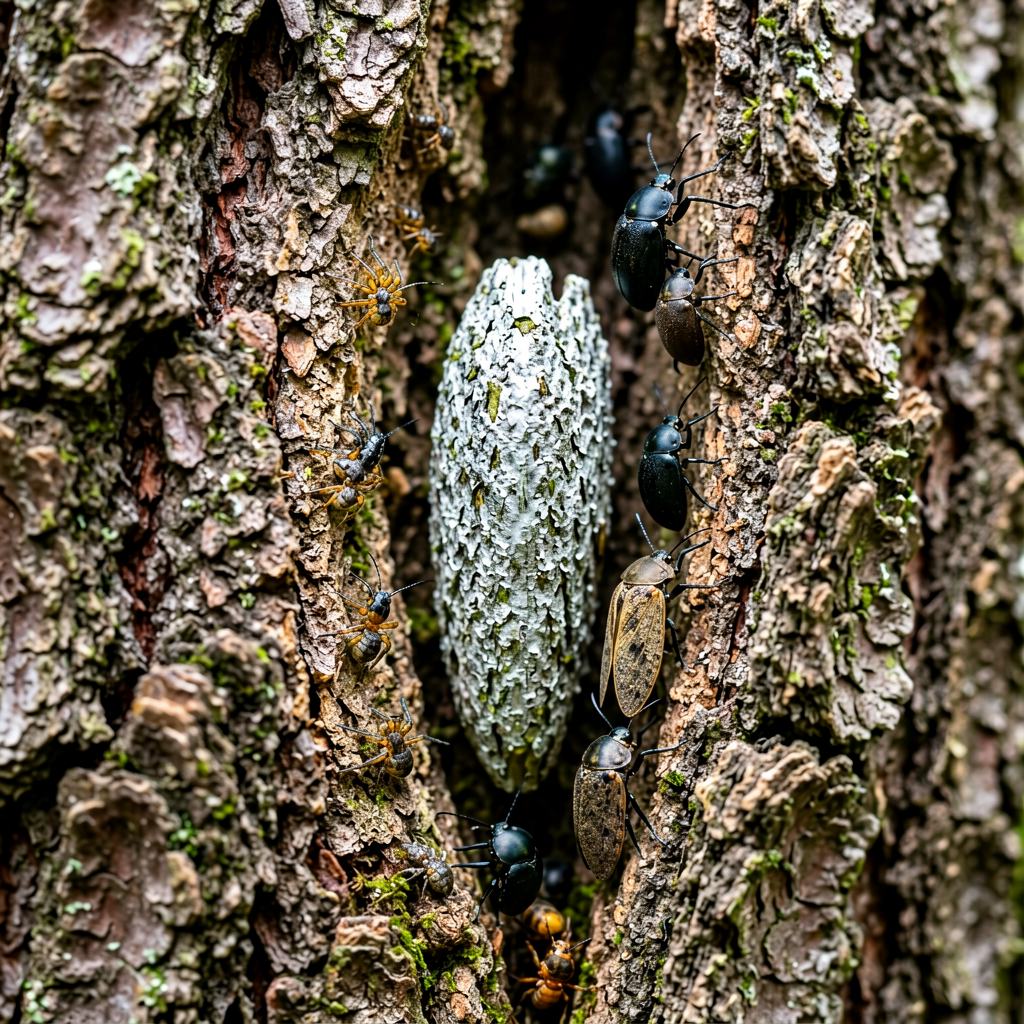
The Eurasian treecreeper is an insect eater. It takes its prey almost entirely from the surface and the crevices of tree bark. Its diet is dominated by the adults, larvae and pupae of small beetles. Weevils and bark beetles are the most important of those. It also takes the caterpillars of small moths, flies, aphids and other small bugs. To these it adds a wide range of spiders, harvestmen and mites. Springtails, pseudoscorpions and small snails are eaten too. In the winter the birds also take the seeds of conifers such as larch, pine and spruce. They eat yew seeds and the kernels of beechmast and hazel. They split these open with the fine bill.
That gives an important source of energy when insect prey is scarce. The foraging technique is highly fixed. A bird that is working a trunk begins low down. It starts on the uphill or the downhill side. It moves upwards with a slight sideways progression. That gives the appearance of a spiral. It examines the bark by probing and picking rather than by hammering. It also searches the undersides of branches and the bases of broken limbs. It uses decaying stumps and, at times, the bark of fallen timber. The roof thatch of old buildings will do as well.
So will the stems of large ivy plants. The bird takes food only from the trunk and its immediate area. It is very rarely seen on the ground. It searches the bark in a single direction and then moves to a fresh tree. So it covers many hundreds of trees in a single day. It depends on bark-dwelling invertebrates. So its numbers rise in woodland that holds a continuity of old and standing timber. They fall sharply in stands that are regularly cleaned, thinned and sprayed. The species is therefore a useful sign of the ecological state of a wood.
A nest behind loose bark
The breeding cycle
The Eurasian treecreeper is monogamous and largely solitary when breeding. It may raise 1 or 2 broods in a season. Its courtship is quiet. It involves thin, high, descending songs and chases through the branches. The male sings a short, gentle series of high notes. The series speeds up and falls away at the end. It is so high and so faint that many people over the age of 40 cannot hear it. The nest is almost always placed behind a flap of loose, peeling bark. It uses the trunk of a dead or a dying tree. The species will also use a crevice in the bark of a living tree.
It uses rot holes and gaps in a broken trunk. A crack in a wall, a hole in a building and, at times, a nest box will do. The bird may enlarge a natural gap by picking at the bark. It keeps going until the cavity is deep enough. The cup is a solid structure of twigs, grass, moss and lichen. It also holds rootlets and fragments of bark. It is lined with feathers, hair, wool and spider silk. The site is often so well concealed that only watching the adults will reveal it. The clutch holds between 5 and 6 white eggs marked with reddish brown. The female incubates them alone for between 13 and 15 days.
The male brings her food every few minutes. The chicks are fed by both parents. They leave the nest at between 15 and 17 days of age. They then stay with the adults for a further 2 or 3 weeks. They follow the male in particular, and he feeds them. Meanwhile the female begins a second clutch. The laying season runs from April to June. Its timing matches the caterpillars and beetles that the young are fed on. Ringing records show that the species may live for 5 years or more. The oldest known British bird reached an age of more than 8 years.
Resident and easily overlooked
Conservation
The Eurasian treecreeper is listed as Least Concern on the global Red List. It is one of the commonest woodland birds of Europe and of the western Palaearctic. Its European breeding population runs into millions of pairs. Its British population has been estimated at several hundred thousand territories. That population has been broadly stable over the last 3 decades, or has grown slowly. The species is nevertheless more sensitive to woodland management than its abundance suggests. It keeps to habitat with old, rough-barked trees. It is resident and sedentary, so it cannot recolonise a cleared wood from elsewhere.
And it is vulnerable to severe winter weather. Hard winters cut the supply of bark-dwelling invertebrate prey. Numbers in Britain fall sharply after a hard winter. It then recovers only slowly over the following years. Its conservation is therefore bound up with keeping old timber. It also depends on veteran and dead standing trees. It needs broad-leaved woodland in general. And it needs the hedgerow and parkland trees that link the woods.
The species is a quiet argument for leaving the dead wood in the wood. A dead tree that holds loose bark is worth more to the treecreeper. It beats any amount of new planting. The bird is easily overlooked. It is small, quiet, cryptically coloured and silent when not singing. So the most useful thing an observer can do is record it wherever the thin song is heard.
Quick hits
Five things to remember
- The treecreeper climbs a trunk only upwards and never descends head first. When it has finished with a tree it flutters down to the base of another one. The nuthatch fills the same niche in the same woods, and it can walk down a trunk as well as up.
- The tail feathers have stiff shafts and blunt, worn tips. Those tips press against the bark and hold the bird in place. The arrangement has evolved separately in the treecreepers and in the woodpeckers.
- The nest is normally hidden behind a flap of loose bark on a dead tree. It is often impossible to find without watching the adults fly to it with food.
- The song is extremely high-pitched and quiet. Many observers simply cannot hear it, so the species is recorded far less often than it actually occurs.
- A hard winter can cut the population of a wood by a large fraction. The bird hardly ever travels more than a few kilometres in its life, so the numbers take years to recover.