 By st20113
 The giant panda (Ailuropoda melanoleuca) is one of the most beloved and iconic animals on Earth. Native to the mountainous forests of central China, this remarkable bear has become a powerful symbol of wildlife conservation worldwide. With its distinctive black-and-white markings, rounded face, and gentle demeanor, the giant panda captures hearts wherever it is seen. Despite centuries of human fascination, the giant panda remained shrouded in mystery to Western science until the late nineteenth century, and even today it continues to reveal surprising secrets about its biology and behavior.
You may also be interested in the Red Panda (Ailurus fulgens) — a smaller, reddish cousin that shares its name but belongs to a completely different family.
Scientific Classification
For decades, the giant panda’s taxonomic identity sparked intense scientific debate. Did it belong to the bear family (Ursidae), the raccoon family (Procyonidae), or something entirely separate? Modern molecular genetic studies have definitively placed the giant panda within the bear family, making it a true bear despite its unusual diet and appearance. Its closest living relatives are other bears native to Asia, including the sun bear and the spectacled bear of South America.
Two subspecies are recognized: the more common Qinling panda (A. m. qinlingensis), named after the Qinling Mountains in Shaanxi province, and the larger, more familiar Sichuan panda (A. m. melanoleuca) found throughout the remaining wild habitat in Sichuan, Shaanxi, and Gansu provinces. The giant panda’s name comes from the Nepali word punjia, meaning “bamboo-footed,” a reference to its distinctive wrist bones adapted for gripping bamboo stalks.
Physical Description
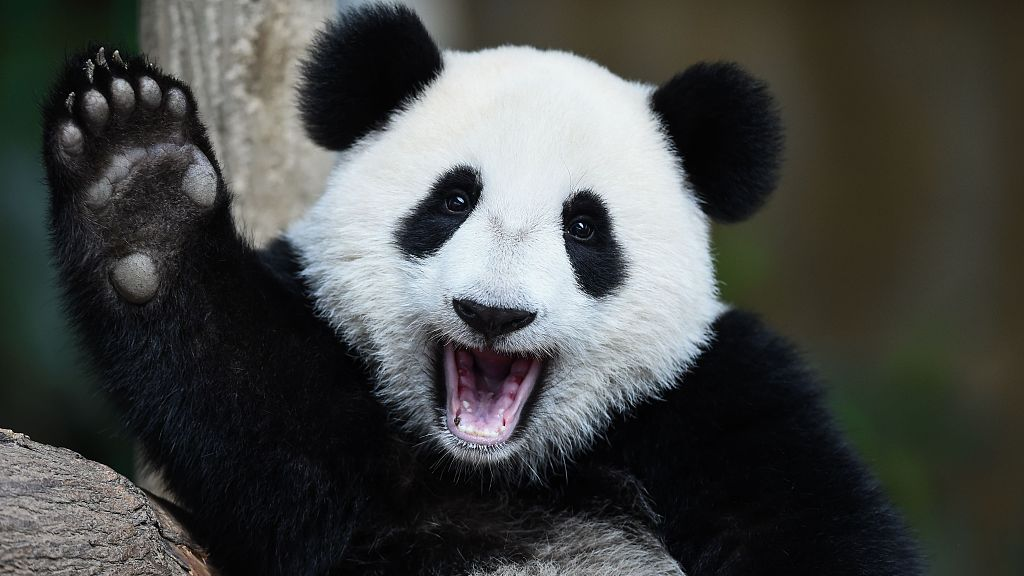
The giant panda is a large bear, with adults typically measuring 120 to 190 centimeters in length and weighing between 70 and 125 kilograms. Males are approximately 10 to 20 percent larger than females. Its fur is thick and woolly, providing essential insulation against the cold, wet mountain climate of its natural habitat. The bold black-and-white coloration serves a dual purpose: the dark fur absorbs heat in winter, while the white fur provides camouflage in snow, and the high-contrast markings on the face may help individual pandas recognize one another.
The giant panda’s face appears unusually flat due to its enlarged cheekbones and powerful jaw muscles, which are specially adapted for crushing tough bamboo. Perhaps its most remarkable anatomical feature is the enlarged, radially sesamoid wrist bone—popularly called a “thumb”—that works in opposition to the true digits, allowing the panda to grip and manipulate bamboo stems with remarkable dexterity. Its molars are broad and flat, with complex ridges ideal for grinding fibrous plant material.
Habitat and Distribution
Giant pandas live in the mountainous forests of central China, historically spanning a far wider area than they occupy today. Their current range is fragmented across six mountain ranges in Sichuan, Shaanxi, and Gansu provinces: the Qinling, Minshan, Qionglai, Daxiangling, Xiaoxiangling, and Liangshan mountains. These temperate forests, situated at elevations between 1,200 and 3,900 meters, are rich in bamboo and receive abundant rainfall and mist year-round.
Conservation efforts have expanded the panda’s habitat in recent decades. China has established more than 60 panda reserves, protecting approximately 67 percent of the wild population. The creation of ecological corridors connecting isolated panda populations has been a particular priority, allowing pandas to move between fragmented forest patches and maintain genetic diversity through breeding.
Diet and Feeding Behavior
The giant panda is classified as a carnivore, yet bamboo accounts for more than 99 percent of its diet—an extraordinary dietary specialization among bears and indeed among mammals as a whole. An adult giant panda consumes 12 to 38 kilograms of bamboo every day, depending on the part of the plant consumed. Shoots and young leaves are preferred in spring and summer, while leaves form the bulk of the winter diet when other vegetation is scarce.
Despite its bamboo-heavy diet, the giant panda’s digestive system remains fundamentally that of a carnivore. It lacks the elongated gut typical of herbivores and cannot digest cellulose efficiently, absorbing only about 20 to 30 percent of the bamboo it eats. This inefficiency means pandas must spend 10 to 16 hours per day foraging and eating, leaving little time for other activities. Their powerful jaw muscles and robust teeth allow them to process up to 20 kilograms of bamboo leaves and stems daily.
Behavior and Social Life
Giant pandas are generally solitary animals, with each adult maintaining a home range that may overlap with the ranges of neighboring individuals, particularly during the breeding season. They communicate through vocalizations—including bleats, honks, and growls—and scent marks left on tree stumps and rocks. Pandas do not hibernate, a trait they share with other bears in temperate climates, and they may descend to lower elevations in winter to escape deep snow at higher elevations.
Despite their solitary reputation, pandas show interesting social behaviors around water sources, where they may gather during dry seasons. Mothers are highly attentive to their cubs, carrying them constantly for the first few months and sleeping with them curled together in cave dens or hollow trees. Cubs begin eating bamboo at around six months of age but continue nursing until they are about a year old.
Conservation Status
After decades of decline driven by habitat loss and low reproductive rates, the giant panda’s population in the wild has grown modestly in recent years, leading the IUCN to downgrade its status from “Endangered” to “Vulnerable” in 2016—a rare and celebrated success in modern conservation. The wild population is now estimated at around 1,800 individuals, up from a low of approximately 1,000 in the 1980s.
The panda’s recovery reflects decades of intensive conservation work, including the protection of habitat, anti-poaching enforcement, and captive breeding programs in zoos worldwide. The Chengdu Research Base of Giant Panda Breeding in China has been particularly successful, producing more than 300 panda cubs since its founding in 1987 and contributing significantly to reintroduction efforts. Conservation challenges remain, however: climate change is projected to eliminate more than 35 percent of the panda’s bamboo habitat by the end of the century, making long-term habitat connectivity and climate resilience planning essential.
Fun Facts
- A newborn giant panda cub is about the size of a stick of butter — roughly 1/800th the weight of its mother.
- Giant pandas have a highly developed sense of smell, which they use to detect changes in the hormone levels of potential mates.
- Despite being classified as carnivores, giant pandas have a taste receptor gene (Tas1r1) that has become non-functional, meaning they cannot taste umami — the savory flavor associated with meat.
- The giant panda has been a symbol of WWF (World Wildlife Fund) since the organization was founded in 1961.
The giant panda stands as living proof that even the most threatened species can recover when given adequate protection and political commitment. As China continues to invest in forest restoration and corridor connectivity, the future of this gentle giant looks brighter than at any point in the past half century.
[…] facial markings, and long, ringed tail. Though it shares a name and a fondness for bamboo with the Giant Panda, the red panda belongs to its own unique family, Ailuridae, and is not closely related to giant […]
[…] of the Himalayas and southwestern China. Despite its common name, it is not closely related to the giant panda and belongs to its own family, Ailuridae. With its rusty red coat, white face markings, and ringed […]