 By Iris
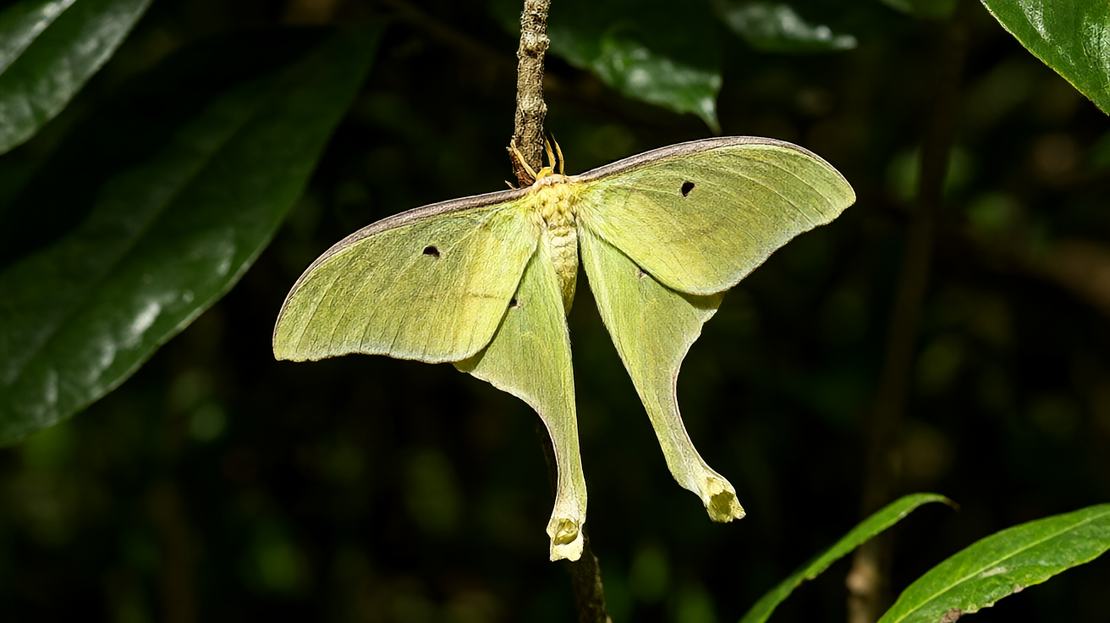
Argema mittrei | Comet Moth
Species Profile · Saturniidae
Comet Moth
A moth with tails longer than its body hangs in the wet eastern forest.
Not assessed
Wingspan
Tails
Adult mouth
Adult life
Range
Rating
The Comet Moth
The moth that lives on stored fat
A pale green moth hangs from a cocoon with two long ribbons trailing behind. Tails reach almost twice the length of the wings. Nothing else in Madagascar carries that shape, and the insect lives only on the island, in the wet eastern forest.
Adults cannot feed at all, since the mouthparts are gone, and their whole adult life runs on fat stored by the larva. Because the adult has no mouth, it lives only a few days. Most of its work happens at night, and the female calls males with scent.
Family tree
Saturniidae, the silk moths
Its proper name is Argema mittrei, one of the silk moths, and the family holds the largest moths on earth. Because the family lost its mouthparts early, no adult silk moth feeds, and the genus occurs in Africa and Asia as well as Madagascar. Two close kin live on the mainland, and both lack long tails.
A French collector gave the species its name. No subspecies are named across the island.
Wings and tails
How to tell one
Wingspan reaches 20 cm, and males carry tails of 8 cm or more. Weight stays light, since the body holds little besides eggs or sperm. Wings run pale yellow green, and each one carries a round eye spot. Because the eyespots mimic a larger animal, a predator pauses.
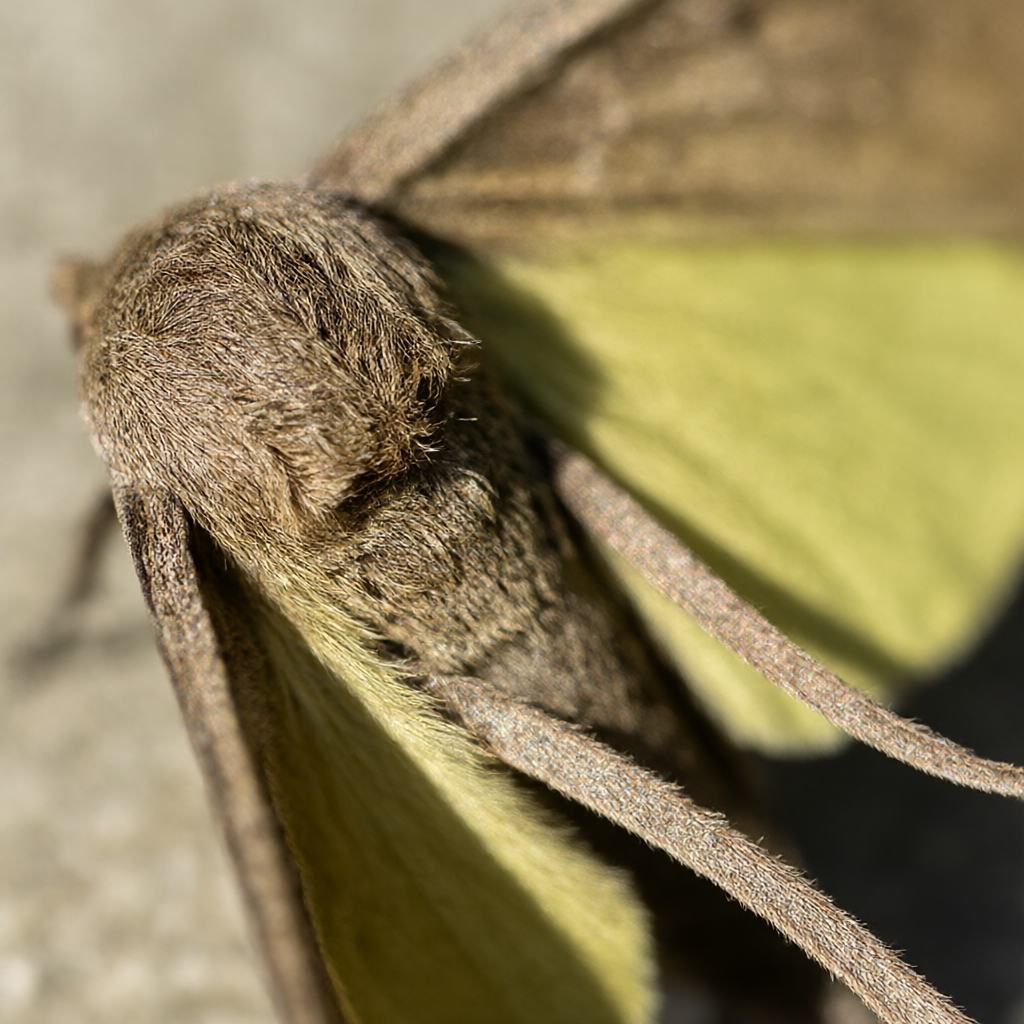
The body is small and furry, and it looks out of proportion to the wings. Tails hang from the hind wings and twist in flight. Antennae of the male run broad and feathered, and they detect female scent. Adult mouths are reduced to nothing at all.
Legs are weak, and the moth rarely walks. Females run heavier than males, and their tails stay shorter.
1
2
3
Wet eastern forest
Where it lives
Wet eastern forest is the only habitat. Because the larva needs its food plant, the moth stays where that plant grows. Forest edge and second growth hold animals as well as primary forest. Most records come from below 1,500 m.
The adult flies at night and rests by day. Light traps draw males from a wide area. A chameleon hunts in the same forest, and both animals rely on disguise rather than speed.
Leaves, as a larva
What it eats
The larva feeds on leaves of the traveler’s tree and related plants. Because the adult cannot eat, all depends on that larval diet. A larva eats for weeks before it pupates. The cocoon hangs from a twig, and it carries rows of holes that let rainwater drain out before it pools.
Adults take no food and no water at all. Their energy comes wholly from stored fat. A butterfly also feeds as a larva and flies as an adult, though most butterflies take nectar.
A cocoon that drains
The breeding cycle
A female releases a scent that draws males across the forest. Because she cannot feed, she has only a few nights to mate and lay. Eggs go onto the food plant one at a time. The larva hatches and feeds through some moults.
Pupation takes weeks inside the hanging cocoon. Adults emerge together after the rains. Neither sex lives more than a week.
Forest clearance
Conservation
The species has not been assessed by the Red List. Forest clearance takes the food plant across eastern Madagascar. Because the adult cannot feed, it cannot cross open ground to reach new forest.
Collectors take specimens, though the trade is small. Silk farming projects now breed the moth locally. Protected forest holds the best groups.
Side by side
How It Compares
| Trait | Comet Moth | Atlas Moth |
|---|---|---|
| Family | Saturniidae | Saturniidae |
| Wingspan | 20 cm | 25-30 cm |
| Tails | 8 cm or more, on males | none |
| Adult mouth | none | none |
| Range | eastern Madagascar | south and southeast Asia |
| Rating | Not assessed | Least Concern |
Common misreadings
What People Get Wrong
- Not a rare insect. The species is common in its own forest. It appears on banknotes and in tourist posters, yet almost all of what is known comes from a handful of reared specimens.
- Not a short life by choice. The adult has no working mouth at all. Everything it needs gets stored by the larva, and the adult spends a few nights mating before that store runs out.
- Not a strong flier. Females wait and release a scent instead. Males cover a long distance to reach her, and the feathery antennae pick up a single female from far across the forest.
Going further
Sources and Further Reading
Quick hits
Five things to remember
- It has no mouth as an adult.
- Its tails are longer than its body.
- It lives only in Madagascar.
- It lives about a week.
- Its cocoon has drain holes.
[…] makes it a useful barometer of the health of both habitats, much as wetland species such as the marsh frog reflect the condition of the freshwater margins it also […]
[…] contextual comparison, the Reed Bunting shares reedbed habitats with the Marsh Frog (Pelophylax cambiensis), though the two species occupy different trophic levels within the same wetland ecosystem. The […]