 By st20113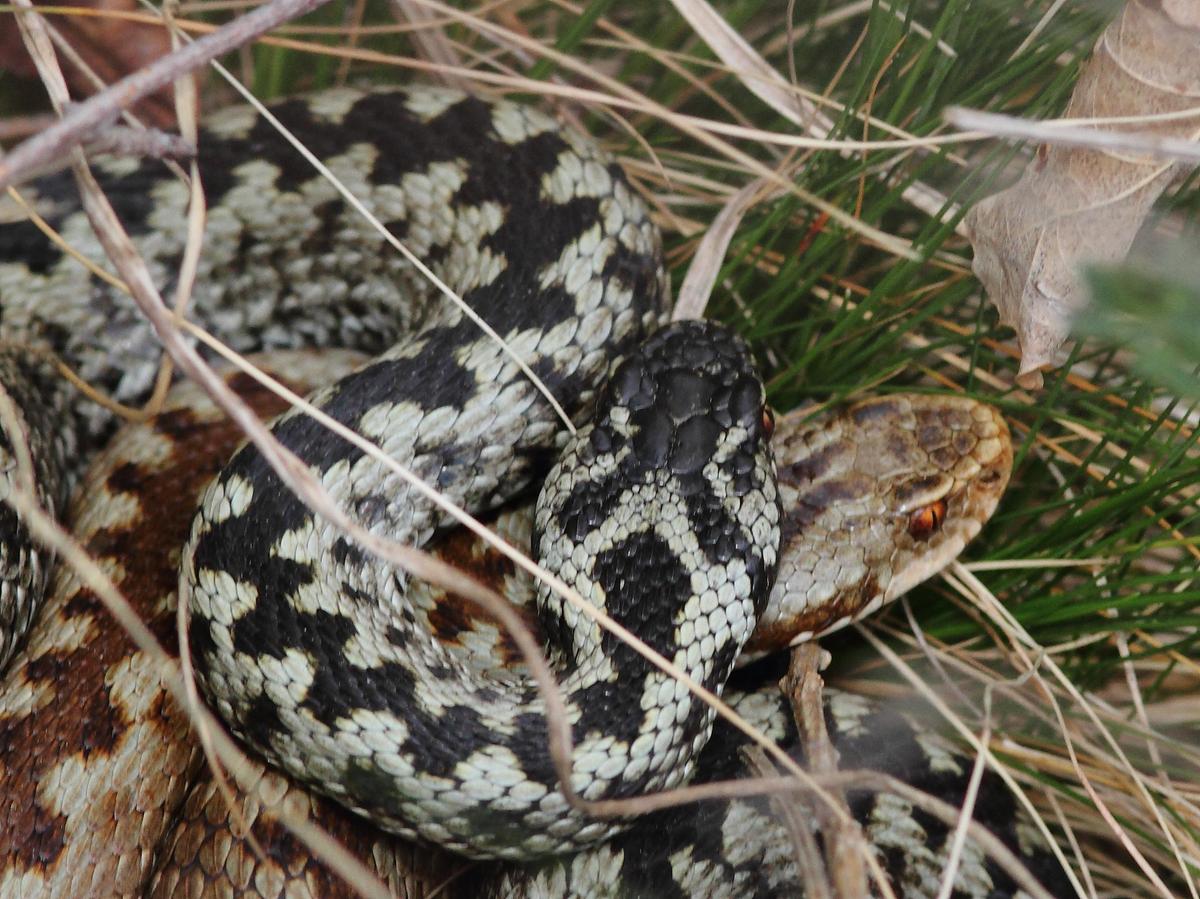
Introduction
The adder (Vipera berus) is a short, stout venomous snake and the only snake found across most of northern Europe, including Britain and inside the Arctic Circle. Adults typically measure 50 to 60 centimeters, though some reach 80 centimeters. Its body is grey, brown, or reddish with a dark zigzag stripe along the back and a V or X marking on the head. Despite its venom, the adder is shy and slow to bite, and serious harm to humans is rare. It plays an important role as both predator and prey in heath, moor, woodland, and grassland ecosystems. Its presence is often a sign of a healthy, undisturbed mosaic of habitats.
Taxonomy
The adder belongs to the family Viperidae, the true vipers, characterized by hinged fangs that fold against the roof of the mouth. Its scientific name Vipera berus was assigned by Linnaeus in 1758. Several subspecies are recognized across its huge range, varying in color from melanistic black individuals in some regions to pale sandy forms elsewhere. It is only distantly related to the harmless grass snakes and to the red fox, which occasionally preys on it.
Physical Characteristics
Adders have a broad, triangular head distinct from the neck, vertical pupils, and keeled scales that give a rough texture. The defining feature is the dark zigzag dorsal stripe, though some adults, especially males, are nearly uniform black. Females are usually larger and browner than males. They possess a pair of long venom fangs connected to glands behind the eyes. The body is relatively thick for a snake of its length. Coloring provides excellent camouflage among heather, leaf litter, and rocks. Young adders are born with a bright yellow tail tip used to lure small prey, a trait lost with age. Their slow metabolism lets them survive long periods between meals.
Habitat
Adders occupy a remarkable variety of habitats: heathland, moorland, woodland edges, bog, coastal dunes, and mountain meadows. They need sunny basking spots close to dense cover where they can hide from the brown bear only in the remotest east, but more often from birds of prey and foxes. They prefer places with a patchwork of open ground and scrub that supports their small-mammal and amphibian prey. In the far north they bask on warm rocks during the short summer. Wetland margins are especially valuable because they attract frogs and lizards. Habitat fragmentation and the loss of sunny refuge spots are the main threats to local populations.
Diet
Adders are ambush predators that feed mainly on small mammals such as voles, mice, and shrews, which they locate by scent and heat-sensing pits. They also take lizards, frogs, and occasionally nestling birds. Prey is subdued with a quick venomous bite, then swallowed whole. Because their metabolism is slow, adults may eat only a few times per month, and a single large meal can sustain them for weeks. Young adders feed on small invertebrates and tiny frogs before graduating to mammals. This low-energy lifestyle allows them to thrive in harsh climates where food is seasonal.
Reproduction
Adders are ovoviviparous: females retain eggs inside the body and give birth to live young in late summer, usually eight to twelve at a time. Mating occurs in spring after emergence from hibernation, with males performing ritualistic combat dances to win females. The young are independent immediately and must find food and shelter on their own. Females breed only every two or three years, investing heavily in each litter. Cold climates slow development, so northern females produce fewer, larger offspring than southern ones. Hibernation in communal dens, often shared with other snakes, helps them survive freezing winters before the next active season begins.
Conservation
The adder is listed as Least Concern globally but has declined severely in many parts of western Europe because of habitat loss, persecution, and accidental killing. It is legally protected in numerous countries, where deliberate harm or collection is prohibited. Conservation focuses on preserving heath, bog, and grassland mosaics and on public education to reduce fear-driven killings. Because adders are slow to recover, disturbed populations can vanish for decades. Road mortality and the draining of wetlands further threaten them. Citizen science sightings help map remaining strongholds and guide habitat management that keeps sunny basking areas connected to refuge cover.
Fun Facts
The adder is the only snake that lives north of the Arctic Circle and the most cold-hardy serpent on Earth. Nearly black adders in some populations are not a separate species but color variants. A newborn adder already has functional venom and a yellow tail tip used like a fishing lure. Adders can survive swallowing prey larger than their own head by stretching their jaws. Males wrestle in spring “dances” that look dramatic but rarely cause injury. Despite their reputation, they usually flee or stay still rather than strike when people approach.
[…] Lizard | Zootoca vivipara Barn Swallow | Hirundo rustica Adder | Vipera berus Great Crested Newt | Triturus cristatus Common Swift | Apus apus European Rabbit | […]
[…] Roach | Rutilus rutilus Common Lizard | Zootoca vivipara Barn Swallow | Hirundo rustica Adder | Vipera berus Great Crested Newt | Triturus cristatus Common Swift | Apus apus European Rabbit | […]
[…] Roach | Rutilus rutilus Common Lizard | Zootoca vivipara Barn Swallow | Hirundo rustica Adder | Vipera berus Great Crested Newt | Triturus cristatus 17 Aug 2026, […]