 By st20113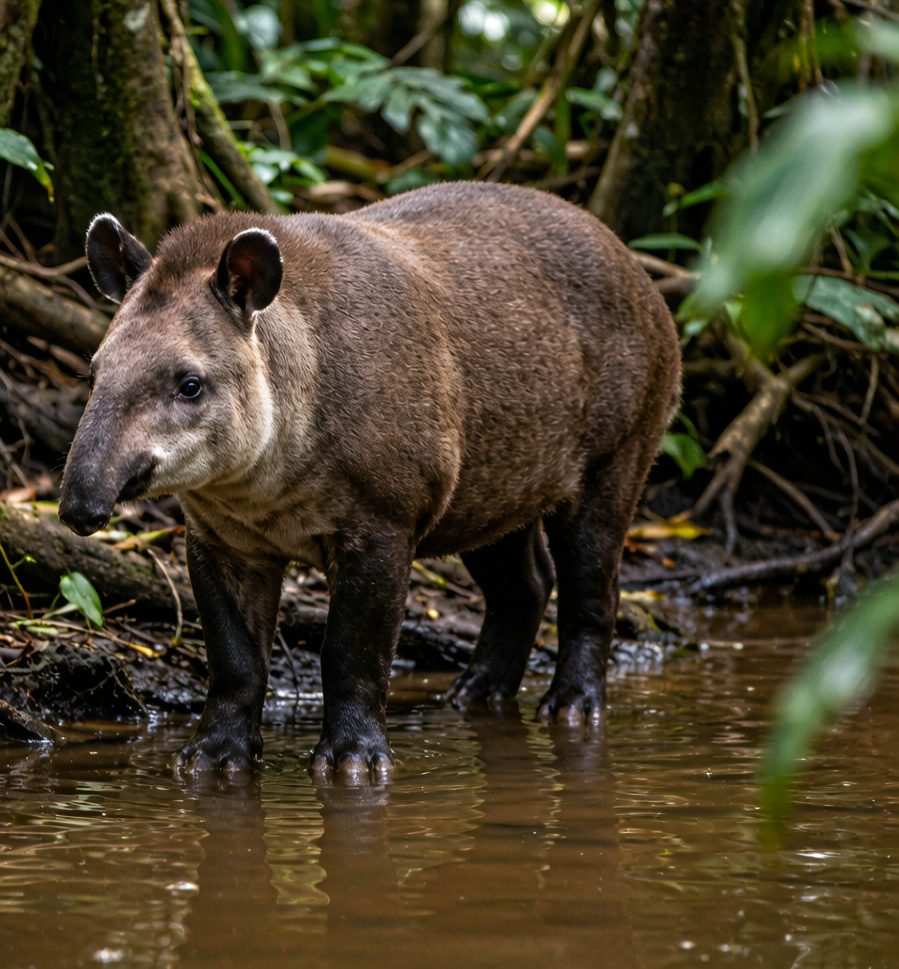
Introduction
The Brazilian tapir (Tapirus terrestris), also known as the South American tapir or lowland tapir, is the largest terrestrial mammal in the Amazon and one of the region’s most important seed dispersers. Resembling a rounded, short-legged horse with a flexible trunk-like snout, the tapir is a shy, solitary browser that inhabits forests and wetlands across much of South America. An excellent swimmer and a vital gardener of the forest, it transports seeds across vast distances in its dung. Despite its size, the tapir is elusive and rarely seen, yet it plays an outsized ecological role in maintaining forest diversity, much like the capybara that shares its waterways.
Taxonomy
The Brazilian tapir is one of four living tapir species in the family Tapiridae, order Perissodactyla, the odd-toed ungulates, which also includes horses and rhinoceroses. Described by Linnaeus in 1758, Tapirus terrestris is the only tapir native to South America. Its closest living relatives are the mountain tapir, Baird’s tapir, and the Malayan tapir of Southeast Asia. Genetic evidence confirms tapirs as a basal lineage within Perissodactyla, retaining primitive traits lost in their horse and rhino cousins over millions of years of separate evolution.
Physical Characteristics
Brazilian tapirs are bulky, barrel-bodied animals with short, sturdy legs, a rounded rump, and a distinctive elongated, mobile snout that functions as a short trunk. Adults weigh 150 to 320 kilograms and stand about 75 to 110 centimetres at the shoulder. Their coarse, dark-brown to greyish coat is sparse on the undersides, and young calves are born with white spots and stripes that fade by six months. The eyes and ears are small, and the upper lip extends into a prehensile proboscis used to grasp leaves and fruit. Despite their bulk, tapirs are strong swimmers with webbed toes that aid movement through water and mud.
Habitat
Brazilian tapirs occupy a wide range of habitats including tropical rainforests, seasonally flooded forests, gallery woodlands, and Cerrado savannas, always near water such as rivers, streams, lakes, and swamps. They are habitat generalists but depend on water for thermoregulation, escape from predators, and access to aquatic plants. Tapirs use well-worn trails through dense vegetation to move between feeding and resting sites and often wallow in mud or water during the heat of the day. They require large, contiguous areas of intact habitat and are highly sensitive to deforestation and the construction of roads and dams.
Diet
Tapirs are herbivorous browsers and frugivores, consuming leaves, shoots, buds, grasses, and a great variety of fruits. Their diet shifts seasonally, with fruit forming a major component when abundant. As they digest fruit, they scatter seeds in their droppings across the forest, earning them the title of “gardeners of the forest.” They may travel several kilometres in a night along established routes to feed. Tapirs are also known to eat mineral-rich soil at salt licks. Their selective browsing influences plant community composition and promotes regeneration of many tree species throughout their range.
Reproduction
Brazilian tapirs are mostly solitary, with males and females meeting only to breed. After a gestation of about 13 months, the female gives birth to a single calf, which she hides in dense vegetation for the first weeks of life. Calves are precocial, able to stand and walk within hours, and are weaned at around six to eight months. The characteristic juvenile camouflage of spots and stripes helps conceal the vulnerable young. Females typically produce a calf every two to three years. Sexual maturity is reached at three to four years, and tapirs may live more than 25 years in the wild.
Conservation
The Brazilian tapir is classified as Vulnerable by the IUCN, with declining populations across its range. Major threats include habitat fragmentation, hunting for meat, and conflict with agriculture. As a keystone seed disperser, its decline threatens the regeneration of numerous tree species and the overall health of tropical forests. Conservation strategies emphasise protected area management, wildlife corridors to connect fragmented habitats, and anti-hunting enforcement. Ecotourism centred on tapir viewing has also raised local awareness and provided incentives for protection.
Fun Facts
The tapir’s flexible snout is a fused extension of its nose and upper lip, used like a hand to pluck leaves and sniff the air. Despite weighing up to 300 kilograms, tapirs can move with surprising grace through dense undergrowth and are strong, confident swimmers. Their dung serves as a miniature nursery, hosting dung beetles and dispersing seeds that grow into the next generation of forest trees. Tapirs have changed little in appearance for millions of years, earning them the nickname “living fossils.” A threatened tapir will often flee straight into water, where it can remain submerged with only its snout above the surface.