 By st20113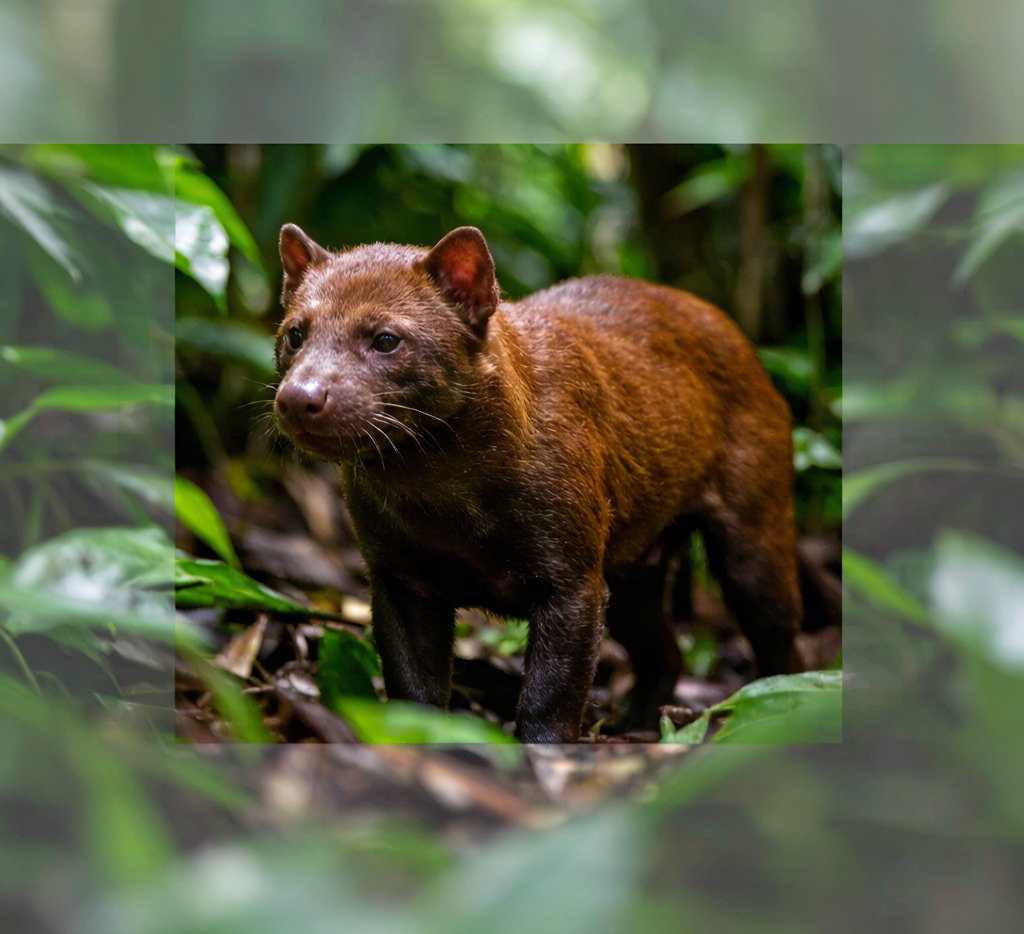
Introduction
The bush dog (Speothos venaticus) is a small, highly social canid found in the forests, wetlands, and savannas of Central and South America. Despite its common name, it is distantly related to domestic dogs and looks more like a short-legged otter than a wolf. With its rounded ears, stocky body, and webbed feet, the bush dog is superbly adapted to a life of cooperative hunting in dense, humid habitats. These animals live and hunt in close-knit packs, relying on teamwork to pursue prey far larger than themselves through tangled undergrowth and across flooded plains.
Taxonomy
Speothos venaticus is the only surviving species in the genus Speothos and a member of the family Canidae. Molecular research places it in a distinct South American branch of the dog family, more closely allied with the maned wolf and the African wild dog than with true foxes or wolves. The genus name Speothos refers to its original description from fossil cave deposits, and venaticus means hunting. Three subspecies are recognized across its range, though boundaries remain debated. Its unusual anatomy and genetics make it one of the most distinctive and evolutionarily isolated of all living canids, and it shares a more recent ancestor with the dhole of Asia than with most New World foxes.
Physical Characteristics
Bush dogs are compact animals, measuring roughly 57 to 75 centimeters from nose to rump, with a short tail of about 12 to 15 centimeters and a shoulder height near 25 to 30 centimeters. Adults typically weigh between 5 and 8 kilograms, with males slightly larger than females. Their coat is a uniform dark brown to reddish-brown, lighter on the head, neck, and throat. The legs are short and sturdy, and the toes are partially webbed, an adaptation for swimming. Bush dogs possess strong jaws and relatively large, sharp teeth suited to seizing and crushing prey. Their small eyes and rounded ears reflect a lifestyle centered on dense cover rather than long-distance sight.
Habitat
Bush dogs occupy a wide variety of humid habitats, including tropical rainforests, gallery forests, seasonally flooded savannas, and marshes. They prefer areas near water, where dense vegetation offers hunting cover and refuge. Their range extends from Panama through the Amazon and Orinoco basins into Bolivia, Paraguay, and northern Argentina. They are generally absent from high mountains, dry scrub, and open grasslands without nearby forest. Because they depend on connected vegetation and abundant prey, bush dogs are sensitive to habitat fragmentation, and they often disappear quickly from landscapes broken up by agriculture or roads, sharing such disturbed edges with the adaptable coati.
Diet
Bush dogs are obligate carnivores that hunt cooperatively in packs. Their favorite prey are large rodents such as capybaras and pacas, but they also take peccaries, armadillos, birds, snakes, and occasionally fish. Working as a team, a pack will surround, tire, and overwhelm animals many times its weight, using coordinated bites. Their powerful jaws can crush bones and deliver a suffocating grip. Unlike many solitary canids, bush dogs share kills among pack members, and adults regularly regurgitate food for pups and for companions that remained at the den. This social feeding strengthens pack bonds.
Reproduction
Bush dogs are monogamous, with a single dominant pair doing most of the breeding inside each pack. After a gestation of about 65 to 70 days, the female gives birth to a litter of three to six blind, helpless pups in a burrow, hollow log, or abandoned armadillo tunnel. Non-breeding pack members, including mature offspring, help care for the young by guarding the den and bringing food. The pups open their eyes at about two weeks, begin eating solid food by four weeks, and gradually join hunts as they grow, reaching full independence within several months of age.
Conservation
The International Union for Conservation of Nature lists the bush dog as Near Threatened. The principal threats are deforestation, draining of wetlands, and fragmentation of forests these animals need to travel and hunt. Declining populations of large rodents and peccaries reduce their food supply, while domestic dogs can introduce deadly diseases such as canine distemper and parvovirus. Road construction increases both direct mortality and isolation between groups. Protected areas that conserve intact, connected forest and wetland mosaics are the most effective safeguard, together with monitoring programs that track this secretive species across its range.
Fun Facts
Bush dogs are surprisingly vocal, using whistles, purrs, and sharp alarm barks to stay in contact in thick cover. They are strong swimmers and readily enter water to hunt or escape. A coordinated pack can bring down a capybara weighing more than thirty times a single member. Males take an active role in rearing pups, grooming and feeding them. The animals mark trails with scent from anal glands, and packs often travel in single file, the leader breaking a path through the undergrowth for the rest to follow.