 By st20113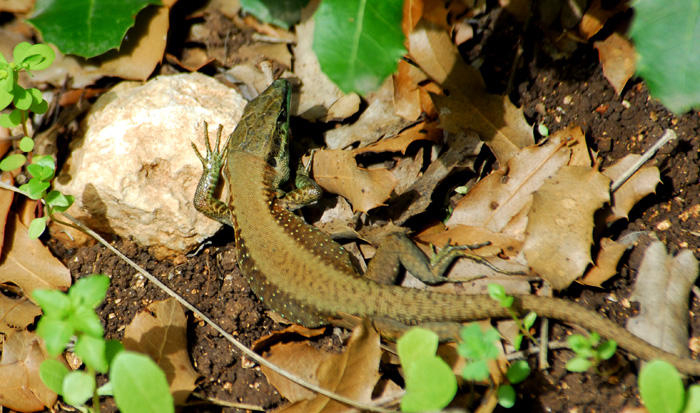
Introduction
The sand lizard (Lacerta agilis) is a slender, fast-moving reptile native to the grasslands, heathlands, and sandy dunes of central and eastern Europe. Adults usually reach 18 to 25 centimetres including the tail, with males generally larger and more vividly marked than females. The body is brown or olive with a network of darker markings, and males develop conspicuous green flanks during the breeding season. As a relative of the giant Komodo dragon, the sand lizard shares the basic body plan of scaly, four-limbed reptiles, though on a far smaller scale.
Taxonomy
Lacerta agilis is a member of the family Lacertidae, the true lizards, within the order Squamata. It was described by Carl Linnaeus in 1758. Several subspecies are recognised across its broad range, differing mainly in colour pattern and scale detail. Genetic analysis supports a close relationship with other European Lacerta species. The genus name refers to the Latin word for lizard, while the species name agilis means agile, a nod to the animal’s quick movements and rapid escapes from danger.
Physical Characteristics
The sand lizard has a long tail that can break off and regrow if seized by a predator, a defence known as caudal autotomy. Its body is covered in small, granular scales with larger plates on the head. Males display bright emerald-green sides bordered by black and white spots during spring and summer. Females are browner with two pale dorsal stripes. The limbs are well developed for running, digging, and climbing low vegetation. Like other reptiles such as the green sea turtle, the sand lizard is ectothermic and depends on external heat to regulate its body temperature.
Habitat
This species favours open, sunny habitats with loose, sandy, or well-drained soils that allow it to dig shallow burrows. Typical locations include heathland, coastal dunes, dry grassland, and forest edges. It avoids dense woodland and poorly drained clay soils. Basking sites such as bare ground, rocks, and low plants are essential for thermoregulation. In northern parts of its range the sand lizard hibernates underground from late autumn until early spring, emerging when temperatures rise enough to support activity.
Diet
Sand lizards are active predators of small invertebrates. Their diet consists mainly of spiders, beetles, grasshoppers, crickets, and various flies, which they chase and seize with a quick lunge. Juveniles feed on tiny prey such as mites and springtails. Because they hunt by sight, they are most active during warm, sunny periods when insect activity peaks. The lizards themselves are preyed upon by birds of prey including the golden eagle, as well as foxes, snakes, and domestic cats.
Reproduction
Mating occurs in spring soon after emergence from hibernation. Females lay small clutches of 5 to 12 eggs in warm, sandy soil where they incubate for six to ten weeks. Unlike many reptiles, the sand lizard often chooses nest sites that receive enough solar warmth to speed development. Hatchlings emerge in mid to late summer, already independent and capable of foraging. They reach sexual maturity after two to three years. In cooler climates, females may breed only in alternate years because of the energy cost of egg production.
Conservation
The sand lizard is listed as least concern globally, but many local populations have declined owing to the loss of heathland and grassland to agriculture and development. Habitat fragmentation isolates colonies and prevents natural dispersal. Conservation programmes in several countries involve managing open habitat through controlled grazing and scrub removal, as well as translocating animals to restored sites. These measures have helped stabilise vulnerable populations in western Europe.
Fun Facts
A sand lizard can sprint at surprising speed and change direction instantly to evade capture. Its tail, if lost, regrows as a slightly shorter, paler replacement. Males perform push-up displays and head bobbing to signal territory and attract mates. The vivid green breeding colour fades after the season, making males look almost like females by autumn. Females can store sperm, allowing fertilisation to occur even if mating was brief.
[…] The Indian cobra (Naja naja), also known as the spectacled cobra, is a highly venomous snake native to the Indian subcontinent, famous for the hood it flares when threatened and its prominent role in Indian culture and snake-charming. One of the “Big Four” snakes responsible for the majority of human snakebite deaths in the region, it commands both fear and reverence. Despite this, the Indian cobra is a shy, nocturnal hunter that prefers to avoid people. It occupies a remarkable range of habitats from forests to farmland and city fringes, making human encounters frequent across South Asia, where it shares the landscape with other reptiles such as the lizard. […]
[…] Five-lined Skink is a slender, glossy lizard common across sub-Saharan Africa, easily recognized by the five pale […]
[…] Common Lizard (lizard-lacerta-agilis) is the widespread close relative with which the Sand Lizard shares many […]