 By st20113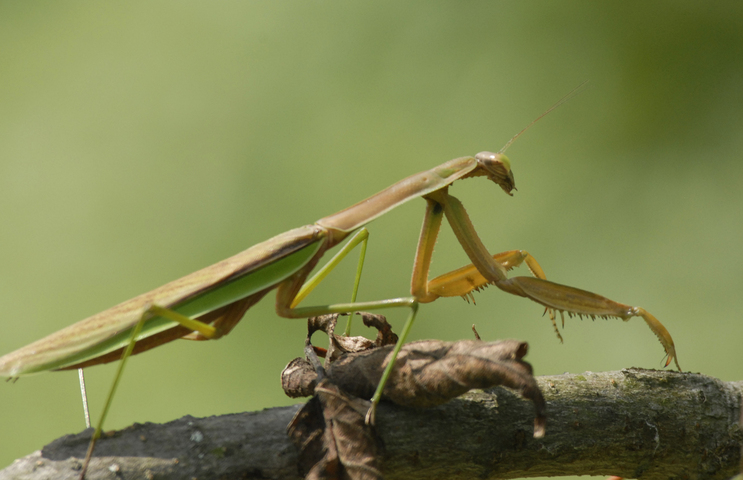
Introduction
The European Mantis (Mantis religiosa) is the most recognisable and widely distributed mantid species across Europe and parts of Asia and North Africa. A member of the family Mantidae, it is a generalised predator of insects and other small invertebrates found in meadows, gardens, agricultural fields, and scrubland. The European Mantis is instantly recognisable by its elongated prothorax, distinctive raptorial forelegs held in a perpetual praying posture, and the ability to rotate its triangular head through nearly one hundred and eighty degrees to track prey without moving its body. This species has long inspired cultural associations with spirituality and is among the most studied mantid species globally as a model organism in research on prey capture mechanics and camouflage evolution.
Taxonomy
Mantis religiosa belongs to the order Mantodea, a group of predatory insects characterised by raptorial forelimbs, triangular heads, and flexible prothoracic segments. The order Mantodea comprises approximately twenty families and more than two thousand described species distributed primarily in tropical and subtropical regions worldwide. Within Mantodea, the species sits within the family Mantidae, the largest and most diverse mantid family. The genus Mantis includes several closely related species sharing distinctive elongate tegmina and well-developed eyes. The species epithet “religiosa” (Latin for religious) references the prayer-like posture of the forelegs, which early naturalists compared to a figure in devotional contemplation. No subspecies are currently recognised, though body colour and size show considerable geographic variation.
Physical Characteristics
The European Mantis exhibits the iconic mantid body plan: an elongate somewhat flattened body ranging from six to fourteen centimetres in total length, with females considerably larger and more robust than males. The head is triangular in dorsal view and highly mobile, capable of rotating approximately one hundred and eighty degrees to scan surroundings for prey and predators. The compound eyes are large and bulging, providing stereoscopic vision essential for judging distances during strikes. The defining feature is the greatly enlarged raptorial foreleg folded against the thorax in the characteristic praying position. Each foreleg bears a series of spines along the tibia and femur that interlock when the leg is rapidly extended, impaling prey with remarkable speed. Coloration is highly variable and includes green, brown, grey, and yellowish morphs, with green being most common.
Habitat
The European Mantis inhabits open vegetated habitats across a vast range extending from southern Scandinavia and the British Isles through continental Europe to North Africa, and eastward through the Middle East and Central Asia to China and Japan. It occupies meadows, grasslands, rocky hillsides, scrubland, woodland edges, hedgerows, and urban gardens, preferring habitats with dense varied ground-layer vegetation providing both ambush hunting positions and effective camouflage. It preys on pest insects including grasshoppers, moths, and crickets in agricultural landscapes. In northern parts of the range, autumn frosts trigger adult mortality, and populations persist year to year only through the overwintering egg stage.
Diet
The European Mantis employs a sit-and-wait ambush strategy relying on exceptional crypsis to approach within striking range of unsuspecting prey. Its diet spans grasshoppers, crickets, moths, butterflies, beetles, flies, bees, wasps, and dragonflies. Large adult females occasionally capture small frogs and lizards. Prey is detected primarily through visual cues, and the mantis employs a characteristic slow swaying approach to refine depth perception before launching a strike completed in under one hundred milliseconds. The spined forelegs are extended with explosive speed, grasping prey and holding it immobile during feeding. Like other mantids, this species is an opportunistic cannibal particularly during the mating season.
Reproduction
Mating occurs during late summer and autumn, with males actively searching for females using visual cues and possibly sex pheromones. Courtship involves careful approach by the male balancing the need to get close enough to mate with the risk of being attacked and eaten by the larger female. Copulation can last several hours, and in many cases the female begins feeding on the male during or after copulation, a phenomenon known as sexual cannibalism that may provide nutritional benefits to developing eggs. The female produces one to three oothecae (egg cases) during autumn, each containing between one hundred and three hundred eggs. The ootheca hardens into a durable protective case attached to stems or bark, within which eggs overwinter protected from frost and desiccation. Nymphs emerge the following spring and are immediately independent.
Conservation
Mantis religiosa is classified as Least Concern globally due to its extremely broad distribution, large populations, and tolerance of human-modified environments. However, the species has been granted protected status in several northern countries where it represents a species of regional biodiversity significance. Primary threats are habitat loss through urbanisation, agricultural intensification, and removal of hedgerows and field margins. Widespread use of broad-spectrum insecticides reduces prey availability and can cause direct mortality to mantids.
[…] insect shares the order with the European Mantis. That insect has a plain rounded head. It grows larger and heavier. Our insect carries a tall […]