 By st20113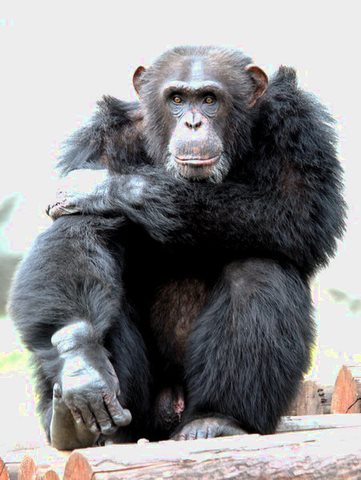
Introduction
The common chimpanzee (Pan troglodytes) is a great ape of equatorial Africa and one of our closest living relatives, sharing about 98 percent of its DNA with humans. Intelligent, social, and adaptable, chimpanzees live in fluid communities where individuals form lifelong bonds and intricate alliances. Their use of tools, varied calls, and capacity for planning have made them a central subject of studies into the origins of human behavior. They remain widespread but are increasingly threatened across their range.
Taxonomy
Chimpanzees belong to the family Hominidae, which includes gorillas, orangutans, and humans. They are grouped with the bonobo in the genus Pan, and the two split from a common ancestor only about two million years ago. Four traditionally recognized subspecies inhabit different parts of Africa, from the west to the east and central regions. Genetic evidence places chimpanzees closer to humans than either is to gorillas, making them a key window into our own evolutionary past.
Physical Characteristics
Adults stand about 1 to 1.7 meters tall when upright and weigh between 40 and 70 kilograms, with males larger than females. Their bodies are covered in coarse black hair, while the face, hands, and ears are bare and may darken with age. Long arms, strong shoulders, and hook-like hands suit a life of climbing and brachiation. A powerful bite and large canine teeth are used in displays and social contests. Chimpanzees walk on all fours using knuckle-walking but can also stand and move bipedally for short distances.
Habitat
Common chimpanzees occupy a remarkable range of habitats, from tropical rainforests and swamp forests to woodlands, savannas, and montane forests across central and western Africa. They build sleeping nests of branches in trees each night, often choosing a new spot to avoid predators. Their flexibility allows them to persist where other apes cannot, though they avoid open dry grasslands. Home ranges shift with the seasons as fruit trees come into production.
Diet
Chimpanzees are omnivorous and highly opportunistic. Fruit makes up the bulk of the diet, supplemented by leaves, seeds, bark, flowers, and honey. They hunt monkeys, small antelopes, and birds, and they fish for termites and ants with carefully prepared twigs and stems. Different communities have distinct “cultures,” passing down tool-use techniques across generations. Such traditions, once thought uniquely human, reveal deep cognitive abilities shared among the great apes.
Reproduction
Females give birth for the first time around age thirteen or fourteen after a gestation of about eight months. Usually a single infant is born, dependent on its mother for years of carrying, nursing, and teaching. Young chimpanzees stay close to their mothers well into childhood and may remain in the community for life. Males typically remain in their birth group while females often transfer to neighboring communities, weaving connections between populations.
Conservation
The common chimpanzee is listed as Endangered, with populations declining because of habitat loss, hunting for bushmeat, and the illegal pet trade. Disease, including Ebola, has devastated some groups. Protected areas and sanctuaries offer refuge, while international agreements restrict trade. Community-based conservation that links local welfare to forest protection has proven the most durable safeguard for wild chimpanzees. The gorilla and the bonobo face similar pressures as fellow African apes.
Fun Facts
Chimpanzees greet friends with embraces and grooming sessions that strengthen social bonds as much as they remove parasites. They can recognize themselves in mirrors, a sign of self-awareness shared with only a few animals. Wild chimpanzees have been seen fashioning spears to hunt, showing foresight and planning. Their pant-hoot calls carry for kilometers through the forest to coordinate groups. Communities can exceed one hundred members, yet every individual knows its rank through a shifting web of friendships and rivalries. Tool kits differ from one region to another, showing that culture, not instinct alone, shapes how they live. The colorful mandrill and the thoughtful orangutan are more distant cousins within the primate family. Despite their intelligence, chimpanzees face severe threats from habitat loss and the illegal pet trade, making conservation efforts across their range increasingly urgent.
[…] to blur species boundaries in contact zones. They share a close taxonomic relationship with the chimpanzee and bonobo, both of which occupy overlapping ranges in central and eastern […]