 By st20113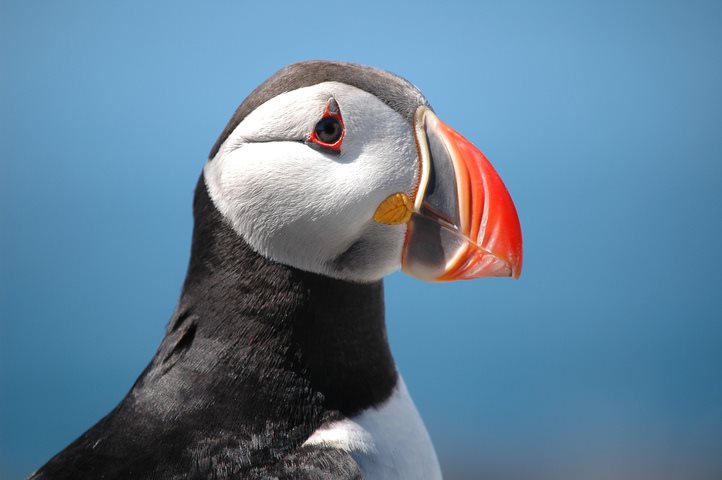
Introduction
The Atlantic puffin (Fratercula arctica) is a small seabird of the North Atlantic, beloved for its colorful, parrot-like bill and clownish expression. Often called the “sea parrot,” it spends most of the year far out at sea and returns to land only to breed. Puffins are superb swimmers, using their wings to “fly” underwater in pursuit of fish. Though still numerous overall, regional populations have declined sharply, making the species a focus of marine conservation efforts across the northern Atlantic.
Taxonomy
The Atlantic puffin is one of three puffin species in the genus Fratercula, alongside the horned and tufted puffins of the North Pacific. It belongs to the family Alcidae, which also includes guillemots and murres, and is most closely related to the auks. Fossil relatives show that puffin-like birds have inhabited the North Atlantic for millions of years. Despite their parrot-like appearance, they are not related to parrots but are specialized diving seabirds shaped by life in cold northern waters.
Physical Characteristics
Adults stand about 25 to 30 centimeters tall and weigh between 320 and 500 grams. In breeding plumage they display a broad triangular bill striped with red, yellow, and blue-gray, set against a white face and black crown. Their feet are bright orange-red. In winter the bill appears smaller and duller, and the face turns grayer. Puffins have short wings built for underwater propulsion rather than fast flight, and their dense bones help them dive. A single chick, called a puffling, is reared each year.
Habitat
Atlantic puffins nest in burrows on grassy clifftops and rocky islands from Iceland and Norway to the coasts of Britain, Maine, and Atlantic Canada. They favor islands free of land predators, where they can dig safe nesting tunnels. For the rest of the year they live entirely at sea, riding waves and resting on the water’s surface. They often share their breeding grounds with other seabirds and marine mammals, and penguins of the Southern Hemisphere fill a similar ecological role on the opposite side of the globe.
Diet
Puffins feed mainly on small schooling fish such as sandeels, herring, and capelin, which they catch by diving to depths of about 30 to 60 meters. A single bird can carry more than a dozen fish crosswise in its bill at once, held in place by backward-pointing spines on the tongue. They also eat crustaceans and squid when fish are scarce. Parents make many feeding trips to deliver whole fish to the chick waiting in the burrow.
Reproduction
Breeding begins in spring when pairs return to the same burrow year after year. A single white egg is laid in a chamber at the end of a burrow dug with the bill and feet. Both parents incubate for roughly six weeks and then share the task of feeding the chick. The puffling fledges at night after about six weeks, slips into the sea alone, and spends several years maturing before it returns to breed. Puffins may live more than twenty years.
Conservation
The species is classified as Vulnerable, with some local colonies collapsing due to overfishing, climate change, and introduced predators such as rats and cats. Warming seas reduce the availability of the small fish puffins depend on, forcing adults to travel farther for food. Protected reserves, predator control, and sustainable fisheries management help safeguard key colonies. Citizen science and long-term monitoring track population trends across their range.
Fun Facts
A puffin’s bill brightens in color during the breeding season and fades afterward, somewhat like a seasonal badge. Their eyes are adapted to see clearly both in air and underwater, with specialized lenses that adjust to the change in light. Puffins can beat their wings up to several hundred times a minute to stay airborne. They are surprisingly long-lived, with some individuals returning to the same burrow for decades. In icy northern waters they mingle with the arctic fox onshore and with humpback whales feeding offshore, both shaped by the same cold ocean.
[…] does the amount of white in the plumage. The guillemot is the close relative of the Atlantic Puffin (Fratercula arctica). That bird is much smaller and far more colourful. Its huge bill is famous. It nests in a burrow […]
[…] millimetres long. That shape holds slippery fish firmly. The razorbill is the close relative of the Atlantic Puffin (Fratercula arctica). That bird shares the same colonies and the same fishing grounds. Yet its bill and its nesting […]
[…] and the geography of the arctic were very different then. The bird is a close relative of the Atlantic Puffin (Fratercula arctica). The 2 share the same family and the same colonies. They also share the same cold and productive […]