 By st20113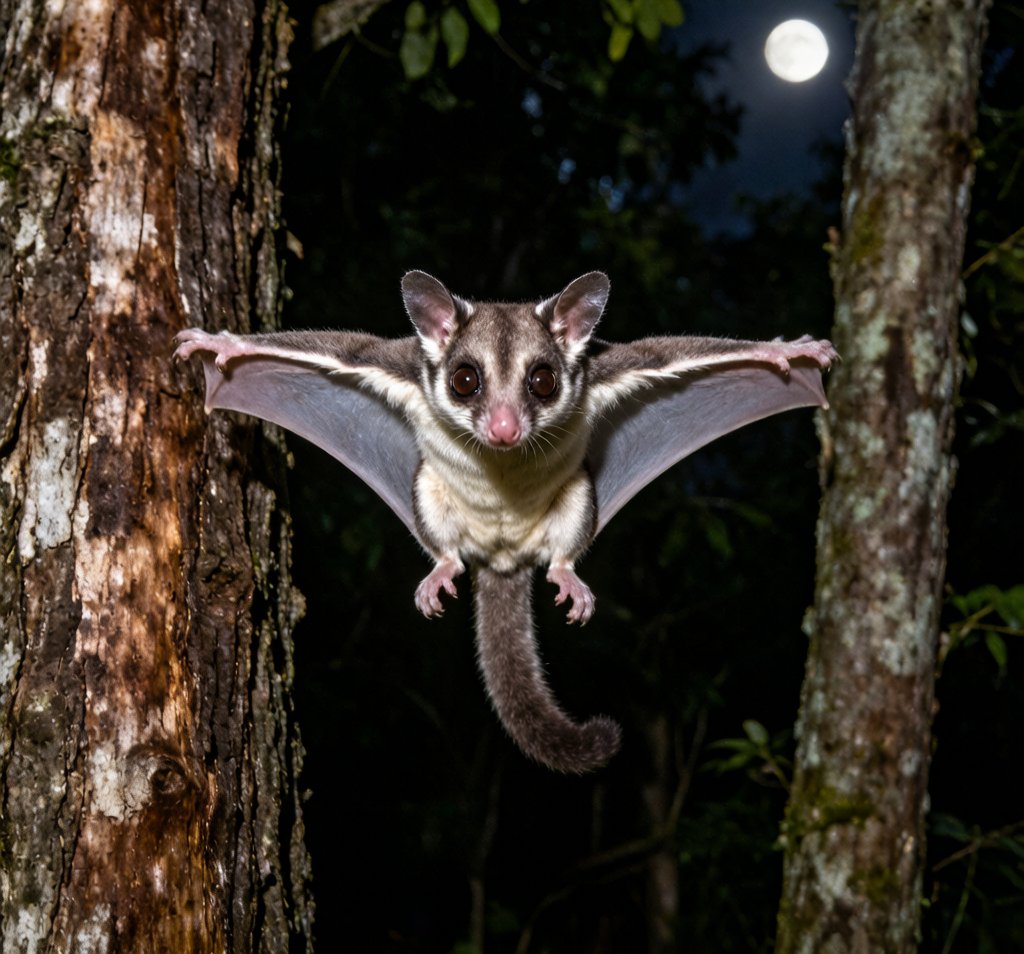
Introduction
The sugar glider (Petaurus breviceps) is a small, nocturnal marsupial native to the forests and woodlands of Australia, New Guinea, and nearby islands. It is named for its fondness for sweet tree sap and nectar and for its ability to glide between trees. Barely larger than a human hand, it spends its days hidden in leafy nests and emerges at dusk to forage. As a marsupial, it is more closely related to the red kangaroo than to any placental mammal. In recent decades it has become popular in the pet trade, though in the wild it remains a highly social and endlessly active animal.
Taxonomy
The sugar glider belongs to the family Petauridae, which also includes the striped possum and Leadbeater’s possum. Within the genus Petaurus it is the most widespread species, and up to seven subspecies have been described across its range. Recent genetic research suggests that some island populations once assigned to this species may actually be separate species, a reminder that molecular tools continue to reshape taxonomy. The scientific name Petaurus breviceps means “short-headed rope-dancer,” referring to the animal’s acrobatic movement and its short, rounded head.
Physical Characteristics
Adults measure 16 to 21 centimeters from nose to tail tip, with the tail making up nearly half of that length, and weigh 90 to 160 grams. The fur is gray-brown above with a dark dorsal stripe, and the underside is pale. Its most distinctive feature is the gliding membrane, a furred flap of skin stretching from the wrists to the ankles. When the animal leaps, it spreads this membrane into a square sail and glides up to 50 meters, steering with its tail. Although tiny beside the blue whale, the sugar glider has mastered a form of movement few mammals can match.
Habitat
Sugar gliders live in a wide range of forested habitats, from tropical rainforest to dry eucalypt woodland, up to about 3,000 meters in elevation. They are most abundant where hollow-bearing trees provide nesting sites. A family group defends a home range of one to several hectares and moves through the canopy in search of food. Gliding lets them travel between scattered trees without descending to the ground, where they are vulnerable. They depend on intact forest, and habitat fragmentation is a growing concern across much of their range.
Diet
The sugar glider is an opportunistic omnivore. It feeds on the sap and gum of eucalyptus and acacia trees, gouging notches in bark with its lower incisors so that sweet exudates flow, and it also takes nectar, pollen, insects, and spiders. This mixed diet provides sugars for energy and protein for growth, and it resembles the flexible, take-what-is-available feeding strategy of a brown bear. Because they depend on flowering and sap flow, sugar gliders are sensitive to drought and fire, which can strip the forest of its food supply for months.
Reproduction
Females carry their tiny young in a well-developed pouch, as is typical of marsupials. After a gestation of about 16 days, one or two joeys, each smaller than a grain of rice, crawl into the pouch and attach to a teat for roughly two months. Once they leave the pouch, the young ride on the mother’s back and remain dependent for several more weeks. Unusually among marsupials, the father also helps carry and groom the young. Sexual maturity is reached at about one year of age, and in warm regions breeding can occur throughout the year.
Conservation
The sugar glider is listed as Least Concern by the IUCN thanks to its wide range and large population, but local declines have occurred where forests are cleared, and island populations are vulnerable. Bushfires, now more frequent and severe in Australia, add further pressure, echoing the climate-driven threats already faced by the polar bear. The pet trade also raises concerns about wild-caught animals. Protecting woodland corridors and hollow-bearing trees is essential to keep this small marsupial common in the wild.
Fun Facts
A sugar glider can glide more than 60 times its own body length and change direction in mid-air by adjusting its limbs and tail. Groups groom one another for hours to strengthen social bonds, and their calls include churring, crabbing, and a sharp hiss. Early European naturalists mistook the animal for a flying squirrel until the pouch revealed its true marsupial nature. Habitat loss affects animals of every size, from the smallest glider to the African elephant, so preserving whole ecosystems benefits all of them together.