 By st20113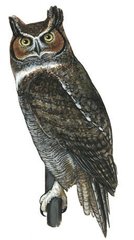
Introduction
The great horned owl (Bubo virginianus) is a powerful, widespread raptor of the Americas, often called the tiger of the woods for its fierce hunting style. Recognizable by its large size, earlike feather tufts, and deep hooting call, it ranges from Arctic tundra to tropical forests. A supremely adaptable predator, the great horned owl occupies deserts, swamps, grasslands, and city parks alike. Unlike the ground-dwelling ostrich of Africa, this owl rules the night sky as a silent, lethal hunter.
Taxonomy
Great horned owls belong to the family Strigidae, the typical owls, within the genus Bubo, which includes the large eagle owls of the world. The species Bubo virginianus was first described by Gmelin in 1788 and includes numerous subspecies across its vast range. Closely related forms include the snowy owl of the Arctic tundra and the Eurasian eagle owl. Birds are classified separately from flightless groups such as the emperor penguin of Antarctica, though all are modern avians. The great horned owl’s scientific name reflects its bearded facial discs and virginian origins in early taxonomy. Strigidae owls are among the most widespread nocturnal birds in the Americas.
Physical Characteristics
This owl stands forty-three to sixty-four centimeters tall with a wingspan reaching one hundred forty centimeters and a weight of zero point nine to two point five kilograms. Its plumage is mottled brown and grey, providing superb camouflage against tree bark. Large yellow eyes face forward for binocular vision, and a facial disc funnels sound to asymmetrical ears that pinpoint prey in total darkness. Powerful talons exert enormous grip, crushing victims instantly. The king penguin of the southern oceans is flightless and built for diving, a stark contrast to this airborne hunter.
Habitat
Great horned owls occupy an extraordinary range of habitats, from dense forests and open woodlands to deserts, marshes, and suburban edges. They need only cavities or old nests of other large birds in which to raise young. These owls are nonmigratory, holding territories year round and tolerating both extreme cold and intense heat. The emu of Australia and the ostrich of Africa also thrive in open country, but as flightless runners rather than fliers. In North America the species adapts readily to farmland and parks, often nesting near human settlement. Its versatility explains a distribution stretching from the boreal north to the southern tip of South America across countless ecosystems.
Diet
Great horned owls are generalist carnivores, taking mammals from mice and rabbits to skunks and young raccoons, plus birds, reptiles, amphibians, and large insects. They hunt by perching silently and dropping onto prey, aided by soft feathers that permit near-silent flight. Unlike the fish-eating emperor penguin, the owl captures terrestrial and airborne prey with equal skill. Pairs often hunt cooperatively during the breeding season to feed hungry chicks. This broad diet buffers the species against prey shortages, allowing it to persist where more specialized raptors might fail during hard winters or drought conditions.
Reproduction
Breeding begins in late winter, unusually early for northern raptors. Great horned owls do not build their own nests but seize old hawk, crow, or squirrel nests, sometimes even chimneys and ledges. Females lay two or three eggs, incubated primarily by the mother for about thirty days while the male delivers food. Chicks fledge at seven weeks but remain dependent for months, learning to hunt under parental guidance. The king penguin and the emperor penguin invest far longer in single chicks on Antarctic ice, contrasting with this owl’s quicker cycle. High juvenile mortality is offset by the species’ longevity, as adults may survive more than a decade in the wild under favorable conditions.
Conservation
The great horned owl is listed as Least Concern, with stable populations across most of its immense range. It benefits from human-altered landscapes that provide edge habitat and abundant prey such as rodents. Historically persecuted as a predator of poultry and game, the species is now protected by law across much of the Americas. Collisions with vehicles, poisoning from rodenticides, and loss of large nesting trees pose local threats. The ostrich and the emu face different pressures as flightless birds, yet all depend on habitat continuity. Continued monitoring ensures that this apex nocturnal predator remains a common, healthy presence in forests, fields, and neighborhoods alike.
Fun Facts
Great horned owls can rotate their heads up to two hundred seventy degrees thanks to specialized neck vertebrae and a unique blood supply. Their hoot, a classic sound of the wilderness, carries for kilometers on still nights. The snowy owl and the great horned owl occasionally clash where territories meet in the north. These birds swallow prey whole and later cough up tidy pellets that scientists study to map local food webs. Perhaps most surprising, a great horned owl can take prey larger than itself, including skunks that other predators wisely avoid because of their potent defensive spray.