 By st20113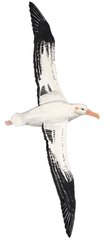
Introduction
The Wandering Albatross (Diomedea exulans) is one of the most extraordinary birds on Earth, with the largest wingspan of any living bird — reaching up to 3.5 meters. It is a master of the open ocean, spending the vast majority of its life in flight above the most remote stretches of sea on the planet. Often called the “royal albatross,” this magnificent seabird has inspired countless legends, most famously in Samuel Taylor Coleridge’s poem “The Rime of the Ancient Mariner.” Like all 22 albatross species, it is globally threatened, with populations declining due primarily to mortality on fishing hooks.
Taxonomy
The Wandering Albatross belongs to the family Diomedeidae, which includes all albatross species. The genus name Diomedea references the mythological Greek hero Diomedes, whose companions were said to be transformed into birds. The species name exulans means “wanderer” in Latin, applied by Carl Linnaeus in 1758 to capture the bird’s extraordinary tendency to roam across the world’s oceans. The family Diomedeidae diverged from other procellariiform birds approximately 40 to 50 million years ago. Currently, most authorities recognize the Wandering Albatross as a single species.
Physical Characteristics
The Wandering Albatross is one of the largest flying birds in the world, with a body length of 110 to 135 centimeters and a wingspan that can exceed 3.5 meters — surpassed only by the Southern Royal Albatross. Its body is predominantly white, with a pinkish-grey to orange bill and dark wingtips. Young birds are dark brown and progressively lighten to white over 5 to 10 years. The wing anatomy is a masterpiece of evolutionary engineering: bones are reinforced with a lattice of bony struts, and the shoulder joint has a unique locking mechanism allowing the wings to be held extended without muscular effort.
Habitat
The Wandering Albatross is a pelagic species, spending the vast majority of its life over the open ocean. Its global range encompasses the Southern Ocean and adjacent waters of the Atlantic, Indian, and Pacific oceans, from Antarctic waters south to approximately 30 degrees south latitude during the breeding season. Breeding occurs on sub-Antarctic islands with tussock grass, including South Georgia, Marion Island, Prince Edward Island, Crozet Islands, and Kerguelen Island. These remote islands provide relatively predator-free breeding habitat on exposed ridges and hillsides where strong winds facilitate take-off and landing.
Diet
The diet of the Wandering Albatross is dominated by squid, which constitutes the majority of its food intake by both weight and caloric value. Fish and crustaceans including krill make up a smaller but significant portion. Carrion from fishing vessels is an increasingly important food source in some regions. Like the Osprey, the species feeds exclusively at the ocean surface, either by surface seizing or by shallow plunge-diving. Individuals can travel over 3,000 kilometers in a single foraging trip lasting up to three weeks, exploiting scattered and unpredictable prey across enormous expanses of ocean.
Reproduction
The Wandering Albatross is one of the slowest-breeding birds in the world, rivaled by the Emperor Penguin, with a breeding cycle that spans nearly two years from egg-laying to fledging. Successful pairs take a full year to raise a single chick before breeding again the following season. Courtship involves elaborate dances with synchronized gestures. Pairs bond for life and reunite at the same nest site year after year. A single white egg is laid in October or November in a nest of grasses, moss, and mud. Both parents share the 75-day incubation, with shifts lasting 1 to 3 weeks. The chick is fed by both parents for approximately 280 days.
Conservation
The Wandering Albatross is classified as Vulnerable on the IUCN Red List, with population declines documented at most major breeding sites. The primary threat is incidental mortality on fishing hooks, particularly in pelagic longline fisheries. Albatrosses are attracted to fishing vessels by offal and many are drowned when they dive on baited hooks. The species is protected under the Agreement on the Conservation of Albatrosses and Petrels (ACAP), which commits signatory nations to reducing seabird bycatch. Bird-scaring lines and night-setting in longline fisheries have significantly reduced mortality in some managed fisheries.
Fun Facts
The Wandering Albatross holds the record for the largest wingspan of any living bird, with confirmed measurements reaching 3.7 meters from tip to tip. Its ability to fly for hours or even days without a single wingbeat relies on dynamic soaring, exploiting wind speed differences between the ocean surface and higher altitudes. GPS tracking has recorded individuals traveling more than 100,000 kilometers in a single year. The species forms lifelong pair bonds with elaborate courtship dances of more than 25 distinct movements and can sleep while in flight by shutting down one brain hemisphere at a time.
[…] while weighing little more than a kilogram. Its mastery of the air rivals that of the wandering albatross, and it is considered one of the most accomplished fliers in the bird […]