 By st20113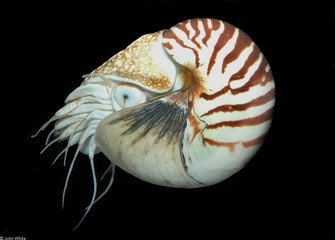
Introduction
The chambered nautilus (Nautilus pompilius) is one of the most ancient and enigmatic creatures inhabiting Earth’s oceans, a living representative of a lineage that first appeared in the fossil record over 500 million years ago — long before the first dinosaurs walked the land. Often called a living fossil, the nautilus has survived multiple mass extinction events that obliterated countless other species. Its graceful, spiraled shell and mysterious deep-dwelling lifestyle have inspired poets, artists, and naturalists for centuries. The American poet Oliver Wendell Holmes Sr. devoted an entire poem to the nautilus and its beautiful logarithmic shell, marveling at its architectural perfection.
Taxonomy
The chambered nautilus belongs to the class Cephalopoda, the same group that includes octopuses, squids, and cuttlefishes, though it represents an early branch that diverged approximately 500 million years ago. Its full scientific name is Nautilus pompilius, with the species name derived from the Latin for a small trumpet or pipe. Two subspecies are currently recognized: N. p. pompilius, found across the broader Indo-Pacific, and N. p. samoensis, restricted to the waters around Samoa and Fiji. The nautilus is the only extant cephalopod that retains an external shell, a feature lost in all other living members of the class.
Physical Characteristics
The chambered nautilus is renowned for its beautiful, involute shell, which grows to a diameter of 8 to 10 inches (20 to 25 cm) in adult specimens. The shell is divided into internal chambers separated by delicate calcified septa, with the nautilus occupying only the outermost chamber. The shell exterior displays a striking pattern of bold brown and white stripes radiating from the central coil. The nautilus has around 90 retractile tentacles without suckers, equipped with sticky ridges that grip prey. Its eyes are unusual: they lack a lens and form images using a pinhole aperture, analogous to the camera obscura principle. The nautilus precisely regulates gas and liquid in its chambers to control buoyancy.
Habitat
The chambered nautilus inhabits the deep fore-reef slopes and rocky substrate areas of tropical Indo-Pacific coral reefs at depths between 300 and 600 meters, making regular vertical migrations upward at night to hunt in shallower waters. Its range extends across the Indo-Pacific from the Andaman Sea and the Great Barrier Reef to Fiji, Samoa, and the Marshall Islands. The nautilus prefers steep reef slopes and rocky walls that provide the crevices it uses for shelter during daylight hours. Climate change and ocean acidification pose significant long-term threats to nautilus populations. The nautilus shares its habitat with the green sea turtle, which inhabits the shallower reef areas above the nautilus’s daytime range.
Diet
The chambered nautilus is a nocturnal predator and scavenger, using its keen sense of smell to locate food in the darkness of the deep ocean. Its diet consists primarily of crustaceans such as crabs and small shrimp, as well as fish, which it captures using its tentacles and a leathery hood that covers its shell opening when threatened. The nautilus is an opportunistic feeder that will readily scavenge on dead animals that sink to the seafloor. Its beak is well adapted for crushing the shells of crustacean prey. The nautilus has a relatively slow metabolism and can survive for extended periods — up to a year or more in captivity — without feeding.
Reproduction
The chambered nautilus reproduces by laying eggs, among the largest of any marine invertebrate, measuring up to 1.5 inches in length. The female coats each egg with a protective layer of calcium carbonate and deposits it on the substrate in depths between 200 and 500 meters. Development is slow and extended, with eggs hatching after 8 to 14 months — the longest incubation period of any cephalopod. The hatchling emerges as a fully formed miniature of the adult, immediately capable of swimming and hunting independently. This extended development period makes nautilus populations extremely vulnerable to exploitation, as even modest increases in adult mortality translate into prolonged population decline.
Conservation
The chambered nautilus is listed as Vulnerable on the IUCN Red List, reflecting severe population declines documented across much of its range over the past three decades. The primary threats are the international trade in its decorative shell, carved into ornaments and jewelry and sold to tourists across the Indo-Pacific, and accidental bycatch in deep-water fisheries. Nautiluses are particularly vulnerable because of their slow growth rate, late sexual maturity, and low reproductive output. In 2016, all species of nautilus were listed in Appendix II of CITES. Large oceanic species such as the blue whale and the sperm whale demonstrate how international cooperation can help protect vulnerable marine species.
Fun Facts
The nautilus shell follows a near-perfect logarithmic spiral described by the mathematical formula known as the golden ratio, a principle that has fascinated mathematicians, artists, and architects since antiquity. The nautilus’s shell is featured on the reverse side of the American one-dollar coin. Unlike fast-swimming squids and cuttlefishes, the nautilus moves by propelling water from its mantle cavity through a funnel called a hyponome, producing a gentle form of jet propulsion. The nautilus is also prey to formidable ocean predators including the great white shark, which hunts in the deep waters the nautilus calls home.
[…] live in the warm Indo Pacific. Our animal sits in the genus Nautilus. It shares that genus with the Chambered Nautilus, the far better known member of the group. The Chambered Nautilus has a wider range. It reaches […]