 By st20113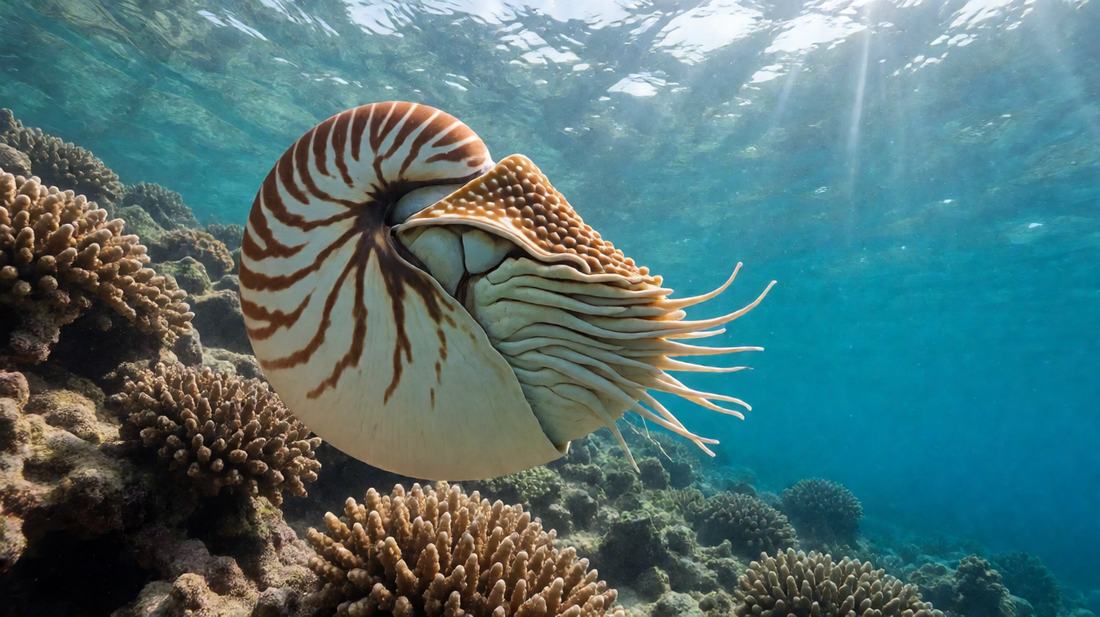
Nautilus macromphalus | Bellybutton Nautilus
Species Profile · Nautilidae
Bellybutton Nautilus
A small nautilus of the deep reef slope around New Caledonia that still carries an outer shell and keeps an open hollow at the centre of its coil.
A deep reef nautilus with a hollow centre to its shell
Shell
Bands
Chambers
Tentacles
Eggs
Depth
The bellybutton nautilus
A living fossil of the reef slope
The Bellybutton Nautilus is a living fossil. It lives on the deep reef slope. It is a cephalopod. It is a cousin of the squid and the octopus. It is the only one of that group with an outer shell. It swims above the reef at night. It sinks into deep water by day.
Its shell is a flat coil of cream and brown. It holds a row of empty chambers. Only the outermost chamber holds the animal. The species lives around New Caledonia and the Loyalty Islands. It is found almost nowhere else. It is far rarer than the Chambered Nautilus. Its shell is collected for the sea curio trade.
That trade is now controlled. The animal is a slow breeder. It is easy to overfish. It is 1 of the finest animals of the coral slope. Very few people ever see it alive.
Family tree
Cephalopoda, Nautilidae
The Bellybutton Nautilus belongs to the phylum Mollusca. It is a member of the class Cephalopoda. It sits in the order Nautilida. Its family is the Nautilidae. The nautiluses are the oldest living group of cephalopods. Their line goes back more than 400 million years. Their shells lie in rock before the first dinosaur.
The family holds only a few species. All of them live in the warm Indo Pacific. Our animal sits in the genus Nautilus. It shares that genus with the Chambered Nautilus, the far better known member of the group. The Chambered Nautilus has a wider range. It reaches from the Philippines to northern Australia. Our animal is smaller.
It carries an open hollow at the centre of its shell. That hollow is the umbilicus. It gives the species its name. Most other nautiluses have a closed centre. The difference is easy to see.
A spiral shell of 30 chambers
How to tell one
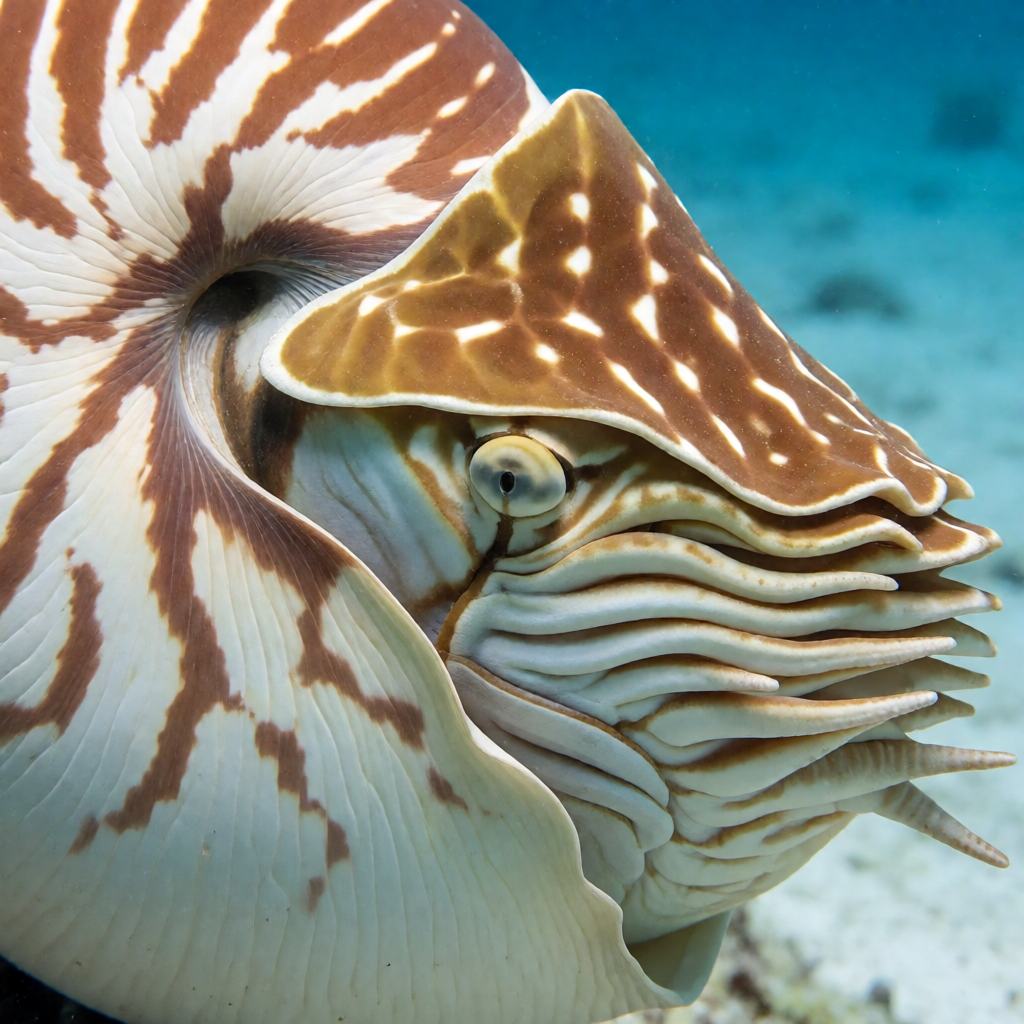
The shell grows to 18 cm across. It is a flat spiral. The colour is cream or white. The outer surface carries 30 to 40 bands of reddish brown. Each band runs from the centre out to the edge. The shell is divided into about 30 chambers. The animal sits in the last and largest one. A thin tube runs from the body through every chamber. The tube is called the siphuncle.
The animal uses it to pump water out and gas in. That is how it changes its depth. The centre of the shell has an open hollow. The hollow is the mark of the species. The head carries about 90 short tentacles. Not one of them has a sucker. Each tentacle is grooved. The whole set works like a pair of hands. The eyes are simple.
They carry no lens at all. They work like a pinhole camera. They take in only light and shadow. The animal has a funnel under the head. It squirts water from the funnel to move. The shell is strong and light. The animal can dive to 300 m without harm.
1
2
3
Deep water by day
Where it lives
The species lives on the outer slope of a coral reef. It is found around New Caledonia and the Loyalty Islands. It also lives around Vanuatu. It keeps to deep water by day. Its usual home lies between 60 m and 300 m down. The water there is cool and dim. At night the animal rises.
It may swim as high as 5 m below the surface. It then hunts over the reef flat. The animal cannot stand bright light. It cannot live in a shallow lagoon. It also needs hard ground. It glues its eggs to rock. The species is uncommon over much of its small range.
It is also slow to spread. The young do not drift far. Divers meet it by night on the reef slope. Most records come from traps set in deep water. A trap left down for a week may hold many animals.
Carrion and small crabs
What it eats
The Bellybutton Nautilus is a hunter. It is also a scavenger. It eats small crabs, shrimps and prawns. It also takes dead fish and other remains. It finds its food by smell. It can follow the scent of a dead animal a long way. It does not chase its prey. It drifts down onto the animal.
It wraps its tentacles around it. The tentacles hold the prey. The strong jaws break it up. The animal has no venom. It has no ink sac of the kind a squid uses. It can bite, but the bite is small. It does no harm to a person. It feeds at night.
It returns to deep water before dawn. A nautilus can go a long time without food. One in a trap survives for weeks on almost nothing. The animal needs very little energy. It swims very slowly. It is 1 of the few reef hunters that lives on carrion.
10 to 20 eggs on a rock
The breeding cycle
The male carries a special tentacle. He uses it to pass a packet of sperm. The female lays 10 to 20 eggs in a season. Each egg is large. An egg is about 4 cm long. It is covered with a hard case. She glues the eggs to a rock in shallow water.
They take about 12 months to hatch. The young animal looks like the adult. It has no larval stage at all. That is unusual among cephalopods. It means the young cannot drift to a new reef. A young nautilus grows very slowly. It may take 5 to 10 years to become an adult.
The animal then breeds more than once. It may live for 15 to 20 years. Few cephalopods live so long. The slow life of the species is its weakness. It cannot stand heavy fishing.
A shell trade under control
Conservation
The Bellybutton Nautilus is not listed as threatened on its own. Its small range is a risk. Its slow breeding is another. The trade in its shell is heavy. The shell is sold as a curio. The whole animal is killed to get it.
Since 2016 all nautiluses sit on Appendix II of CITES. That listing does not ban the trade. It does control it. A seller must show the shells were taken in a legal way. In practice the rules are hard to enforce. The animal is also caught in traps set for fish.
There is no good count of the population. No one knows how fast it falls. The best support for the species is a tight limit on the shell trade. A set of protected reefs would help too. A trap left in deep water for a week may hold a whole catch of dead animals.
Quick hits
Five things to remember
- It is a cephalopod with an outer shell, and its line has lasted more than 400 million years.
- Its shell is divided into about 30 chambers, and the animal lives in the last one.
- It has about 90 short tentacles, and not 1 of them carries a sucker.
- The female lays only 10 to 20 large eggs a season, and each takes about 12 months to hatch.
- Its eyes have no lens at all, so the animal sees only light and shadow.