 By st20113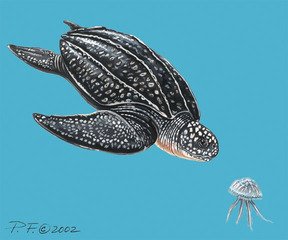
Introduction
The Leatherback Sea Turtle is the largest of all living turtles and one of the most remarkable marine creatures on Earth. Unlike other sea turtles with hard shells, the Leatherback has a flexible, leather-like carapace that allows it to dive to incredible depths. These giants can reach lengths of over 7 feet and weights exceeding 2,000 pounds, making them true ocean giants. Leatherbacks are found in oceans around the world, from tropical waters to the cold seas of the Arctic and Antarctic. They are the only sea turtles that can maintain body temperature above that of the surrounding water, allowing them to venture into frigid waters that would kill other reptiles. These ancient mariners have swum the world’s oceans for over 100 million years.
Taxonomy
The Leatherback Sea Turtle belongs to the family Dermochelyidae and is the only living member of its genus, Dermochelys. Its scientific name, Dermochelys coriacea, refers to its leathery skin covering. Unlike other sea turtles in the family Cheloniidae, Leatherbacks represent a completely different evolutionary lineage that diverged from other turtles over 110 million years ago. They are the sole survivors of a once-diverse group of leatherback turtles. This unique evolutionary history makes them particularly important for understanding turtle evolution. While the green sea turtle represents typical sea turtle anatomy, the Leatherback shows how evolution can produce radically different solutions to marine life.
Physical Characteristics
Leatherback Sea Turtles are enormous, with adults typically measuring 5 to 7 feet in length and weighing 550 to 1,500 pounds. The largest recorded Leatherback weighed over 2,000 pounds. Instead of a hard shell, they have a carapace covered with leathery skin and embedded with tiny bones called osteoderms. Seven distinctive ridges run the length of their carapace, streamlining their body for efficient swimming. Their front flippers can span over 8 feet, making them powerful swimmers capable of crossing entire oceans. Unlike the hard-shelled giant tortoise, Leatherbacks have evolved for speed and deep diving. Their throat contains backward-pointing spines that help them swallow slippery jellyfish, their primary prey.
Habitat
Leatherback Sea Turtles have the widest geographic range of any reptile, found in all tropical and temperate oceans and even into Arctic waters. They spend most of their lives in the open ocean, only coming ashore to nest on sandy beaches in tropical regions. Major nesting sites include beaches in Costa Rica, Papua New Guinea, Malaysia, and the Caribbean. Leatherbacks are highly migratory, traveling thousands of miles between feeding and nesting areas. They can dive to depths of over 4,000 feet, deeper than any other turtle species. Their ability to tolerate cold water allows them to feed in waters where the blue whale also feeds on krill and small organisms.
Diet
Leatherback Sea Turtles are specialized predators that feed almost exclusively on jellyfish and other soft-bodied invertebrates. They consume enormous quantities of jellyfish, with adults eating their body weight in prey daily during feeding seasons. Their delicate, scissor-like jaws are perfectly adapted for slicing through jellyfish tissue. The backward-pointing spines in their throat prevent slippery prey from escaping. Leatherbacks play an important ecological role by controlling jellyfish populations, which have been increasing in some areas due to overfishing of jellyfish predators. They locate prey using their excellent vision and sensitive whisker-like structures on their lips. Unlike the orca which hunts large prey, Leatherbacks focus on abundant soft-bodied organisms.
Reproduction
Leatherback Sea Turtles reach sexual maturity at 15 to 30 years of age, one of the longest maturation periods of any reptile. Females return to their natal beaches every 2 to 3 years to nest, often traveling thousands of miles to reach them. They nest at night, digging deep body pits in the sand before excavating an egg chamber. Each nesting season, a female may lay 6 to 9 clutches of 60 to 90 eggs each. The eggs incubate for about 60 days before hatchlings emerge and scramble to the sea. Temperature determines the sex of hatchlings, with warmer temperatures producing females. Leatherbacks face numerous threats during reproduction, from predators to human disturbance, unlike the narwhal which gives live birth in water.
Conservation
The Leatherback Sea Turtle is listed as Vulnerable globally, with some populations critically endangered. Pacific populations have declined by over 95% in recent decades due to egg harvesting, bycatch in fishing gear, and habitat destruction. Other major threats include plastic pollution, as Leatherbacks often mistake plastic bags for jellyfish and can die from ingesting them. Climate change poses additional threats through rising sand temperatures that skew sex ratios of hatchlings and rising sea levels that erode nesting beaches. International conservation efforts include protecting nesting beaches, reducing fisheries bycatch, and banning plastic bags in some countries. Conservation of Leatherbacks requires global cooperation due to their migratory nature.
Fun Facts
Leatherback Sea Turtles can hold their breath for up to 85 minutes when resting, though typical dives last 3 to 8 minutes. They can swim at speeds up to 22 miles per hour, making them among the fastest swimming reptiles. Their blood contains special adaptations that allow them to survive deep dives without getting decompression sickness. Leatherbacks can see in both air and water and have excellent night vision. The temperature inside their nests can determine the ratio of male to female hatchlings. These ancient creatures have remained virtually unchanged for millions of years, representing one of evolution’s most successful designs for ocean life.