 By st20113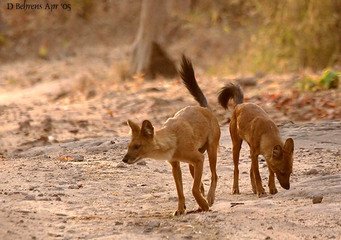
Introduction
The dhole (Cuon alpinus), also known as the Asiatic wild dog, red dog, or whistling hunter, is a highly social and endangered canid native to the forests and mountains of Asia. Smaller than a Gray Wolf but larger than a fox, the dhole is a formidable pack hunter capable of bringing down prey many times its size. Found from the Russian Far East through India and Southeast Asia, the dhole is known for its coordinated hunts, distinctive whistling calls, and remarkable endurance across rugged terrain.
Taxonomy
The dhole is the sole living member of the genus Cuon within the family Canidae. Although it resembles a typical dog, its biology is distinctive: it has fewer teeth than other canids and a more rounded skull. Genetic evidence places it as a sister lineage to wolves, jackals, and African wild dogs, rather than directly within the wolf line. Its closest ecological and evolutionary counterparts among canids include the African Wild Dog and various wolf species, all of which are similarly social pack hunters.
Physical Characteristics
Dholes are slender, athletic canids measuring 90 to 110 centimeters in body length, with a bushy tail of about 40 to 50 centimeters, and standing 42 to 55 centimeters at the shoulder. Adults weigh between 12 and 20 kilograms. Their coat is typically reddish-tawny on the back, fading to cream or white on the belly, chest, and paws, with a dark, brush-like tail tip. Their rounded ears are short, and unlike many relatives their jaws have only six cheek teeth per side, an unusual reduction among dogs. Their build closely resembles that of the Red Fox in coloration but is far more robust.
Habitat
Dholes occupy a wide range of habitats, including deciduous and evergreen forests, scrubland, and alpine meadows up to 4,000 meters. They are most abundant in central and south Asian forests but historically ranged from the Kazakh steppe to Java. They require sufficient prey and cover, and they avoid dense human settlement. Unlike the open-country Maned Wolf of South America, the dhole is fundamentally a forest and woodland predator that relies on stealth and teamwork among trees.
Diet
Dholes are carnivorous and hunt in coordinated packs that can number from five to over twenty individuals. Their prey includes deer, wild boar, goats, and smaller mammals and birds, and they are among the few predators able to tackle large ungulates cooperatively. They often compete with and occasionally displace Bengal Tiger and leopards, sometimes driving bigger cats off kills. Packs use incredible stamina to chase prey over long distances, and they communicate with whistles, clicks, and screams rather than the long howls typical of wolves.
Reproduction
Breeding usually occurs once a year, with pups born after a gestation of about 60 to 63 days. Litters are large, often six to eight pups but sometimes more than ten, among the largest of any canid. The entire pack participates in rearing, with non-breeding adults bringing food to the mother and pups at the den. This cooperative breeding boosts pup survival and binds the pack tightly together. Young dholes reach maturity in one to two years and may disperse or remain to help raise future litters.
Conservation
The dhole is listed as Endangered by the IUCN, with a fragmented population estimated at only a few thousand adults. Major threats include habitat fragmentation, prey depletion from hunting, competition with domestic dogs, and disease. Conservation efforts focus on protecting forest corridors and prey bases across its range. As an apex pack predator, the dhole plays a vital role in regulating herbivore populations, and its decline signals broader ecosystem stress.
Fun Facts
Dholes are nicknamed ‘whistling hunters’ because they use a rich vocabulary of whistles to keep the pack in contact during hunts. They can leap over obstacles up to 2 meters high and are among the most tireless runners in the cat-dog world. A dhole pack will sometimes share food by regurgitating meals for pups and den-bound adults, a behavior rare among wild dogs. Despite their fearsome reputation, dholes are shy around humans and are rarely seen, which is one reason they remain poorly understood compared with wolves.