 By st20113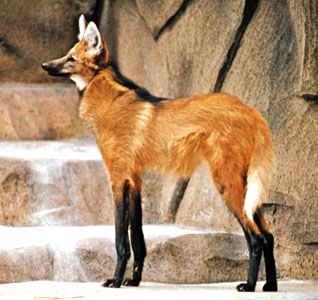
The Maned Wolf (Chrysocyon brachyurus) is the tallest wild canid in the world, native to the grasslands, wetlands, and scrub forests of South America. Despite its name, it is not closely related to true wolves. It is the only species in the genus Chrysocyon (“golden dog”), representing a distinct evolutionary lineage within Canidae that diverged approximately 6–7 million years ago.
Physical Characteristics: Standing approximately 90 cm at the shoulder, the Maned Wolf’s most distinctive feature is its remarkably long, slender black legs—the longest of any canid relative to body size—an adaptation for hunting in tall grasslands. The coat is a striking reddish-golden with black legs, muzzle, and a prominent erectile black mane along the neck and back.
Habitat and Distribution: Found primarily in Brazil (where the majority of the population occurs), and also in Bolivia, Paraguay, Argentina, and Peru. They inhabit the cerrado—a vast tropical savanna characterized by mixed woodland, grassland, and wetland habitats, requiring large home ranges of 20–80 km².
Diet: Unlike true wolves, Maned Wolves are solitary hunters and do not form packs. Up to 50% of their diet consists of fruits and vegetables, particularly wolf’s apple (Solanum lycocarpum), making them important seed dispersers. Their diet also includes small mammals, birds, and reptiles.
Conservation Status: Listed as Vulnerable by the IUCN. Major threats include habitat loss due to agricultural expansion, road mortality, and disease transmitted from domestic dogs.
[…] require sufficient prey and cover, and they avoid dense human settlement. Unlike the open-country Maned Wolf of South America, the dhole is fundamentally a forest and woodland predator that relies on stealth […]