 By st20113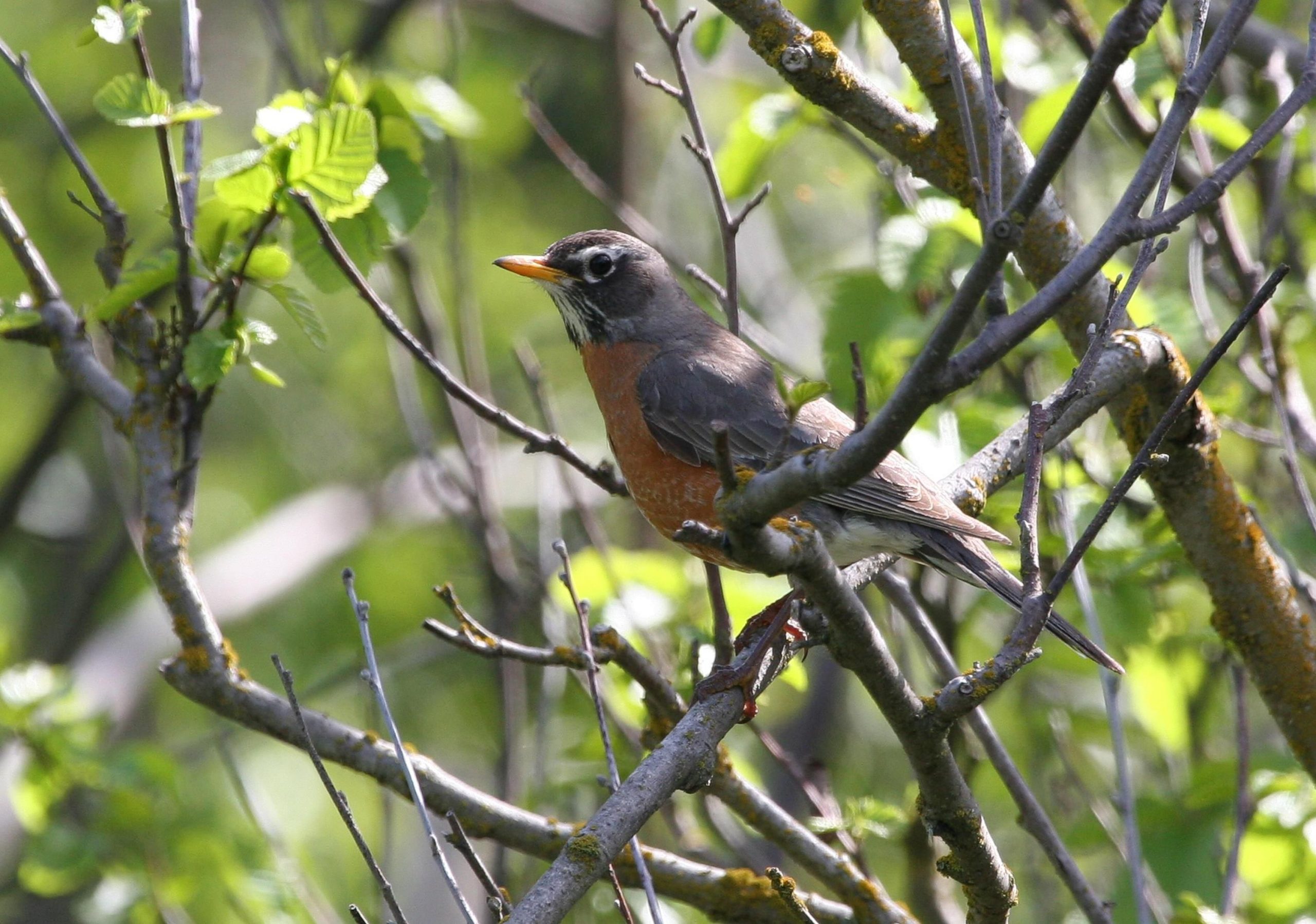
Introduction
The American Robin (Turdus migratorius) is one of the most widespread and familiar birds in North America, easily recognized by its orange-red breast, gray back, and cheerful, warbling song. A member of the thrush family, it is often considered a harbinger of spring, though many populations remain through the winter in milder regions. Robins thrive in lawns, parks, woodlands, and gardens, where they forage conspicuously for earthworms and insects.
The robin’s adaptability has made it a constant presence across the continent, from Alaska to Mexico. It often shares suburban habitats with the Northern Cardinal, and both are common sights at backyard feeders and on grassy lawns.
Taxonomy and Classification
The American Robin belongs to the family Turdidae, the thrushes, and the large genus Turdus, which includes hundreds of thrush species worldwide. Its scientific name, Turdus migratorius, references its historical reputation as a migratory bird. Seven subspecies are recognized, varying in size and plumage across its range.
Despite its name, the American Robin is not closely related to the European Robin, which is a small chat in the family Muscicapidae. The resemblance is superficial, based on the shared orange breast rather than true kinship.
Physical Characteristics
American Robins measure 23 to 28 centimeters in length and weigh 77 to 85 grams. Adults have a brownish gray head and back, a warm orange-red breast and belly, and a white lower belly and undertail. The bill is yellow in adults and darker in juveniles, which also show heavy spotting on the breast.
Males are typically brighter and slightly larger than females. Robins have strong legs for running and hopping on the ground, and their upright posture and alert gaze make them easy to identify as they tilt their heads to listen for worms.
Habitat and Distribution
American Robins occupy an extraordinary range of habitats, from Arctic tundra to subtropical forests, including cities, farms, mountain meadows, and open woodlands. They are found across North America and into Central America during winter.
They breed farther north than almost any other thrush and winter as far south as Guatemala. In open country, robins may gather in large flocks near water, sometimes sharing wetland edges with the Sandhill Crane during migration, though the crane uses the same marshes for resting while the robin forages the nearby grass.
Diet and Behavior
Robins are omnivorous but strongly tied to invertebrates, especially earthworms, which they pull from moist soil. They also eat beetles, caterpillars, and a wide variety of fruits and berries, the latter becoming the bulk of the diet in fall and winter.
Their foraging behavior is iconic: a robin hops, tilts its head, spots prey, and then lunges to seize it. They are social outside the breeding season, forming flocks that roost communally in trees and shrubs by the thousands.
Reproduction and Life Cycle
Robins build a neat cup nest of grass, mud, and twigs, usually on a ledge, in a fork of a tree, or on a structural shelf. The female lays three to five pale blue eggs, sometimes called robin’s egg blue, and incubates them for about 12 to 14 days.
Both parents feed the nestlings, which fledge at 13 to 16 days. Robins commonly raise two or three broods per season, and young from early broods may help feed later siblings. The species reaches breeding maturity in its first year.
Conservation Status
The American Robin is listed as Least Concern, with one of the largest populations of any North American songbird, estimated in the hundreds of millions. It tolerates human presence extremely well.
Threats include pesticide use that reduces insect prey, window strikes, and predation by cats, but the overall trend is stable. Its abundance makes it an important indicator of ecosystem health in many regions.
Fun Facts
A robin’s egg blue color comes from biliverdin, a pigment also found in bile, and may help camouflage the eggs in dappled nest shade. Robins can produce three broods in a single season under good conditions.
The species is an excellent runner on the ground and a strong migratory flier. Near rivers and lakes, the American Robin sometimes forages close to the Great Blue Heron, a tall wading bird that stalks fish in the same shallow waters, though the two species ignore each other as they hunt different prey.
Anaconda | Eunectes murinus American Robin | Turdus migratorius Northern Cardinal | Cardinalis cardinalis Blue Jay | Cyanocitta cristata Sandhill Crane
Blue Heron | Ardea herodias Green Anaconda | Eunectes murinus American Robin | Turdus migratorius Northern Cardinal | Cardinalis cardinalis Blue Jay | Cyanocitta cristata Sandhill Crane