 By st20113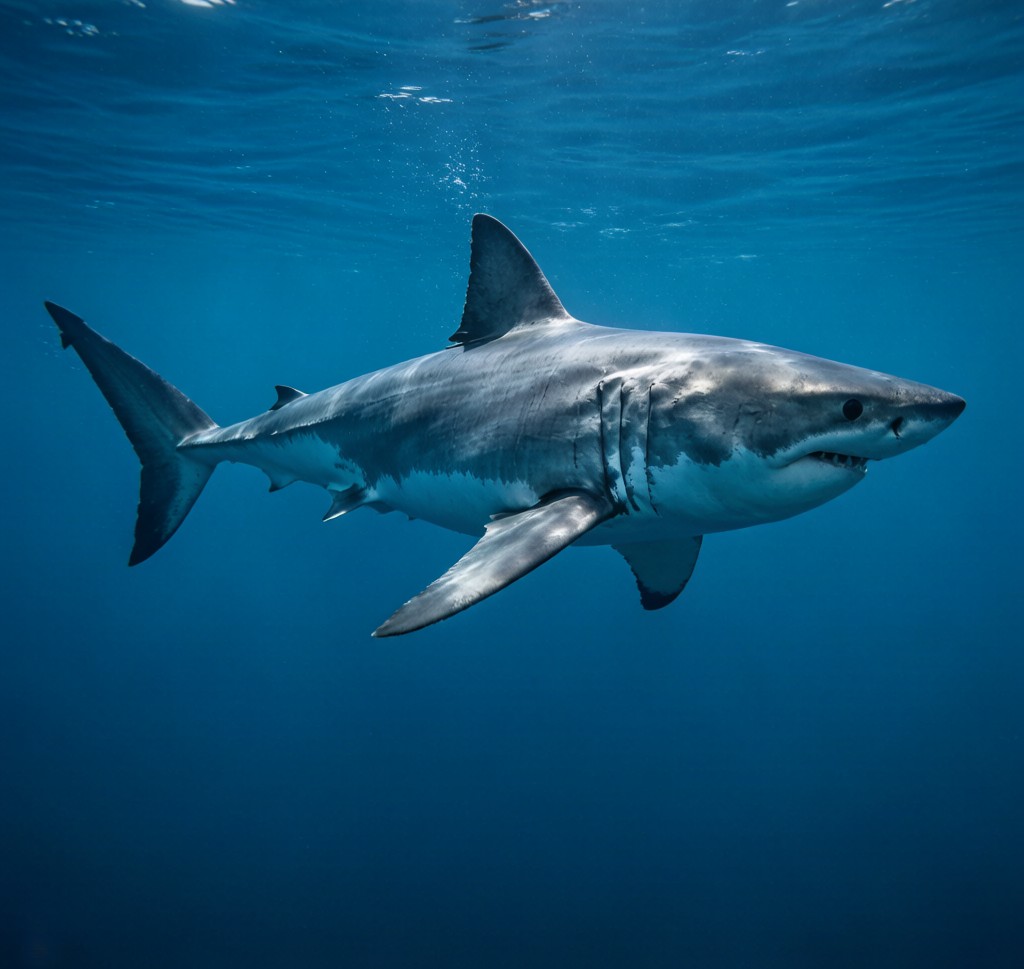
Introduction
The Great White Shark (Carcharodon carcharias) is the world’s largest known predatory fish and one of the most formidable marine predators on Earth. Growing to more than 6 meters and weighing over 2,000 kilograms, it combines speed, power, and finely tuned senses to hunt seals, sea lions, and schooling fish across temperate and subtropical oceans. Its slate-gray back, white belly, and rows of serrated teeth make it instantly recognizable.
Apex predators like the great white help keep ocean food webs in balance. Near coastlines they may share shallow waters with the Great Blue Heron, a tall wading bird that fishes the same estuaries, though the heron works the shallows while the shark patrols deeper channels below.
Taxonomy and Classification
The Great White Shark belongs to the family Lamnidae, the mackerel sharks, and the genus Carcharodon, meaning jagged tooth. Its scientific name, Carcharodon carcharias, repeats the root for sharp tooth, emphasizing its defining feature. It is closely related to the mako and porbeagle sharks.
Despite its fearsome image, it is not a primitive fish but a highly evolved cartilaginous fish, more closely related to rays than to bony fish. Fossil relatives such as the megalodon were even larger, though the great white is the largest living predatory shark.
Physical Characteristics
Great whites have a torpedo-shaped body built for bursts of speed up to 56 kilometers per hour. They average 4 to 5 meters in length, with females larger than males. Their coloration is countershaded: dark gray above to blend with the seabed when viewed from above, white below to disappear against sunlight from below.
They possess around 300 serrated teeth arranged in several rows, replaced continuously throughout life. Specialized organs called ampullae of Lorenzini detect the weak electrical fields of hidden prey, and a network of blood vessels helps them maintain body warmth in cold water.
Habitat and Distribution
Great white sharks inhabit coastal surface waters of all major oceans, favoring temperate regions such as South Africa, Australia, California, Mexico, and the Mediterranean. They undertake long migrations, sometimes crossing entire ocean basins to reach feeding or breeding areas.
They are often found near seal colonies, upwellings, and continental shelves where prey concentrates. Young sharks use shallower, warmer nurseries before moving into deeper adult ranges.
Diet and Behavior
Great whites are apex predators that eat seals, sea lions, large fish, rays, and carrion, with adults specializing in marine mammals. They often hunt with a surprise attack from below, breaching the surface in spectacular leaps when catching seals.
They rely on keen smell, hearing, and electroreception, and they investigate unknown objects with a cautious test bite. Despite popular myth, humans are not preferred prey, and most encounters are exploratory rather than predatory.
Reproduction and Life Cycle
Great whites are ovoviviparous; embryos develop inside the mother, nourished first by yolk and later by unfertilized eggs, with the largest young sometimes consuming siblings. Litters of 2 to 10 pups are born after a gestation estimated at 12 to 18 months.
Newborns measure about 1.2 to 1.5 meters and are independent immediately. They grow slowly, reaching maturity at around 15 years for males and 20 for females, and may live 40 years or more, making them vulnerable to overfishing.
Conservation Status
The Great White Shark is listed as Vulnerable by the IUCN, with populations declining in parts of its range due to bycatch, targeted fishing, and the shark fin trade. Many countries now protect it, and ecotourism has raised its value alive.
As an apex predator, its loss can ripple through entire marine ecosystems. Continued protection, safe migration corridors, and reduced bycatch are key to its recovery.
Fun Facts
A great white can detect a single drop of blood in 25 gallons of water and sense electrical signals from prey hidden in sand. Its teeth are replaced constantly, with thousands produced over a lifetime.
The species can raise its body temperature above the surrounding water, boosting speed and digestion. In shallow seagrass beds it may swim above tiny relatives like the seahorse, a small fish that grips plants with a prehensile tail, the two sharing coastal habitat though one is a giant hunter and the other a gentle drifter.