 By st20113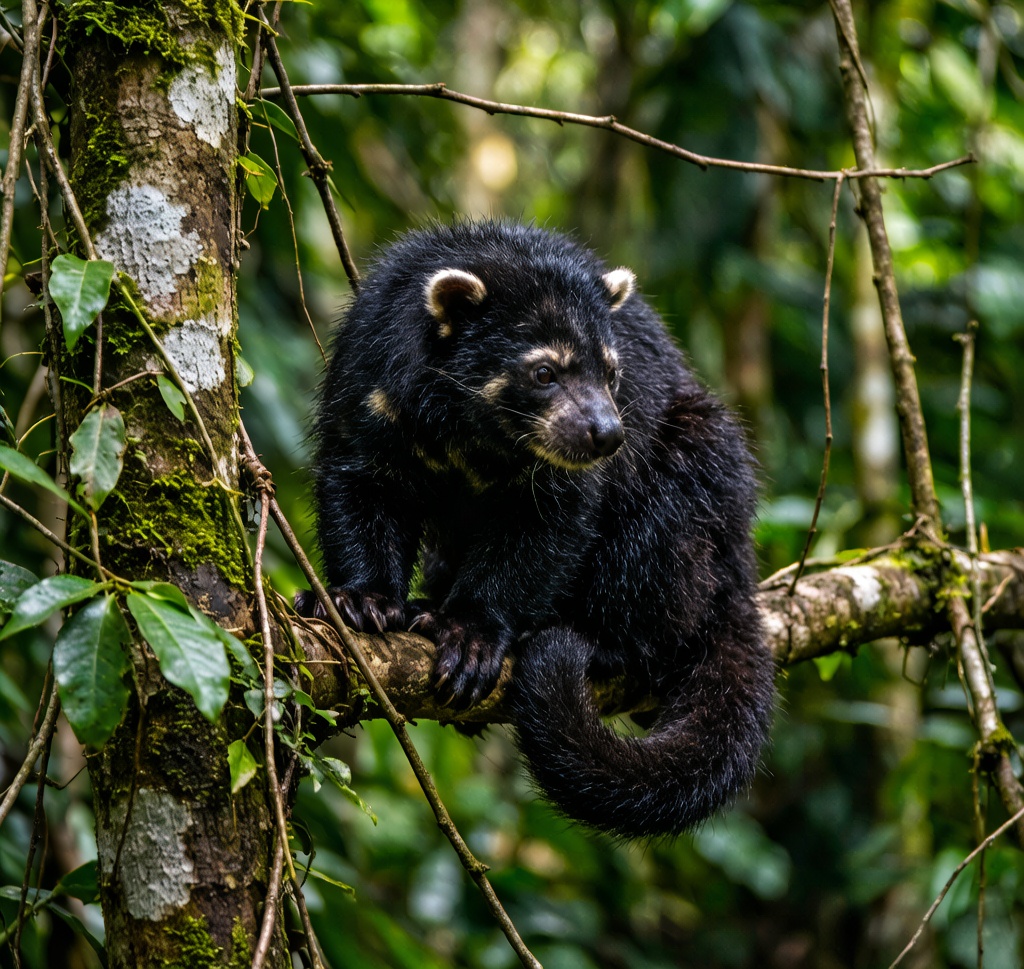
The binturong (Arctictis binturong) — also called the bearcat, despite belonging to neither the bear nor the cat family but to the Viverridae (civet and genet family) — is one of the largest and most unusual carnivores of the Southeast Asian rainforest. With its shaggy black fur, cream-colored ear tufts, distinctive prehensile tail that acts as a fifth limb, and slow, methodical arboreal movements, the binturong occupies a unique ecological niche in the canopy of the Asian rainforest. Perhaps most remarkably, the binturong is one of only two carnivores known to use tool use. Found throughout the rainforests of mainland Asia and the Philippines, the binturong plays an important role as both a seed disperser and predator in the forest ecosystem, consuming large quantities of fruit — particularly figs — and spreading seeds across its range. Despite its unassuming appearance, the binturong faces serious threats from habitat loss and the illegal wildlife trade.
## Physical Characteristics
The binturong is one of the largest members of the Viverridae family, with a body length of 60 to 95 centimeters, plus a long, bushy, prehensile tail of 55 to 90 centimeters, and a weight of 9 to 20 kilograms. Males are typically 10 to 20 percent larger than females. Its fur is long, coarse, and entirely black — providing camouflage in the dark rainforest canopy. The face is marked with distinctive, stiff, cream-colored whiskers and long, pointed, tufted ears. The binturong’s most remarkable feature is its prehensile tail — the longest and most heavily furred of any non-human primate — which is capable of supporting the animal’s entire body weight and is used as a fifth limb for grasping branches. Like many civets and genets, the binturong has scent glands near the base of the tail that produce a distinctive, musky smell reminiscent of popcorn.
## Habitat and Distribution
The binturong is found throughout much of mainland Southeast Asia — from southern China, India, Nepal, and Bangladesh through Myanmar, Thailand, Laos, Vietnam, Cambodia, and Peninsular Malaysia — and on several islands including Sumatra, Java, Borneo, and the Philippines. It inhabits tropical and subtropical broadleaf forests, including primary and secondary rainforest, swamp forest, and forest edges, from sea level up to approximately 600 meters elevation in the Himalayas. The binturong is almost entirely arboreal and spends the vast majority of its life in the forest canopy. Each individual maintains a large home range — typically 4 to 20 square kilometers — marked with scent from its anal glands.
## Behavior and Diet
The binturong is primarily frugivorous, with fruit — particularly figs — constituting approximately 60 percent of its diet. It is one of the most important seed dispersers in Southeast Asian rainforests, swallowing fruit seeds whole and depositing them intact in its droppings. Its diet is supplemented by insects, small mammals, birds, fish, and carrion. The binturong forages slowly and methodically in the canopy, using its excellent sense of smell to locate ripe fruit. It is also one of approximately 100 mammal species that can digest caffeine, allowing it to consume coffee fruit without ill effects. The binturong is one of the few carnivores that can use tools: it has been documented using sticks or leaves to scratch itself.
## Reproduction
Binturongs have one of the longest gestation periods of any carnivore relative to body size — approximately 84 to 99 days. After birth, the female gives birth to one to three (typically one to two) young in a nest in a hollow tree or dense canopy tangle. Newborn binturongs weigh approximately 280 to 310 grams and are covered in fine, light-colored fur. The young are carried on the mother’s back or tail for the first several months of life. Sexual maturity is reached at approximately two to three years of age. Perhaps most remarkably, binturongs exhibit facultative parthenogenesis — females in captivity have given birth without mating with a male, producing viable offspring through asexual reproduction. Captive binturongs have lived up to 25 years.
## Conservation
The binturong is classified as Vulnerable on the IUCN Red List, with populations believed to be declining across most of its range. The primary threats are habitat loss due to deforestation for agriculture, logging, palm oil plantations, and human settlement; and hunting — both targeted poaching for meat and accidental capture in snares set for other animals. The binturong is also targeted for the illegal wildlife trade. Conservation efforts include the protection of remaining rainforest habitat, anti-poaching patrols, and community education programs. The species occurs in numerous protected areas across its range.