 By st20113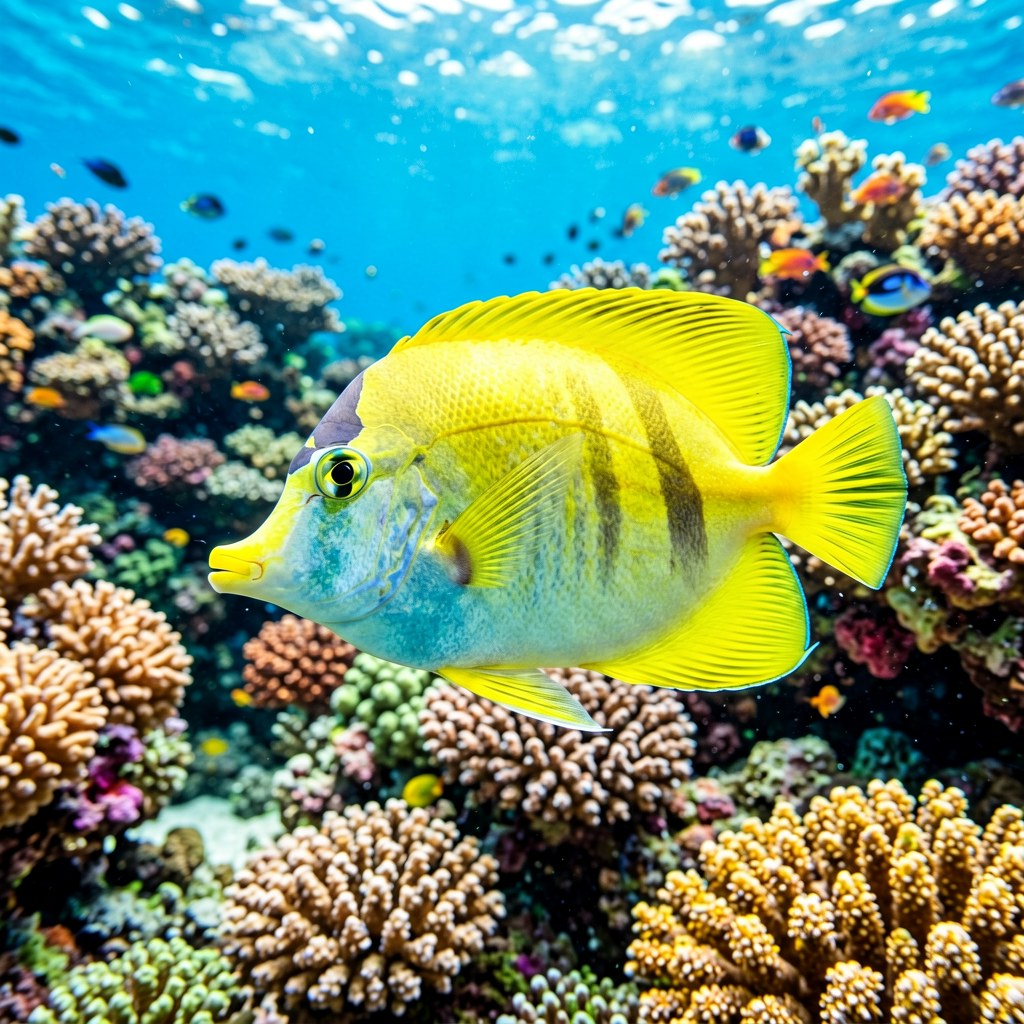
Zebrasoma veliferum | Yellow Tang
Introduction
Zebrasoma veliferum is a strikingly patterned marine surgeonfish in the family Acanthuridae, native to the coral reefs and lagoons of the Indo-Pacific, from East Africa and the Red Sea across to the central Pacific including Hawaii and the Johnston Atoll. Although it is sometimes cataloged under the common name “yellow tang,” the species is more precisely and widely known as the sailfin tang, a name that refers to its enormously tall, sail-like dorsal and anal fins. Reaching lengths of up to 40 centimeters, it is among the largest members of its genus and a favorite of marine aquarists for its bold zebra-like bands and dramatic finnage. Like all surgeonfishes, it bears a sharp, retractable scalpel-like spine on each side of the tail, used in defense. In the wild it is an herbivore that grazes on algae, playing a useful role in keeping reef surfaces clear, and it is generally abundant across its broad range.
Taxonomy
Zebrasoma veliferum was described by the English naturalist Edward Turner Bennett in 1828, who placed it in the genus Zebrasoma—from the Greek for “zebra body”—with the species epithet veliferum meaning “sail-bearing,” a clear reference to its elevated fins. The genus Zebrasoma sits in family Acanthuridae, the surgeonfishes and tangs, within the order Acanthuriformes, a group of predominantly herbivorous reef fishes characterized by the presence of the caudal “scalpel” spine. Molecular and morphological phylogenies place Z. veliferum among the Indo-Pacific zebrasomas, related to the brown tang (Zebrasoma scopas) and the well-known yellow tang (Zebrasoma flavescens) of Hawaii, from which its much taller fins and banding readily distinguish it. A useful comparative fish of coastal waters is the largetooth sawfish (Pristis pristis), described at https://www.gloencyc.com/pristis-pristis-largetooth-sawfish/, which, like the sailfin tang, inhabits warm shallow seas and is a conspicuous member of its ecosystem, though the sawfish is a critically endangered ray rather than a herbivorous perciform. Within Acanthuridae, Zebrasoma species are typified by their disc-shaped, laterally compressed bodies and the single pair of scalpels at the caudal peduncle, traits that make the genus one of the most recognizable reef herbivores.
Physical Characteristics
The sailfin tang is a deep-bodied, strongly compressed fish that can grow to about 40 centimeters in total length, though most adults are somewhat smaller. Its most arresting feature is the greatly enlarged dorsal and anal fins, which in adults rise into tall, sail-like sails that can be taller than the body is deep, giving the fish a striking silhouette when displayed. The body is pale to yellowish, overlaid with several vertical dark bands—typically five to six—that resemble zebra stripes and can intensify or fade with mood and stress. The snout is moderately long and the mouth small, with fine, comb-like teeth suited to scraping algae. As in all surgeonfishes, the caudal peduncle bears a sharp, hinged, scalpel-like spine on each side, bright white or pale, which the fish can flick outward to slash at rivals or predators. Juveniles are proportionally even more elongated in the fins and show sharper banding. Coloration and fin extension are used in both species recognition and threat displays, with agitated fish erecting their sails and positioning the scalpel toward an opponent.
Habitat
Zebrasoma veliferum inhabits the clear, warm waters of the Indo-Pacific, where it is associated with coral reefs, lagoon patch reefs, seaward reef slopes, and occasionally rocky coasts, typically from shallow water down to about 30 meters. It favors areas with abundant coral and rock substrate that support the algal films and turfs on which it feeds, and it is often seen hovering among branching corals or picking at the reef surface. The species ranges widely, from the Red Sea and East Africa through the Indian Ocean to the Pacific, including the Hawaiian Islands, where it is one of several zebrasomas, and across to the central Pacific reefs. It is generally a territorial herbivore, with individuals or pairs defending small algal patches, though it may roam more widely as a juvenile. Like many reef fishes it depends on healthy coral and algal habitat and is sensitive to the degradation of reefs through bleaching, sedimentation, and destructive fishing.
Diet
The sailfin tang is fundamentally an herbivore, feeding mainly on benthic algae, including filamentous algae, turf algae, and various fleshy and calcareous forms that it scrapes from rock and coral with its small, bristle-fringed teeth. In the aquarium trade it is often valued as an algae-control fish for exactly this reason. Its diet helps regulate algal growth on the reef, preventing turfs and filaments from overgrowing corals and maintaining space for coral recruitment, an ecological service performed by many acanthurids. Although algae dominate, the species may incidentally ingest small invertebrates, detritus, and zooplankton associated with the algal mat, and captive animals accept a varied omnivorous diet of prepared foods, algae, and occasional meaty items. Feeding is typically conducted within a defended territory, and the fish uses its laterally compressed body to wedge into crevices while cropping.
Reproduction
Reproduction in Zebrasoma veliferum follows the typical pattern of many surgeonfishes: it is a broadcast spawner with separate sexes and no parental care. During the spawning period, which is often linked to lunar or tidal cycles in coral reef fishes, males establish or patrol territories and court females with displays that involve fin erection and rapid swimming. Spawning itself occurs in the water column, usually at dusk, when a male and female rise together and release eggs and sperm simultaneously into the current, where fertilization takes place externally. The eggs are small, buoyant, and pelagic, and after hatching the larvae enter a planktonic stage that drifts with ocean currents before settling onto the reef as tiny, transformed juveniles. This pelagic larval phase allows dispersal among reefs, though it also means that recruitment depends on suitable habitat being available when larvae return. There is no care of eggs or young, and juvenile survival is governed by the availability of algal habitat and the pressure of predation during the vulnerable settling phase.
Conservation
The sailfin tang is assessed by the IUCN as Least Concern, reflecting its extensive Indo-Pacific distribution, apparent stability across much of its range, and occurrence in numerous marine protected areas. It is not currently subject to the severe threats facing many reef species, though it is caught in varying numbers for the ornamental aquarium trade and, to a lesser extent, local artisanal fisheries, and heavy collection in some regions can depress local populations. Because it depends on coral reef habitat, the species is vulnerable in the long term to the broad pressures degrading reefs worldwide: climate-driven coral bleaching, ocean warming, acidification, coastal development, sedimentation, and destructive fishing. The largetooth sawfish and other flagship species share these waters and these threats, underscoring the need for healthy reef systems. Responsible collection practices, harvest controls where needed, and the expansion of well-enforced marine reserves are the principal conservation measures. Given its wide range and ecological plasticity, the sailfin tang is expected to remain secure provided that reef habitats are protected and the aquarium trade is managed sustainably.
Fun Facts
- The sailfin tang’s dorsal and anal fins can rise into towering “sails” taller than its own body is deep.
- Like all surgeonfishes, it carries a sharp retractable scalpel spine on each side of its tail for defense.
- Its bold vertical bands give it the zebra-like pattern reflected in the genus name Zebrasoma.
- It is a valuable algae-grazer on reefs, helping keep coral surfaces free of overgrowing turf.
- Spawning happens in the open water at dusk, with eggs and sperm released into the current to drift as plankton.