 By st20113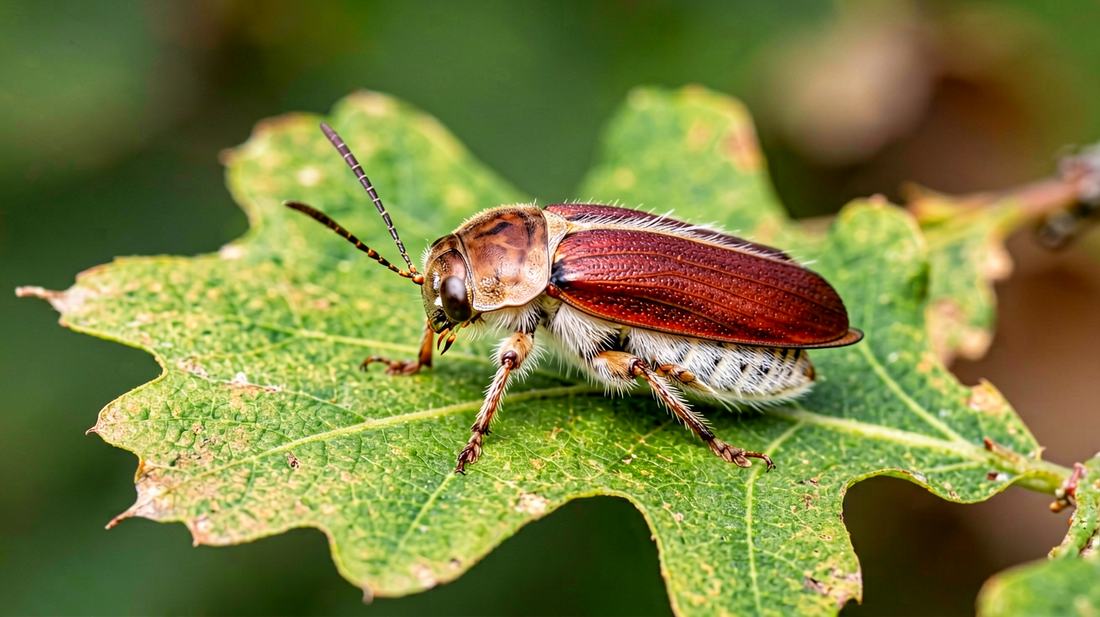
Melolontha melolontha | Common Cockchafer
Species Profile · Scarabaeidae
Common Cockchafer
A heavy brown beetle that blunders into lighted windows in May, and whose fat white grubs spend three or four years eating roots underground.
Not assessed by IUCN
Range
Length
Larvae
Antennae
Cycle
The May beetle
The common cockchafer
The common cockchafer is a heavy, brown, buzzing beetle. It blunders into lighted windows on warm May nights. People greet it with alarm and liking. It is one of the largest beetles in northern Europe. Its body reaches three centimetres long. It flies at dusk in noisy swarms around the tree tops. The adults feed on leaves.
The fat white larvae live underground for three or four years. They eat roots. It is the larvae, not the adults, that made this species a pest. It has been a farm pest for centuries. Cockchafers were once so common that authorities paid bounties. European farmers collected them by the ton. The insects were even eaten and fed to stock.
Their numbers collapsed through the twentieth century. Intensive farming and pesticides caused this. The common cockchafer is now rare or absent across much of Britain. It is scarce in parts of mainland Europe. Its life cycle is slow. Its swarming years are uneven. Watching the species takes patience.
Family tree
Among the scarab beetles
The common cockchafer belongs to the order Coleoptera. It is in the family Scarabaeidae and the genus Melolontha. It is a scarab beetle. Scarabs are one of the largest insect families on earth. Its best-known British relative is the Rose Chafer. That beetle is a smaller, shiny green beetle. It is also a scarab but lives its own life.
Its larvae grow up in rotting wood and leaf litter. They do not live in soil. Both species share the scarab’s stout body and club-tipped antennae. Both pass through a large, slow-growing larva stage and are key recyclers in their habitats. The genus Melolontha holds about twenty species across Europe and Asia. Two of them live together in central Europe: the common cockchafer and the forest cockchafer. They are best told apart by the shape of the tail end.
The family Scarabaeidae includes dung beetles, chafers and rhino beetles. The group is known for fan-like plates at the antenna tip. These plates detect scent. Linnaeus described the common cockchafer in 1758. Its scientific name has been used ever since.
Antennae, plates and patches
How to identify one
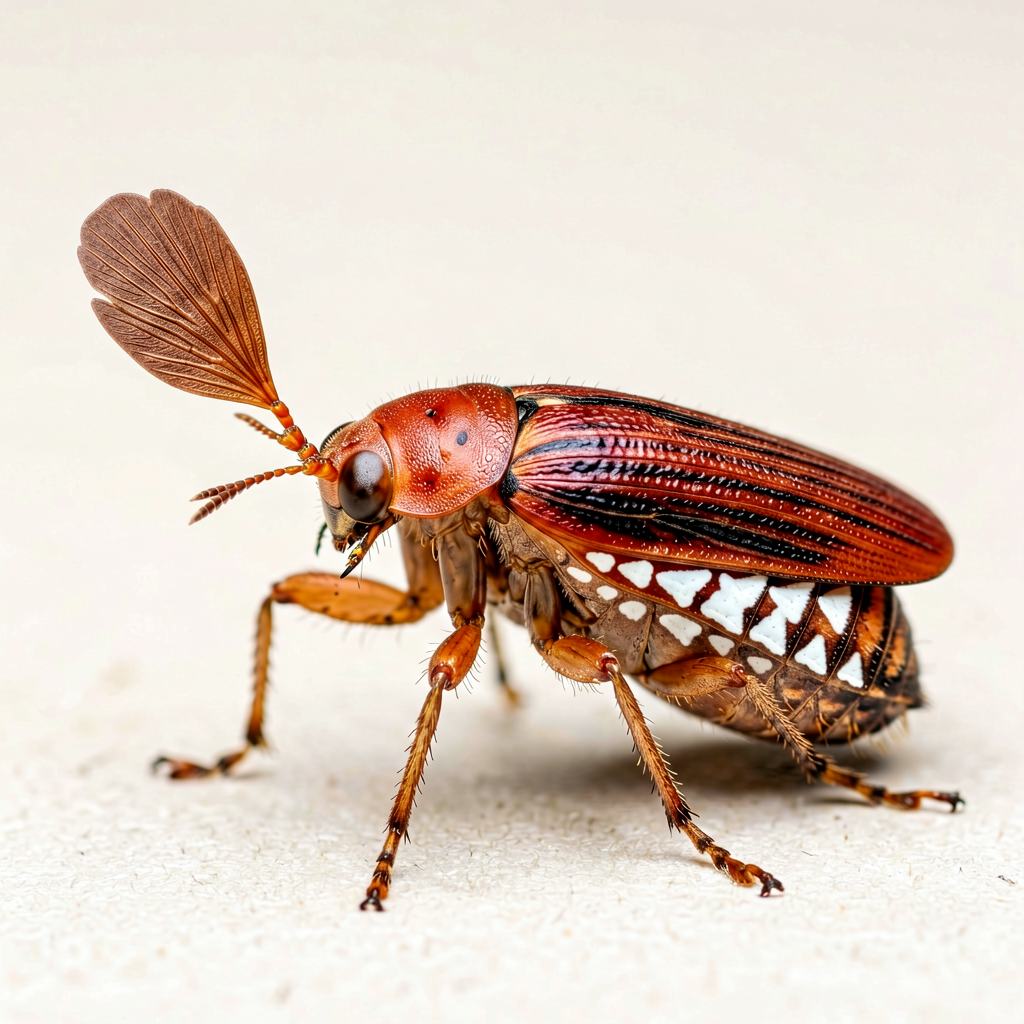
An adult common cockchafer is 25 to 30 millimetres long. It has a broad, slightly flat body. A dense coat of fine greyish hairs covers it. The wing cases, or elytra, are reddish-brown. They show darker ridges. The thorax carries a dark, hairy patch in the centre. The clearest mark is a row of white wedge-shaped patches. They run along each side of the abdomen. You can see them when the beetle is held.
You can also see them when it spreads its wing cases to fly. The antennae end in a fan of flat plates. These plates open and close. This is the simplest way to tell the sexes apart. Males have seven plates on each antenna. Females have six. The legs are strong and toothed. They suit burrowing and gripping leaves and branches. The larvae are fat, white, C-shaped grubs.
They have a brown head capsule and three pairs of legs. A fully grown grub reaches 40 to 50 millimetres. It is one of the largest soil-dwelling larvae in Europe. Growth from egg to adult takes three or four years. The larva moults a few times. It moves deeper into soil to escape frost. Adults live only a few weeks. They emerge in late April or May. They die by early summer.
1
2
3
Woodland, orchard and pasture
Where it lives
The common cockchafer lives across most of Europe. Its range runs from Britain and France east to Ukraine and Russia. It has become rare or extinct in the west and north of its range. It lives in open woodland, woodland edge, hedgerows, orchards, parkland and pasture. It needs both trees and lightly shaded, untouched soil. These must be in the same landscape. Adults gather on broad-leaved trees. They favour oak, beech, willow, poplar, lime, horse chestnut, hazel and fruit trees.
Swarms often form around a single tall tree at dusk. Larvae live in soil beneath grassland and tree roots. They feed within the upper 30 centimetres and move deeper in winter. The species needs soil that is not waterlogged. It also avoids very sandy soil. Heavy clay or always wet ground is no good. Its swarming years follow a three-year rhythm. At times the rhythm is four years.
In a given area adults are many one year. They are nearly absent in the next two years. Such cycles make the beetle hard to survey. They also put local groups at risk. This happens if a swarming year meets severe weather. It can also happen with a change in land care.
What it eats
Leaves above, roots below
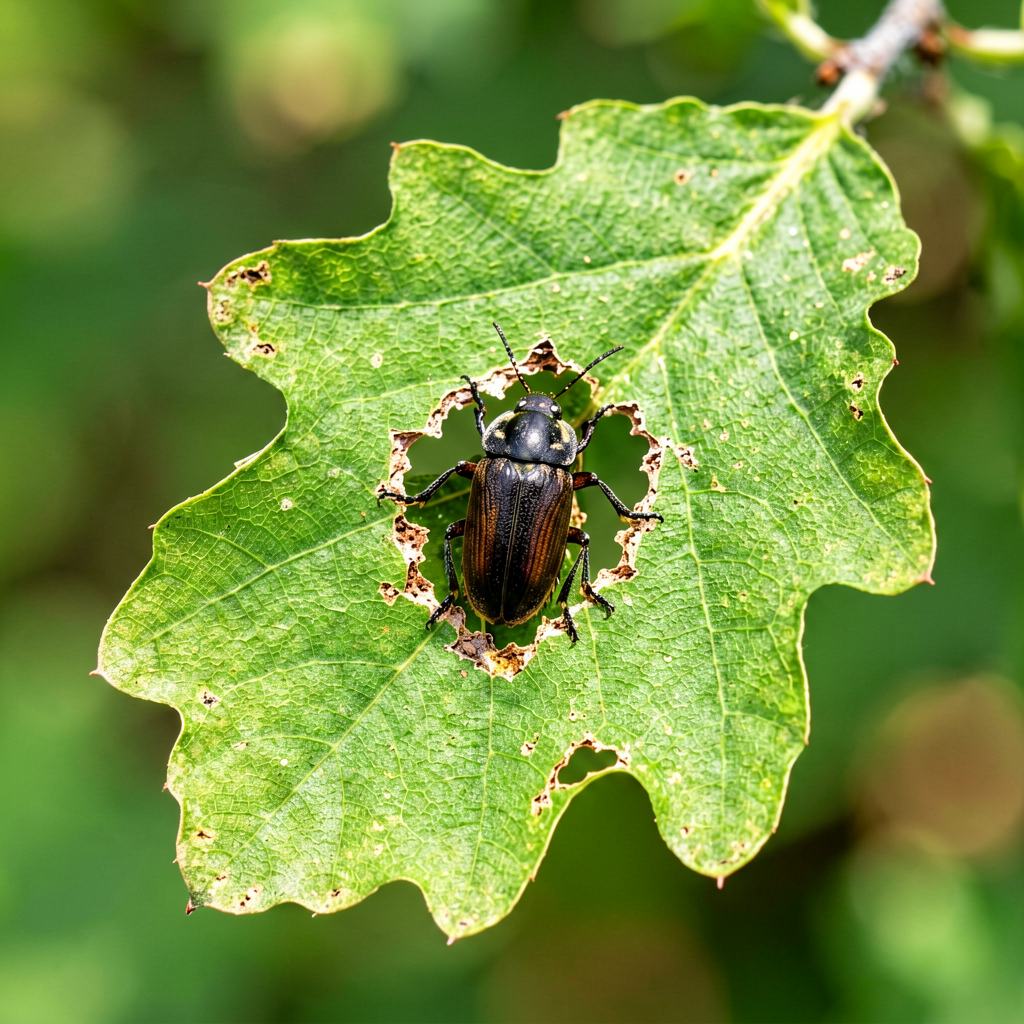
Adult cockchafers are leaf feeders. A swarm can strip a tree of foliage in a few days. Oaks, willows, beeches, poplars, limes, maples and fruit trees are all hit. The beetles bite ragged holes from the edges inwards. They feed mostly at dusk and night and rest in the treetops by day. They can travel a few kilometres to find good trees.
They also take sugar-rich sap and ripe fruit. Swarms are often found in orchards as the fruit ripens. The larvae are root feeders and do far more costly damage than the adults. A grub chews the roots of grasses and cereals. It also eats root crops, strawberries and young trees. In its final year before pupation it eats enough to kill patches of pasture outright.
Damage is worst in sandy soils and in the third year of the cycle, when the largest larvae are present. Cockchafers are eaten by bats and owls. Nightjars, crows, magpies, badgers, foxes and hedgehogs eat them too. The grubs are helpless in soil. Badgers and wild boar dig them out.
Three years underground
A slow life cycle
Adult cockchafers emerge from soil in late April or May. The emergence lasts a week or two. They begin flying at dusk. Males search the treetops for females. After mating the female burrows into soft soil. She lays her eggs in small batches of 15 to 30 at a time, 10 to 20 centimetres deep. A single female lays 60 to 80 eggs in total. She may make a few laying visits.
She flies between the soil and the trees. The eggs hatch after four to six weeks. The young grubs feed on fine roots that first summer before moving deeper for winter. They grow slowly. They spend three or four years underground. They moult twice before reaching full size. In the final spring they move near the surface. There they pupate.
The pupa forms in a smooth earthen cell. The new adult emerges in late summer. It stays in the soil until the next spring. The full cycle from egg to flying beetle takes three or four years. In a colony all members of one generation emerge in the same year. This makes the clear swarming cycle.
A farmland insect in retreat
Why it has gone from many places
The common cockchafer is not globally threatened. In central and eastern Europe it stays common locally. It has suffered severe declines in Britain, Ireland and parts of western Europe. It has vanished from large areas where it was once common. In Britain it is now found at a few southern and eastern sites. The causes match those that have hit many farmland insects. Permanent pasture was converted to arable land, hedgerows and old trees were removed, and insecticides killed larvae in soil and adults on foliage.
The species lives three or four years underground. This makes it very sensitive to soil changes. One dose of a lasting insecticide can remove a whole generation. Climate change may also play a part. It shifts the timing of emergence. This moves the beetles away from their old swarming years. There is no special protection programme.
The species relies on general conservation. Old pasture, hedgerows and woodland edge must be kept. Survey schemes ask the public to report sightings. The swarming years are uneven. A single biennial survey would miss most of the group.
Quick hits
Five things to remember
- Males have seven plates on each antenna and females six. This is the quickest way to tell the sexes apart.
- A fully grown larva reaches five centimetres long. It spends three or four years underground eating roots.
- Adults emerge in the same year in a given area. This makes swarms peak every third or fourth summer.
- In the nineteenth century farmers collected cockchafers by the ton. The insects were even made into soup.
- The beetles fly into lighted windows at night. They use light to steer and are drawn to man-made lights.