 By st20113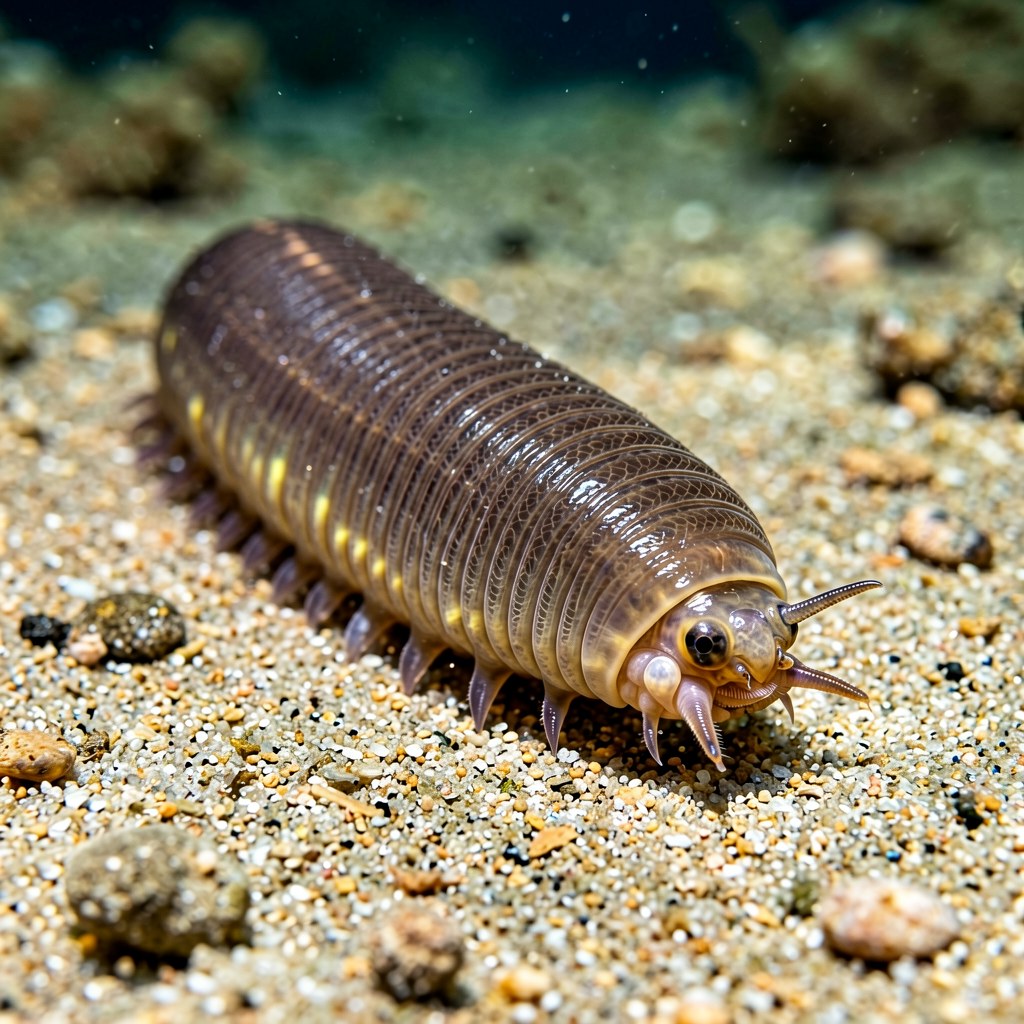
Eunice aphroditois | Bobbit Worm
Introduction
The bobbit worm (Eunice aphroditois) is a large, predatory polychaete annelid in the family Eunicidae, found on sandy and muddy bottoms of tropical and subtropical seas worldwide, including the Indo-Pacific and the Caribbean. Despite its worm-like body, it is a formidable ambush predator, hiding most of its length in a burrow beneath the sediment and waiting with five antennae protruding from the sand to detect passing prey. When a fish, crustacean, or other small animal comes within reach, the worm strikes with astonishing speed, seizing it with powerful, jaw-like mandibles and dragging it underground. Reaching lengths of up to three meters in some reports, though typically shorter, the bobbit worm has become famous through underwater photography and aquarium lore, and it is sometimes kept—carefully—in marine tanks, where it can surprise owners by appearing from the substrate. Its name derives from a notorious 1990s incident, but its biology is what makes it remarkable.
Taxonomy
Eunice aphroditois was described by the French naturalists Jean Victor Audouin and Henri Milne Edwards in 1833, placed in the genus Eunice, a large and diverse group of bristle worms, with the species epithet aphroditois alluding to Aphrodite, the goddess, perhaps referencing the worm’s ornate, iridescent body. The genus Eunice belongs to family Eunicidae, within the class Polychaeta, the marine “bristle worms,” part of the phylum Annelida. Eunicids are characterized by well-developed jaws and parapodia bearing chaetae, and many are large, active predators or scavengers. Molecular phylogenies place E. aphroditois among the jawed eunicids, related to other large Eunice species found on reefs and soft bottoms worldwide. A useful comparative worm is the fifteen-scaled worm (Harmothoe imbricata), profiled at https://www.gloencyc.com/harmothoe-imbricata-fifteen-scaled-worm/, which, like the bobbit worm, is a polychaete annelid of marine sediments, though Harmothoe is a smaller, often commensal scaleworm rather than a giant burrowing predator. The genus Eunice is species-rich and globally distributed, and ongoing taxonomic work, including DNA barcoding, continues to separate closely similar forms long confused under names like Eunice aphroditois.
Physical Characteristics
The bobbit worm has a long, segmented, cylindrical body that can exceed two meters and reportedly reach three meters in large individuals, though most specimens encountered are under a meter. The body is covered in iridescent, often greenish or purplish cuticle with a sheen, and bears paired parapodia—fleshy lobes with bristles—along its length that aid slow movement within the burrow. The anterior end is the most specialized: a segmented, muscular pharynx that can be everted and armed with a pair of sharp, dark, jaw-like mandibles capable of slicing prey, and five long, sensitive antennae (or palps) that extend from the burrow mouth to detect movement and chemicals in the water. The worm’s eyes are absent or reduced, so it relies on touch and chemoreception. Coloration ranges from brownish to vividly iridescent, sometimes with reddish or bluish tones. Most of the animal remains hidden in a mucus-lined burrow in the sediment, with only the antennae and occasionally the jaw tips visible at the surface.
Habitat
Eunice aphroditois inhabits soft sediments—sand, mud, and rubble-strewn bottoms—on tropical and subtropical reefs and adjacent seafloors, typically at depths from a few meters down to several tens of meters, though it can occur deeper. It constructs a vertical or sloping burrow in the sediment, often reinforced with mucus and bits of debris, from which it ambushes prey; the burrow entrance is usually concealed among rocks, coral rubble, or within the substrate of reef flats and lagoons. The species is widely distributed across the Indo-Pacific, the Red Sea, and the western Atlantic and Caribbean, indicating a tolerance for a range of warm marine conditions. In the aquarium trade, specimens are sometimes collected from reef rock and can persist in tanks by burying in the sand bed. Because it is secretive and largely subterranean, the bobbit worm is easily overlooked in surveys, and its true abundance is poorly known. It favors habitats where prey is abundant and the sediment allows burrow construction, and it can coexist with reef frameworks by occupying the soft substrate around and between corals.
Diet
The bobbit worm is a voracious carnivore and ambush predator. It feeds on a variety of mobile animals that venture near its burrow, including small fish, crustaceans such as shrimp and crabs, and other benthic invertebrates, and it will also scavenge on carrion that settles over its lair. Detection relies on the sensitive antennae that wave just above the sediment; when prey approaches, the worm erupts from the substrate with lightning speed, seizing the victim with its eversible jaws and retracting it into the burrow, sometimes slicing larger prey in half—behavior that inspired its dramatic reputation. The mandibles are strong enough to cut through fish and crustacean exoskeletons. In captivity, bobbit worms have been observed taking pieces of meat or fish offered by aquarists and can prey on tankmates, which is why they are considered risky additions to community aquaria.
Reproduction
Reproduction in Eunice aphroditois, as in many polychaetes, can involve sexual reproduction with free-swimming larvae, though detailed life-history studies of this species are limited. Like other eunicids, adults are thought to be gonochoristic, with separate male and female individuals that release eggs and sperm into the water column, where external fertilization occurs. In some related Eunice species, individuals undergo a reproductive transformation in which the posterior body becomes a swimming, gamete-filled epitoke that breaks away to spawn at the surface, though it is not certain that E. aphroditois follows this exact pattern. The resulting planktonic larvae drift and eventually settle to the bottom, metamorphosing into juvenile worms that burrow into the sediment and grow. Because the bobbit worm spends its life hidden in burrows, mating and larval release are rarely observed directly. The combination of pelagic larvae and a broad geographic range helps explain the species’ widespread occurrence across separated tropical seas.
Conservation
The bobbit worm is not assessed as threatened by the IUCN and is generally considered widespread and locally common across its extensive tropical and subtropical range. As a secretive, burrowing predator of reefs and soft bottoms, it faces no major targeted threats, and there is no significant fishery or trade pressure beyond occasional collection for the marine aquarium hobby, where it is prized by specialists but kept with caution because of its predatory habits. Potential concerns are indirect: degradation of coral reef and seafloor habitats through trawling, coastal sedimentation, pollution, and climate-related bleaching could reduce the prey base and suitable burrowing substrate in localized areas. Because the species is cryptic and infrequently surveyed, population trends are poorly quantified, and it may be more abundant than records suggest. From an ecological standpoint, the bobbit worm is a normal component of healthy reef and soft-bottom communities, helping regulate populations of small fish and invertebrates. Conservation of its habitat—through marine protected areas, responsible bottom-fisheries management, and maintenance of water quality—is sufficient to keep this unusual annelid secure, and no species-specific intervention is currently warranted.
Fun Facts
- The bobbit worm can strike from its burrow with such speed that it sometimes slices prey cleanly in half.
- It can grow to impressive lengths, with reports of individuals exceeding two meters and possibly three.
- Only its five sensitive antennae usually show above the sand, hiding a giant body below.
- Its jaws are eversible, shooting forward from the mouth to grab victims and drag them underground.
- Despite its fearsome reputation, it is a normal, non-threatened part of tropical reef ecosystems worldwide.