 By st20113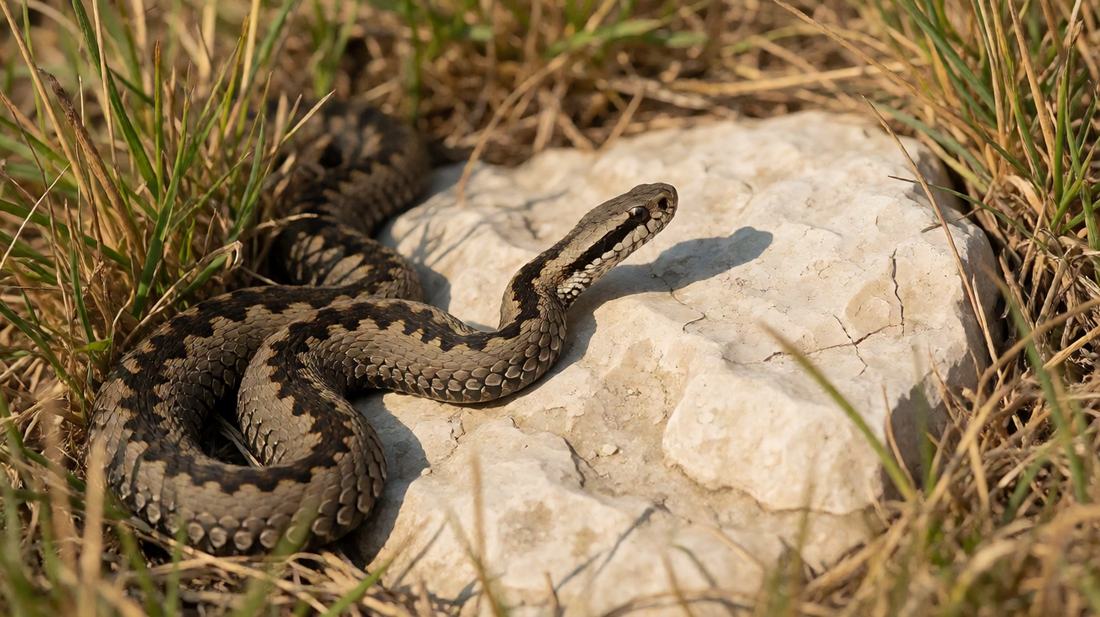
Vipera aspis | Asp Viper
Species Profile · Viperidae
Asp Viper
One of southern Europe’s most familiar snakes, with a dark zigzag down its back and venom that can matter — but a shy ambush hunter that bites only when cornered.
IUCN: Least Concern
Range
Length
Pupil
Scales
Young
The zigzag snake
A familiar viper of the south
The asp viper is one of the most familiar snakes of southern and central Europe and one of the few that can give a person a dangerous bite. It is a short, thick snake with a broad flat head and a dark zigzag stripe down its back. Most adults are grey, brown or reddish, and colour alone will not name one. The sure signs are the head shape, the vertical slit pupil and the keeled scales.
It is a sit-and-wait hunter. It lies coiled in sun and strikes at any small animal in range. It eats voles, mice, shrews and lizards, and can swallow prey that looks too large. It gives birth to live young rather than eggs, which helps in the cool mountains it reaches.
It is common over much of France and Italy. It is protected by law in most of the countries it lives in. Most bites happen when a person picks one up or steps on it, and the snake is far more often the loser.
Family tree
Viperidae, the true vipers
The asp viper belongs to the family Viperidae, the vipers. It sits in the genus Vipera, a group of about 20 species across Europe, North Africa and western Asia. Linnaeus named it in 1758 as Coluber aspis. It was moved to Vipera as the family was worked out in the 19th century. The name aspis is Greek for shield, and refers to the broad head scales. The genus is old.
Its members share a set of features. They have no heat pits between the eye and the nostril. Their fangs are long and fold back when the mouth closes, and are replaced through life. The venom is a mix of proteins that harm tissue and affect blood. Four subspecies are named. The boundaries between them are not sharp, and animals from the contact zones are hard to place.
The species is one of the closest relatives of the common adder, the widespread viper of northern Europe. The two belong to the same genus and meet along a broad front in France and central Europe. Where they meet they sometimes hybridise. They are otherwise easy to separate. The adder is more slender and lives much further north. The asp viper has a heavier body, a more upturned snout and a longer head, and it prefers warmer, drier ground.
Dark zigzag, slit eye
How to identify one
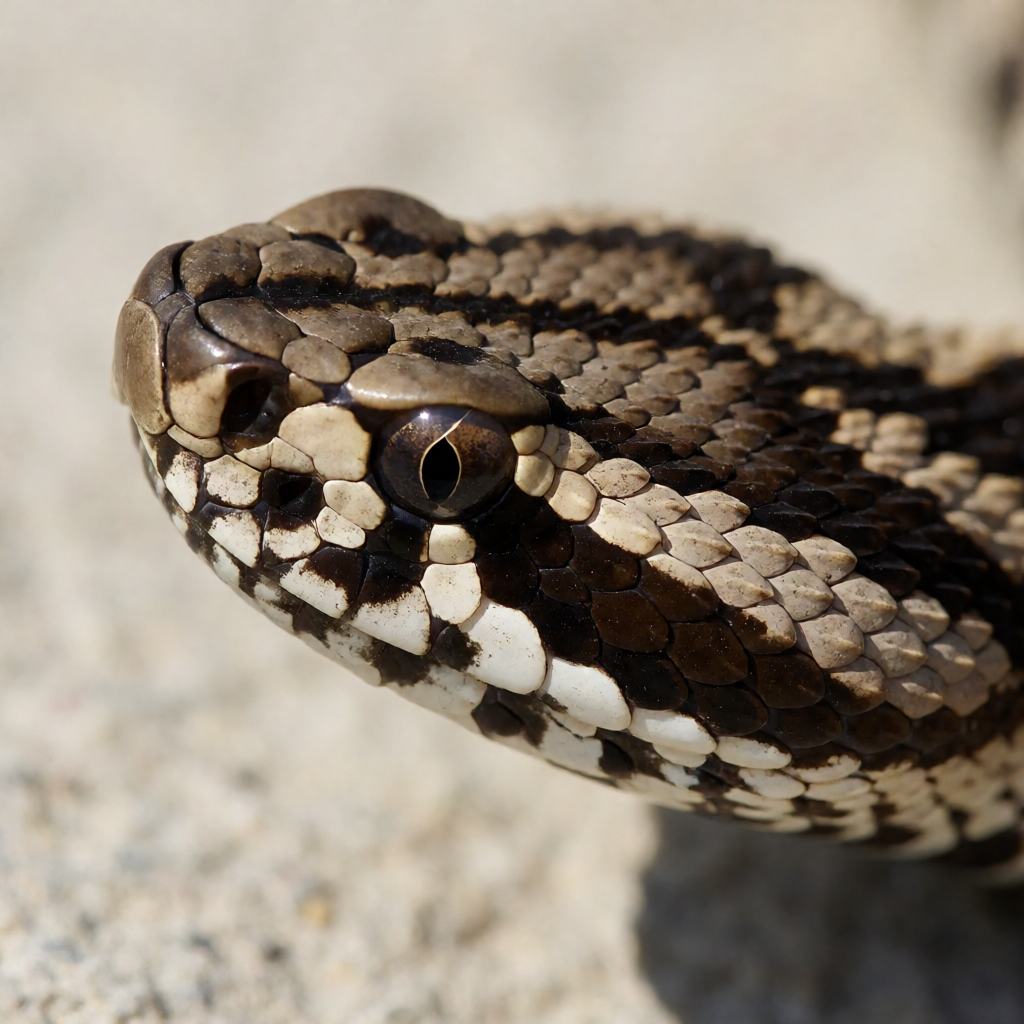
The asp viper is a short, stout snake. Most adults measure 60 to 75 cm from snout to tail. Females grow larger than males and can reach about 90 cm. Males rarely pass 70 cm. The body is thick for its length, with a clear neck and a broad flat head that is triangular from above. The snout turns up a little at the tip, which gives the head a raised look. The pupil is a vertical slit, a quick way to tell a viper from a harmless grass snake.
The scales are strongly keeled, each with a ridge down the middle. That gives the skin a dull, rough look. The dorsal scales sit in 21 rows at mid-body. The belly scales are broad and smooth. The upper colour ranges from pale grey through olive and brown to reddish or near black. A dark zigzag stripe runs from neck to tail, but can fade to a chain of blotches. A dark band runs from the eye to the mouth corner.
The underside is grey, yellow or pinkish. Males and females differ in more than size. Females have a shorter, blunter tail. Males have a longer tail and a slimmer build. Juveniles are smaller and brighter, with a clear zigzag. The venom gear is the most special part. Two long fangs sit at the front of the upper jaw and fold back when the mouth shuts.
1
2
3
Dry slopes and sunny rocks
Where it lives
The asp viper is a snake of warm, dry, broken ground. It wants sun, cover and small mammals. It lives on south slopes, scrub, dry grassland, woodland edges, hedgerows, stone walls, ruins, terraced vineyards and olive groves. It is common in the hills and mountains of southern Europe, and rare on flat, damp, heavy farmland. In the Alps it reaches about 2500 m, high for a viper.
It does not hibernate as deep as the adder, and on mild winter days it may come out to bask. Its range covers France, Spain north of the Ebro, Switzerland, most of Italy, Slovenia and a corner of southwestern Germany. It also reaches Croatia and the western Balkans. It is absent from the Mediterranean islands except Sicily. The animal is an ambush hunter and needs structure.
A wall, a bramble, a stone pile or a hedge gives it both a basking site and a retreat. It moves several hundred metres between its winter retreat and its summer ground. It is a poor coloniser of open ground. Fine farmland with no hedges holds few vipers, while an old hillside with walls and scrub can hold many. It basks on warm stone, paths and long grass, and stands its ground if cornered.
Ambush hunter of small prey
What it eats
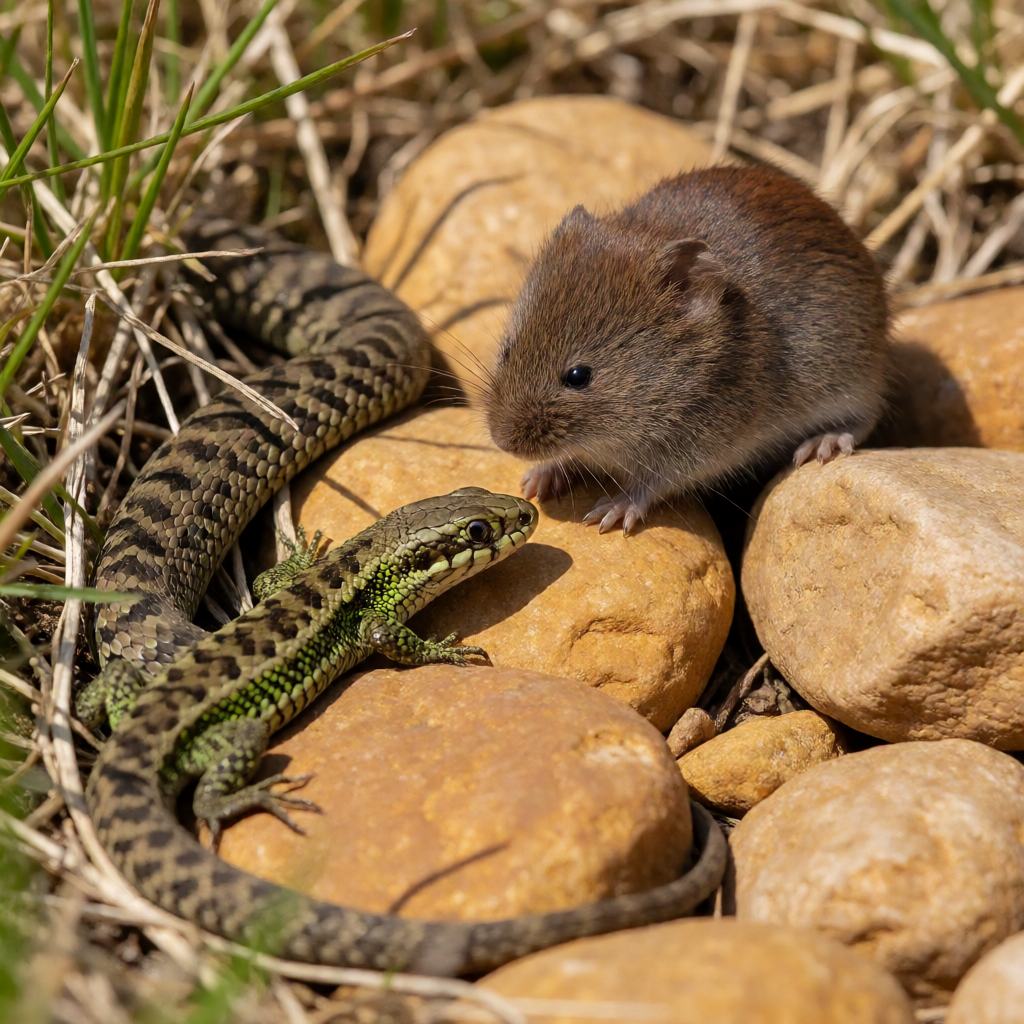
The asp viper eats small animals, and its diet changes with size. Young vipers feed mostly on lizards. Adults switch to small mammals, above all voles, mice and shrews. They also take nestling birds, frogs and the odd insect. The animal hunts by ambush. It picks a spot with sun, cover and a view, coils and waits.
The strike is fast and guided by sight and heat. The fangs pump venom into the tissue, then the snake lets go and follows the scent trail. The venom kills or stuns the prey and starts to digest it. Vipers have strong digestive juices and can break down a whole animal, bones and fur, over several days. An adult can swallow a vole larger around the middle than its own head. It dislocates its jaws and walks the prey down its throat.
Feeding is not frequent. A large meal lasts an adult a week or more, and vipers can go much longer without food in cold weather. That low need is why it can live where prey is patchy. It drinks readily in summer.
Live young, born in autumn
The breeding cycle
The asp viper gives birth to live young. The eggs grow inside the female and the young are born in a thin membrane they break at once. Litters appear between August and October, with timing set by latitude and altitude. A female has 5 to 18 young, with larger litters from larger females. Each newborn measures about 15 to 20 cm. The mating season runs from March to May, soon after the animals leave winter.
Males search for females and fight for access. The combat is a wrestling match, not a bite contest. Two males raise the front of the body and try to press each other down. The winner mates. The female stores sperm and the young grow over about 3 to 4 months. Breeding costs a female heavily.
She needs a good fat store, and in cool mountains she may breed only every 2 or 3 years. The young are independent from birth. They carry venom and can eat small lizards within days. They grow slowly and take 4 to 5 years to reach adult size. Females mature at about 4 years, males a little earlier. Life in the wild is roughly 7 to 10 years, and animals over 15 are known.
Least Concern, but shy
Conservation
The asp viper is listed as Least Concern on the global Red List, and also Least Concern in Europe. Its range is large and its numbers are steady over most of it. It uses a wide set of habitats, including farmland and villages. The picture is not even. In Switzerland it has declined in the lowlands and is now in the warmer valleys. In Germany the rest lives near the Swiss border. In parts of Italy and France it has lost ground as hedges and walls were removed.
The animal faces two main pressures. The first is the loss of warm, dry, structured habitat. Hedgerow removal, land consolidation, terrace loss and wall tidying all cut the ground it needs. The second is killing. Vipers are feared and many are killed on sight, though bites are rare and deaths rarer. Road traffic adds a toll, because snakes bask on warm tarmac. The species is protected by law in France, Italy, Switzerland, Germany and others.
It is illegal to kill, catch or disturb one. Practical conservation means keeping the mosaic. Dry stone walls, hedge bases, scrub patches and cut grass in rotation all help. Public education matters as much. Most bites happen when someone tries to handle a snake, and a quiet step back is almost always right. The asp viper is not aggressive. It would rather retreat and strikes only with no other choice.
Quick hits
Five things to remember
- The asp that killed Cleopatra was almost certainly an Egyptian cobra, not this species.
- It gives birth to live young rather than eggs, which suits the cold mountain valleys where it lives.
- Melanistic, almost black asp vipers are common in the Alps.
- It has no heat-sensing pits, so it finds warm prey by sight and scent rather than body heat.
- A female often breeds only every second or third year, because carrying young costs more than she can afford.