 By st20113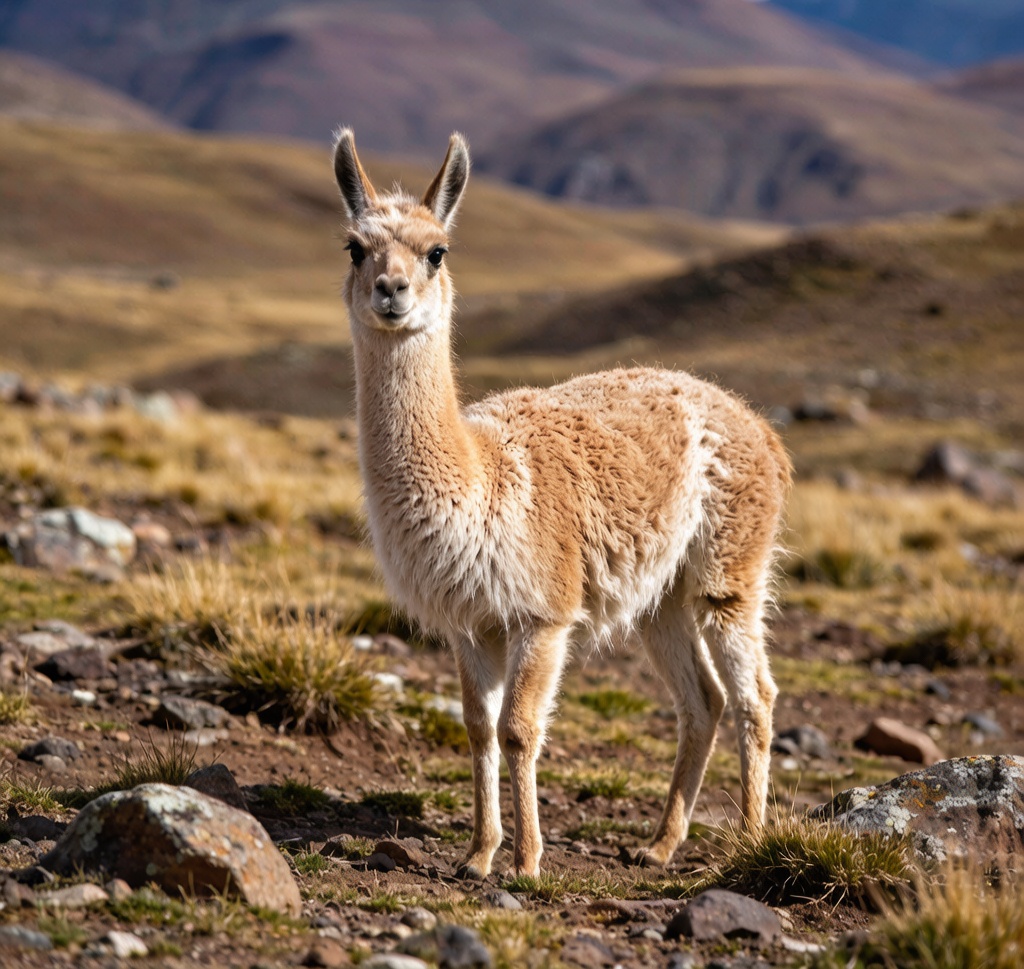
The vicuna (Vicugna vicugna) is the smallest and most graceful member of the camel family — a wild South American camelid whose exquisite, buttery-soft fleece, known as vicuna wool, has been prized since the time of the Inca Empire as one of the most luxurious and valuable natural fibers in the world. Found at elevations of 3,000 to 5,000 meters above sea level in the high Andes of Peru, Bolivia, Argentina, and Chile, the vicuna inhabits one of the most extreme environments on Earth — the cold, windswept Puna grassland known as the altiplano — where it has evolved remarkable physiological adaptations for survival at altitude. The vicuna is the national animal of Peru and a powerful symbol of Andean cultural heritage, conservation success, and the enduring relationship between indigenous communities and their natural environment.
## Physical Characteristics
The vicuna is the smallest of the wild camelids, standing 75 to 85 centimeters at the shoulder and weighing 35 to 65 kilograms, with females slightly smaller than males. Its most celebrated feature is its fleece: the undercoat produces a coat of extraordinarily fine, soft, and lustrous fibers that range in color from creamy white to a warm, pale golden tan, depending on the region. The face is distinctive — relatively small and creamy white or pale, with a dark forehead and cheek markings in some individuals. The ears are long and pointed, held alertly upright. The neck is long and slender, giving the animal an elegant, swan-like profile. Unlike its domestic relative, the llama, the vicuna is not used for carrying loads and its body is slender and gracile, built for speed and endurance rather than burden-bearing. The legs are long and slender, adapted for running at high speed across the flat altiplano to escape predators such as pumas and Andean foxes.
## Habitat and Distribution
The vicuna inhabits the Puna grassland, or altiplano, of the high Andes — a cold, semi-arid plateau at elevations of 3,000 to 5,000 meters above sea level, characterized by coarse grasses, sparse shrubs, occasional cacti, and numerous small lakes and wetlands fed by glacial meltwater. The climate is harsh: temperatures swing dramatically from below freezing at night to relatively warm during the day, and fierce winds sweep the open plateau. The vicuna is highly adapted to this environment, with a highly efficient oxygen-carrying blood system and a special modification of the hemoglobin gene that allows it to thrive at altitudes where most mammals cannot survive. It is found in Peru (where the largest population resides), Bolivia, Argentina, and Chile, with populations organized into family groups led by a dominant male, and in bachelor groups for younger males.
## Behavior and Diet
Vicunas are diurnal grazers, feeding primarily on the short, coarse grasses of the altiplano, which they crop with a characteristic side-to-side motion of the head. They obtain most of their water from dew and the moisture content of their forage, but will drink from streams and lakes when available. Vicunas are highly social animals, living in family groups of approximately 5 to 15 individuals, consisting of a dominant male, several females, and their offspring. Bachelor males form separate groups or live as solitary roamers. The dominant male defends a territory through vocalizations, displays, and occasional physical confrontation. When threatened, the vicuna emits a distinctive, high-pitched whistle — a warning call that sends the herd fleeing at speeds of up to 47 kilometers per hour. Vicunas are also known for their communal dung piles, which serve as territorial markers and social gathering points.
## Reproduction
Vicunas breed seasonally, with mating occurring between March and April, and births occurring approximately 11 months later, between February and March. The dominant male mates with all females in his group. A single cria (foal) is born after a gestation of approximately 330 to 350 days. The cria is precocial — able to stand and run within an hour of birth — and is nursed for approximately 10 months. During the nursing period, the cria remains hidden in vegetation while the mother grazes nearby, returning periodically to feed it. Family groups maintain strong bonds, and offspring may remain with the family group for up to two years before dispersing. Sexual maturity is reached at approximately two years of age, at which point young males are typically driven from the group by the dominant male. Wild vicunas can live 15 to 20 years.
## Conservation
The vicuna was brought to the brink of extinction in the 1960s, with the global population falling to fewer than 6,000 individuals, due to relentless poaching for its fleece, which commands extraordinary prices on the international market. In 1975, the species was listed on CITES Appendix I, and aggressive conservation measures — including protection, community-based management programs, and the development of a sustainable harvesting system called “chaku” — enabled a remarkable recovery. Under the chaku system, wild vicunas are periodically rounded up, gently shorn of their fleece, and released, with the income from wool sales shared with local indigenous communities. This innovative model has made the vicuna a flagship example of community-based wildlife conservation. The global population has recovered to approximately 350,000 individuals, and Peru alone now holds over half of the world’s vicunas. The species was downlisted from Endangered to Least Concern in 2008.
[…] event. Its wool was gathered and woven into cloth for the emperor. Then the animal was let go. The vicuna stood for the wild world that the state claimed to […]