 By st20113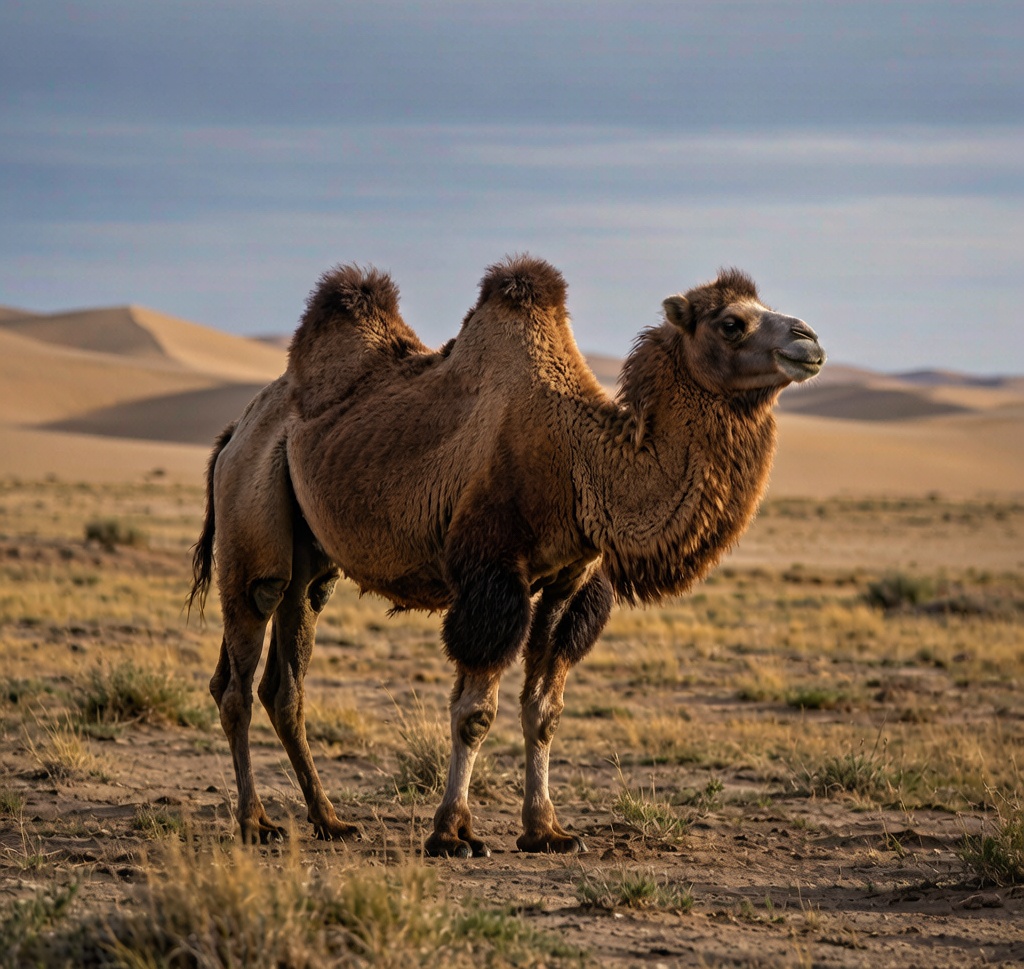
The Bactrian camel (Camelus bactrianus) is a remarkable large mammal native to the steppes and deserts of Central Asia, instantly recognizable by its two large humps and its extraordinary ability to thrive in some of the harshest environments on the planet. While the domestic Bactrian camel is widespread and numerous across its range, its wild counterpart — the truly wild Bactrian camel (Camelus ferus) — is one of the rarest large mammals on Earth, with fewer than 1,000 individuals surviving in the remote deserts of the Gobi in Mongolia and China. The wild Bactrian camel is genetically distinct from its domestic relative and possesses several unique adaptations, including a greater ability to drink brackish (salty) water — a critical survival trait in the desert oases it depends upon. Both wild and domestic Bactrian camels are ecological icons of the Silk Road landscapes they have inhabited for thousands of years.
## Physical Characteristics
The Bactrian camel is a large, heavy-bodied camelid, standing 1.6 to 1.8 meters at the shoulder and measuring 2.5 to 3.0 meters in body length, with males significantly larger than females. The most distinctive feature is its two large, prominent humps — composed of fat deposits rather than water, as commonly believed — which can each reach 30 to 40 centimeters in height. The body is covered in long, shaggy, dark brown fur that is shed in large clumps during the hot summer months. The head is relatively small and blunt, with a divided upper lip, large eyes protected by heavy lashes, and bushy eyebrows that shield the eyes from sun and wind-blown sand. The long, curved neck allows the animal to reach vegetation on the ground and at head height. The legs are long, sturdy, and end in broad, two-toed feet with tough, leathery soles adapted for walking on sand and rocky terrain. Domestic Bactrian camels typically have a wider, more robust body than their wild counterparts.
## Habitat and Distribution
The domestic Bactrian camel is found across a vast range in Central Asia, from Turkey through Iran and Central Asia to the Gobi Desert, adapted to both the hot, dry deserts of the region and the cold, high-altitude steppes of the Tibetan Plateau. The wild Bactrian camel, however, occupies an extremely restricted range in the desert and semi-desert regions of northwestern China (Xinjiang and Gansu) and southwestern Mongolia (Gobi Desert). It is found specifically in the Transaltai Gobi, the Great Gobi Strictly Protected Area, and adjacent desert ranges, where it inhabits rocky mountain valleys, arid plains, and gravel deserts — areas where fresh water is scarce and the camel must rely on brackish desert springs. These remnant populations are highly fragmented, with individual groups separated by hundreds of kilometers of desert.
## Behavior and Diet
The Bactrian camel is a grazer and browser, consuming a wide variety of drought-resistant plants, including dry grasses, thorns, and saltwort. It is an efficient forager, capable of extracting maximum nutrition from sparse, low-quality vegetation, and can survive for months without water by metabolizing the fat stored in its humps. Its kidneys are highly efficient at conserving water, and its dung and urine are extremely dry. Its thick fur provides insulation against both heat and cold, and it can tolerate body temperature fluctuations of up to 6 degrees Celsius without sweating. Wild Bactrian camels are capable of drinking brackish water with salt concentrations up to 1.5 percent — nearly half the salinity of seawater — a unique physiological adaptation found in very few mammals. They are social animals, forming herds of up to 30 individuals led by a dominant male, and are capable of traveling long distances — up to 50 kilometers per day — in search of water and forage.
## Reproduction
Bactrian camels reach sexual maturity at approximately three to five years of age. The breeding season occurs in the autumn and winter months, during which dominant males compete aggressively for access to females. After a long gestation of approximately 13 months, the female gives birth to a single calf — twins are rare — typically between January and March, during the coldest period of the year. Newborn calves are precocial: they can stand and run within hours of birth and are capable of following the herd within days. They are nursed for approximately one to two years. In the harsh desert environment, infant survival is challenging, and mortality rates can be high during severe winters. Bactrian camels can live 30 to 40 years in the wild.
## Conservation
The wild Bactrian camel (Camelus ferus) is classified as Critically Endangered on the IUCN Red List, with fewer than 1,000 mature individuals remaining in the wild. The species faces multiple severe threats, including hybridization with domestic Bactrian camels (which dilutes the genetic integrity of the wild population), hunting for meat and hides, predation by wolves, competition with livestock for water and forage, and the impacts of climate change on the desert springs and oases it depends upon for survival. Major conservation efforts include the protection of the Great Gobi Strictly Protected Area, a protected area specifically created for the wild Bactrian camel in Mongolia, and ongoing research into the genetics and ecology of both wild and domestic populations to guide management decisions.