 By Iris
Cephalotus follicularis | Albany Pitcher Plant
Species Profile · Cephalotaceae
Albany Pitcher Plant
A small pitcher grows close to the ground in southwest Australia.
Vulnerable
Pitcher
Rim
Lid
Family
Range
Rating
The Albany Pitcher Plant
A trap the size of a thumb
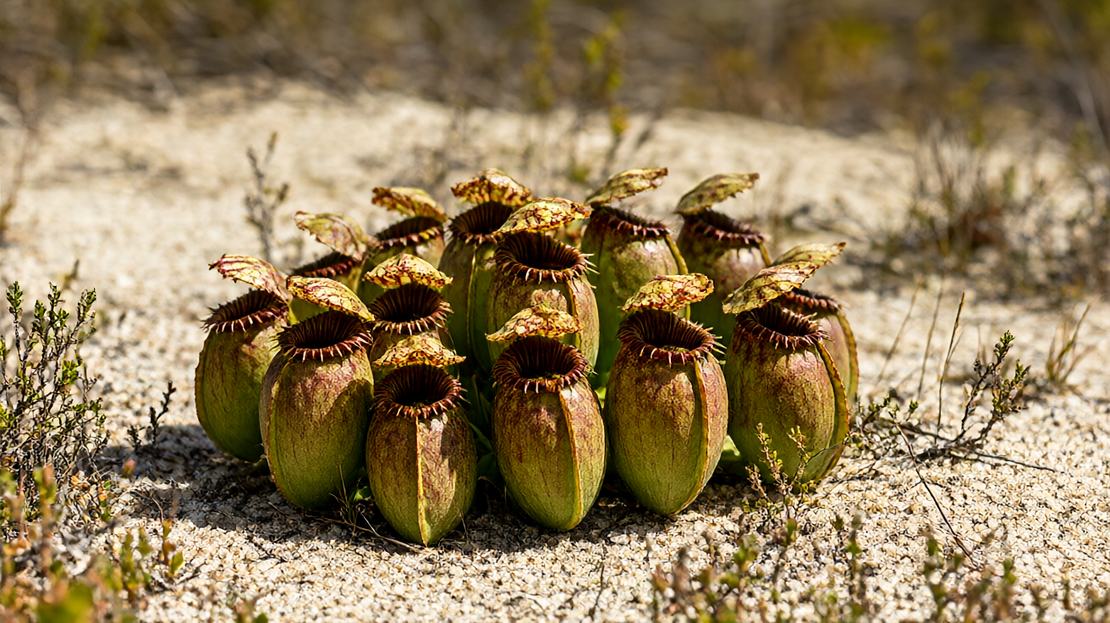
A small pitcher grows close to the ground in southwest Australia. Its lid is striped, and the rim carries teeth that point inward. The whole trap runs under 5 cm.
Cephalotus is the only pitcher plant in Australia. Since the plant lives in poor sandy soil, it takes food from prey instead of from the ground. It grows nowhere else on earth.
Family tree
Cephalotaceae, one genus, one species
Its proper name is Cephalotus follicularis, and it stands alone in its family. Cephalotaceae holds one genus and one species, which makes it a public oddity. A Rajah Brooke’s Pitcher Plant builds a far larger trap, though it grows in Borneo rather than in Australia.
Both plants catch prey, yet they belong to unrelated families. The resemblance came from the same problem solved twice. Its nearest cousins sit in the rosales order, alongside figs and nettles.
Teeth that point in
How to tell one
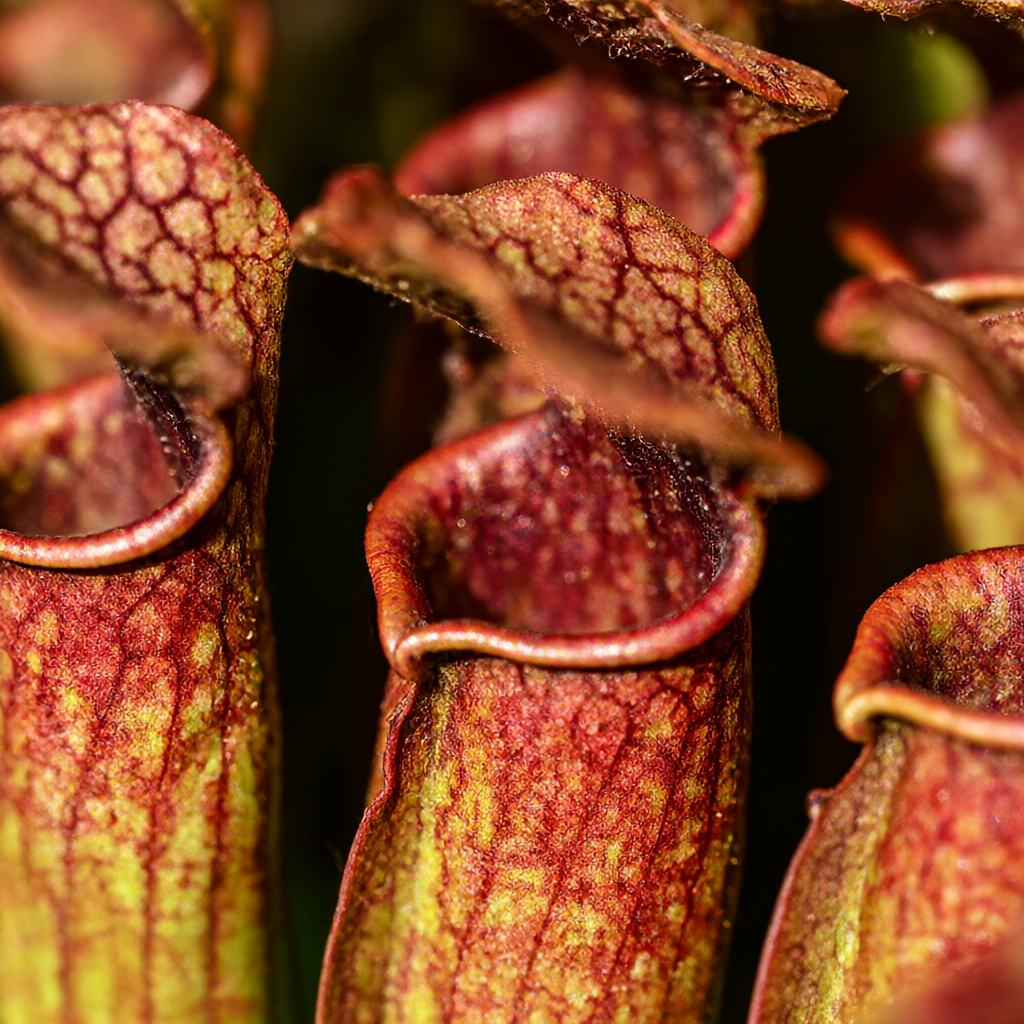
Pitchers run 2 to 5 cm tall, and they sit in a rosette. The rim is thick and rolled, with ribs that guide prey inward. A lid hides the opening, and it keeps rain from filling the trap.
Since the inner surface is waxy and smooth, prey cannot climb out. The colour runs red-purple in full sun and green in shade. Two leaf types come on the same plant.
Flat leaves grow in winter, and they do no trapping at all. Its rhizome sits just below the surface.
1
2
3
Wet sand and sun
Where it lives
Sandy, peaty soil near Albany holds the species. Its range hides a small strip along the southern coast of Western Australia. Wet soil and full sun are both required. Since the soil holds almost no nitrogen, the insect catch supplies what the roots cannot.
Shrub cover shades it out, so it depends on regular fire. Where fire is excluded, the pitchers fade within a few years. It grows near spring lines and creek edges.
Flies and ants
What it eats
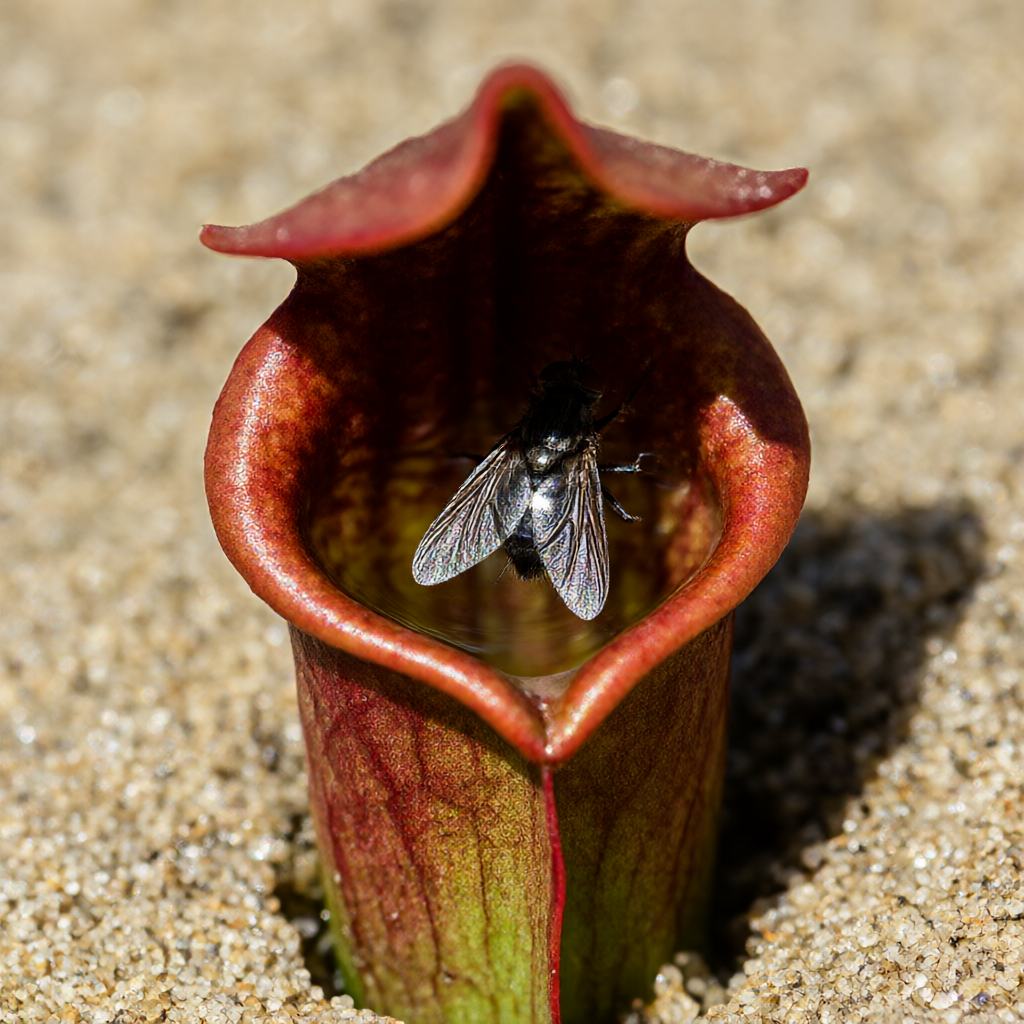
Flies, ants and small crawling bugs fall into the pitcher. The plant digests them with enzymes in the fluid at the bottom. Since the lid blocks rain, the fluid stays at a steady power. Digestion takes several days.
Only the food are taken, and the hard parts remain. That catch adds nitrogen and potash to a poor soil. Nothing large is taken, and indeed nothing is wasted.
Fire, then seedlings
The breeding cycle
Flowers come on a tall stalk, well clear of the pitchers. Each flower is small and lacks petals. Since the blooms sit above the traps, visitors avoid being eaten. Pollination is probably carried out by small flies.
Seed sets rarely, and still many blooms produce nothing. The plant spreads mostly by rhizome, so a patch is often one clone. Seedlings come after fire, when bare soil opens up.
Vulnerable
Conservation
Red List status is Vulnerable. Its range hides a few hundred square miles. Since the plant is sought by thieves, poaching removes whole patches. Land clearing for farming has cut the range.
Drainage lowers the water table, and the pitchers dry out. Fire control allows shrubs to close over the sites. Since the species spreads slowly, a lost patch takes decades to return.
Side by side
How It Compares
| Trait | Albany Pitcher Plant | Rajah Brooke’s Pitcher Plant |
|---|---|---|
| Family | Cephalotaceae | Nepenthaceae |
| Trap | 2-5 cm | up to 35 cm |
| Lid | covers the mouth | partial and raised |
| Range | Western Australia | one mountain in Borneo |
| Soil | sand and peat | ultramafic moss |
| Rating | Vulnerable | Endangered |
Common misreadings
What People Get Wrong
- Not a close relative of Nepenthes. Different family entirely. The two sit in separate orders of flowering plants, so the pitcher evolved twice and the resemblance carries no shared history.
- Not a plant of deep shade. Sun keeps it alive. Full light drives the colour and the catch, and shrubs that close over a site shade the pitchers out within a few seasons.
- Not a plant that seeds freely. Rhizomes do most of it. Flowers set little seed, so a patch usually spreads outward as one clone and a lost site takes decades to refill.
Going further
Sources and Further Reading
Quick hits
Five things to remember
- The rim carries teeth that point down and inward, so an insect can enter but cannot easily leave.
- The lid works as an roof, and without it the fluid would overflow and lose its power.
- It is one of only a few carnivorous plants found in Australia, and the only pitcher plant there.
- Flat leaves come in winter and trap nothing, which suggests the plant can switch plan.
- Thieves have dug out entire sites, and the plant now grows behind locked gates in some places.