 By st20113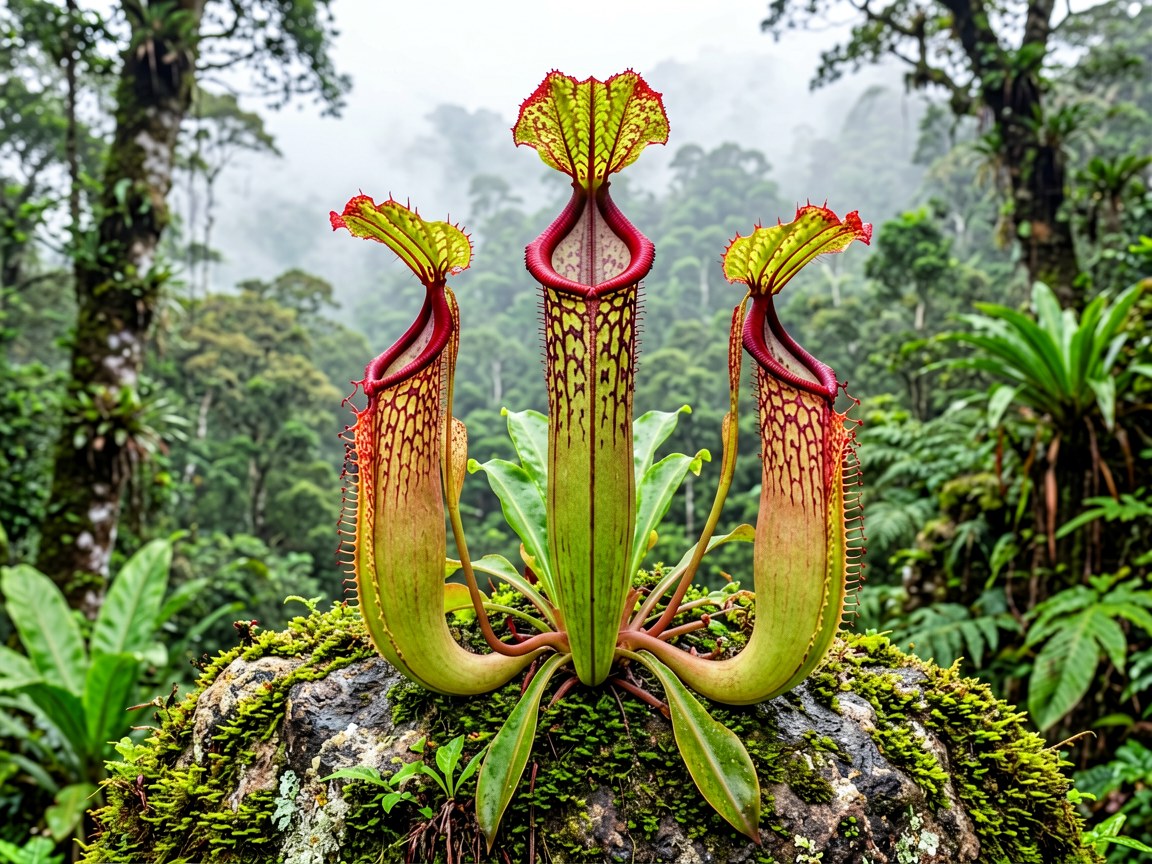
Nepenthes rajah | Rajah Brooke’s Pitcher Plant
Introduction
Nepenthes rajah, universally known as Rajah Brooke’s pitcher plant, is a montane carnivorous plant endemic to the island of Borneo. Growing exclusively on the slopes of Mount Kinabalu and a few neighbouring peaks in Sabah, Malaysia, it is among the largest of all pitcher plants and produces traps that can hold more than two litres of fluid. The species is named in honour of James Brooke, the first White Rajah of Sarawak. Unlike most plants, which draw nutrients from the soil, N. rajah supplements its diet by capturing insects and, on rare occasions, small vertebrates in its elaborate pitcher-shaped leaves. Its extremely restricted range and striking appearance have made it one of the most celebrated and heavily protected carnivorous plants in the world, and it has become an emblem of Borneo’s unique mountain flora.
Taxonomy
Nepenthes rajah belongs to the genus Nepenthes within the family Nepenthaceae, a group of roughly 170 species of tropical pitcher plants. It is most closely related to N. clipeata and shares the carnivorous habit of the better-known Dionaea muscipula (Venus flytrap), although the two employ very different trapping mechanisms: one snaps, the other drowns. The genus name Nepenthes derives from a Greek word for a potion that banishes sorrow, while “rajah” commemorates Brooke’s royal title. Within its section, N. rajah is placed among the giant-pitchered species of northwest Borneo. Botanists have long treated it as a distinct species because of its unique lid morphology and enormous trap size, though in the wild it readily hybridises with several neighbours, producing natural crosses that can confuse identification.
Physical Characteristics
The defining feature of Nepenthes rajah is its pitcher, a modified leaf tip that swells into a deep, urn-shaped vessel. Mature upper pitchers can exceed 40 cm in height and 20 cm in width, with a fluid volume of up to 2.5 litres, making them large enough to drown rodents on rare occasions. The pitcher is crowned by a lid (operculum) that overhangs the mouth but never closes, and the peristome—the ribbed, often colourful rim—can be 10 cm wide and deeply toothed like a collar. Lower pitchers are broader and more rounded; upper pitchers, produced on climbing stems, are narrower and more cylindrical. The plant begins life as a rosette of leathery, bluish-green leaves, later developing a vine that can reach several metres in length. The entire surface is studded with nectar glands that lure prey, and the peristome’s waxy inner wall becomes slippery when wet, preventing escape once an insect slips over the edge.
Colouring varies with altitude and light, from deep maroon peristomes lined with green or yellow on shaded plants to almost black traps on exposed ridges. The lid, which can span 15 cm, bears a vaulted underside studded with nectar-secreting glands and downward hairs that guide prey toward the mouth. Lower pitchers develop on young rosette plants and are the broadest and most colourful, whereas upper pitchers on the climbing stem are slimmer, more cylindrical, and often lighter, adapted to catching airborne prey. The stem itself is woody and can persist for decades, producing pitchers in successive flushes through the wet season, each lasting several weeks before browning and being replaced.
Habitat
Nepenthes rajah is a high-elevation specialist, confined to altitudes between roughly 1,500 and 2,650 metres on ultramafic (metal-rich) soils of Mount Kinabalu and Mount Tambuyukon. These slopes are cool, constantly misty, and receive heavy rainfall throughout the year. The plant favours open, sunny ridges and rocky outcrops where competition from other vegetation is low, often growing directly on cliff faces and barren ground. Soil temperatures remain mild because of the altitude, and the ultramafic substrate—rich in nickel, chromium, and iron—supports a distinctive flora tolerant of toxic metals. Because it depends on such a narrow set of conditions, N. rajah occupies only a tiny fraction of Borneo’s land area and is entirely absent from the lowland rainforests that cover most of the island.
Within Kinabalu Park the species forms a loose altitudinal band centred on the ultramafic ridges of the summit trail, where night temperatures can drop near freezing and daytime cloud cover keeps humidity near saturation. It commonly grows beside the related N. lowii and N. macrophylla, and the same rocky ledges may host several Nepenthes species whose pitchers differ in size and prey. Seasonal mist supplies much of the water the plant needs, reducing dependence on rainfall alone. Because ultramafic soils lock away most nutrients behind high metal concentrations, the carnivory that supplies nitrogen and phosphorus is not a luxury but a necessity for survival at these heights.
Diet
Like all Nepenthes, N. rajah is a carnivore that traps arthropod prey, and occasionally small vertebrates, in its fluid-filled pitchers. The majority of captures are ants, which are attracted to sweet nectar secreted on the peristome and lid. Beetles, wasps, flies, and spiders also fall in, and the plant’s unusual size means it can drown larger animals, including rats and frogs, although such events are uncommon. Once prey is submerged, digestive enzymes and a community of symbiotic bacteria break down soft tissue, releasing nitrogen, phosphorus, and other nutrients that the plant absorbs through the pitcher wall. Because its native soils are nutrient-poor, this carnivorous strategy is essential for growth and reproduction. Remarkably, the pitchers also host a mutualistic crab spider and a species of mosquito whose larvae live in the fluid without being digested.
Reproduction
Nepenthes rajah is a perennial that reproduces both by seed and vegetatively. Flowering occurs during the drier months, when the plant produces a long raceme of small, greenish-yellow, faintly fragrant flowers typical of the genus. As in all Nepenthaceae, individual plants are usually male or female (dioecious), so insect pollinators must carry pollen between separate individuals for seeds to form. After fertilisation, the female flower develops a leathery capsule containing numerous fine, wind-dispersed seeds. In cultivation and in the wild, damaged plants can also sprout shoots from the base or from fallen stems, allowing a single individual to persist for decades. Seedlings are slow to mature, often taking several years before they produce their first sizeable pitcher, which limits how quickly wild populations can recover from losses.
Conservation
Nepenthes rajah is listed as Endangered on the IUCN Red List and is protected under both Malaysian law and international trade controls (CITES Appendix I). Its entire global population sits within Kinabalu Park, a UNESCO World Heritage Site, which shields the core habitat from logging and conversion. The principal threats are illegal collection by enthusiasts, climate warming that could shrink its already narrow alpine band upward, and the risk of fire on the dry ultramafic ridges. Because the species occurs nowhere else on Earth, any local catastrophe could be catastrophic for the taxon as a whole. Propagation in botanic gardens and strict anti-poaching patrols within the park have helped stabilise numbers, but the plant remains highly vulnerable and is never legally traded on the open market.
Fun Facts
- The pitchers of N. rajah are the largest of any carnivorous plant and can hold over two litres of liquid.
- It is named after James Brooke, the 19th-century White Rajah of Sarawak, not after any insect king.
- A tiny crab spider lives among its pitchers and is one of the few animals that can walk on the slippery rim unharmed.
- The plant sometimes traps small rats and frogs, though these make up a negligible part of its diet.
- Despite its fearsome traps, N. rajah is completely harmless to humans and is grown only by specialist collectors under permit.