 By st20113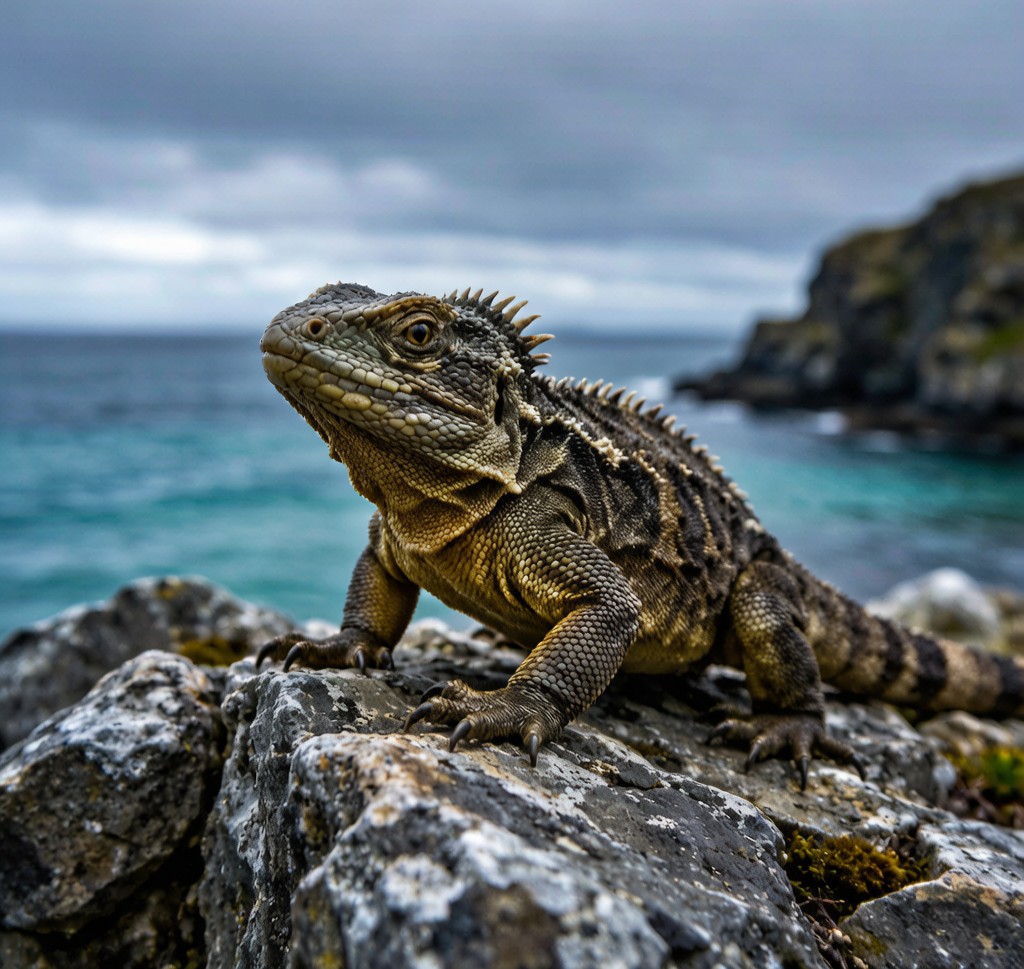
A Tuatara (Sphenodon punctatus) resting on a coastal rock on Stephens Island, New Zealand, showing its distinctive spiny crest along the back
Overview
The Tuatara (Sphenodon punctatus) is one of the most extraordinary reptiles in the world – the sole surviving member of an entire order of reptiles called Rhynchocephalia that diverged from the lineage leading to all other living reptiles approximately 250 million years ago, during the Triassic period, before the age of dinosaurs had fully begun. Found only on a handful of small, predator-free islands off the coast of New Zealand, the Tuatara is often described as a “living fossil” – a relic of a prehistoric world that survived the mass extinction that eliminated the dinosaurs and most other reptile groups. Its lineage predates the split between lizards and snakes by tens of millions of years, making it one of the most evolutionarily distinct vertebrates on Earth.
The Tuatara looks superficially like a large lizard – reaching approximately 30 to 76 centimeters in length – but it differs from all other living reptiles in a suite of anatomical features that make it uniquely primitive. These include a fixed, wedge-shaped lower jaw that locks into the upper jaw (preventing the extreme jaw gape seen in snakes), a unique hooked pedicellate tooth structure in which each tooth is fused to the jawbone, a light-sensitive “third eye” (parietal eye) on the top of the head, and an extremely slow growth rate that means some individuals may live for over 100 years. The Tuatara’s name comes from the Maori word meaning “spiny back” – a reference to the row of spines that runs along its back and tail.
Habitat and Distribution
The Tuatara historically occurred throughout mainland New Zealand and many of the offshore islands, but the arrival of Polynesian rats ( kiore) with Maori settlers approximately 800 years ago, and later European rats, cats, and mustelids introduced by European colonists, devastated Tuatara populations. Today, the species survives naturally only on approximately 30 predator-free islands off the coast of New Zealand, where introduced mammals have been successfully eradicated. These islands are primarily in Cook Strait and off the coast of Northland, and they support wild Tuatara populations ranging from a few dozen to several thousand individuals. Small populations have also been established on several additional islands through translocation.
The Tuatara’s island habitat is typically characterized by burrows dug into soft soil, under rocks, or among tree roots, which provide shelter from predators and extreme temperatures. Tuataras are highly territorial, with individual animals maintaining and defending burrow systems that may be used for decades. On some islands, Tuataras share their burrows with seabirds – particularly shearwaters – in a remarkable example of commensalism, where both species benefit: the Tuatara gains access to well-maintained burrows, and the seabird gains protection from potential predators that avoid the Tuatara’s burrow systems.
Biology and Unique Features
The Tuatara’s biology is filled with features that set it apart from all other living reptiles. Its most famous unique feature is the parietal eye – a light-sensitive structure on the top of the head, between the two normal eyes, that is connected directly to the pineal gland. The parietal eye cannot form images but can detect changes in light intensity and day length, and is thought to help the Tuatara regulate its body temperature and circadian rhythms. The parietal eye is visible in hatchlings as a translucent scale on the top of the head, but becomes covered by scales and pigment in adults.
The Tuatara’s teeth are uniquely structured: rather than being set in sockets like those of most reptiles, the Tuatara’s teeth are fused directly to the jawbone (acrodont dentition), and are not replaced when worn or broken. This means that an old Tuatara may be essentially toothless – a serious disadvantage that forces many older individuals to switch from their preferred diet of insects to softer prey including earthworms. The Tuatara is also remarkably long-lived for its size, with individuals documented living for over 100 years in captivity, and is the only reptile known to show a decrease in metabolic rate at low temperatures rather than entering full hibernation – remaining active at temperatures as low as 5 to 6 degrees Celsius when most reptiles would be dormant.
Reproduction and Conservation
Tuataras have one of the slowest reproductive cycles of any reptile. Females reach sexual maturity at approximately 10 to 20 years of age and lay a single clutch of 5 to 19 eggs every 2 to 5 years – one of the longest intervals between clutches of any reptile. The eggs are laid in a nest chamber excavated in the soil and take approximately 12 to 16 months to incubate – the longest incubation period of any reptile. The gender of hatchlings is determined by the temperature at which the eggs are incubated: eggs incubated at approximately 21 degrees Celsius produce mostly females, while those incubated at approximately 22.5 degrees Celsius produce mostly males. This temperature-dependent sex determination is a concern in the context of climate change, as warming temperatures could skew population sex ratios.
The Tuatara is listed as Least Concern on the IUCN Red List, reflecting its now-stable population following intensive conservation management. However, the species’ extremely restricted natural range – surviving only on small, predator-free islands – makes it inherently vulnerable to catastrophic events including storms, disease outbreaks, and the accidental introduction of rats or other predators. Conservation efforts have been highly successful: all known wild populations are on predator-free islands, translocation programs have established new populations on several additional islands, and egg collection and artificial incubation programs have boosted hatchling survival rates. The establishment of mainland sanctuaries – including a large predator-proof fence at the Karori Sanctuary in Wellington – has also provided new opportunities for Tuatara recovery.