 By st20113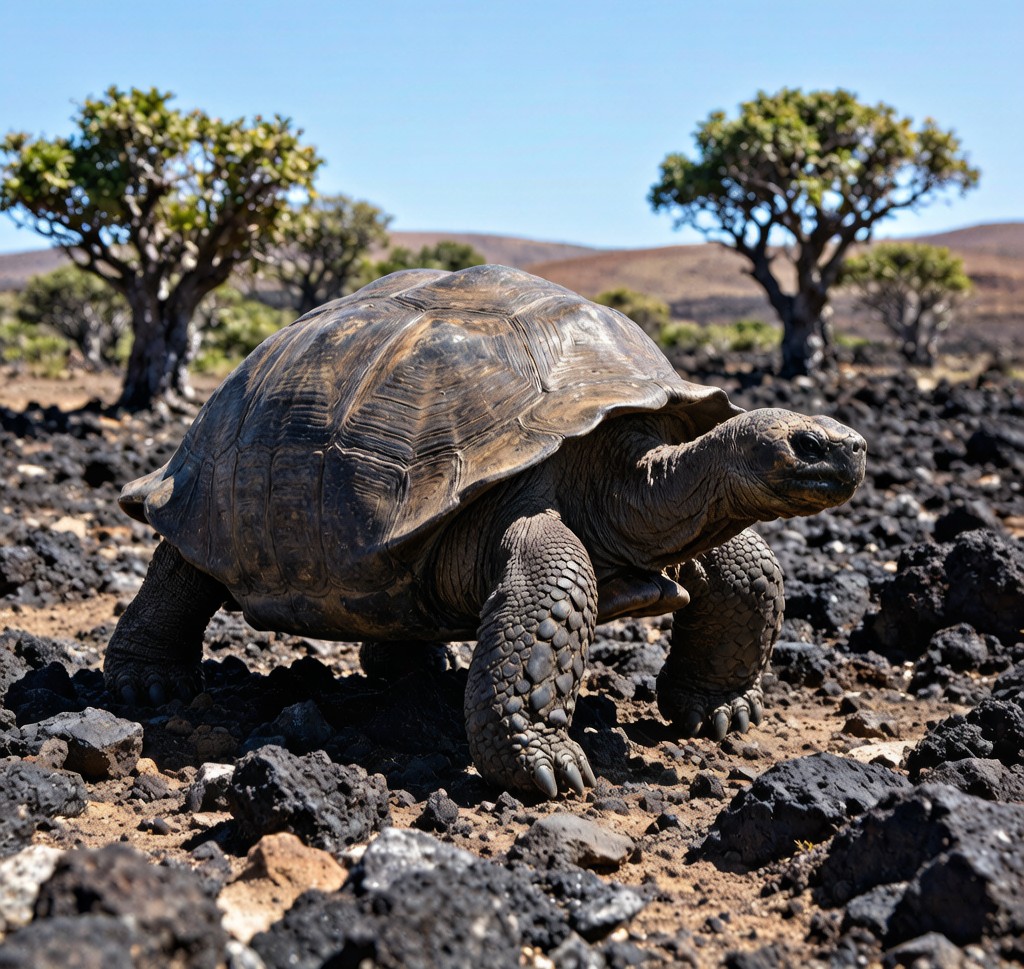
A Galapagos Giant Tortoise (Chelonoidis nigra) walking across the volcanic landscape of the Galapagos Islands, showing its enormous domed shell
Overview
The Galapagos Giant Tortoise (Chelonoidis nigra) is the largest living species of tortoise and one of the most famous animals in the history of biology – the species that helped Charles Darwin formulate his theory of natural selection during his visit to the Galapagos Islands in 1835. Found exclusively on the Galapagos Islands archipelago in the Pacific Ocean approximately 1,000 kilometers off the coast of Ecuador, the Galapagos Giant Tortoise is the largest tortoise in the world, with adults reaching shell lengths of over 1.2 meters and weights of 200 to 400 kilograms. Some individuals are believed to be over 175 years old, making the species one of the longest-lived vertebrates on Earth. The species’ enormous size, longevity, and remarkable adaptations to the island environment make it one of the most iconic animals in the world.
The Galapagos Giant Tortoise exists in two distinct shell morphs: the domed shell form, found on the larger, more humid islands with abundant vegetation at ground level, and the saddleback shell form, found on drier islands with less vegetation, in which the front of the shell arches upward above the head and neck, allowing the tortoise to extend its head upward to browse on taller cactus pads and vegetation. This variation between island populations – combined with differences in size, shape, and behavior – provided Darwin with some of the key observations that helped him develop his revolutionary theory of evolution by natural selection.
Habitat and Distribution
The Galapagos Giant Tortoise occurs naturally only on the Galapagos Islands – a volcanic archipelago of 13 major islands and dozens of smaller islands and islets in the Pacific Ocean, approximately 1,000 kilometers off the coast of Ecuador. Within this archipelago, different populations of tortoises have evolved distinct adaptations to the different environments of each island, with at least 10 distinct populations or subspecies recognized by scientists. The archipelago’s volcanic landscape – characterized by sharp lava fields, arid coastal zones, and humid highlands – has shaped the evolution of distinct tortoise morphs adapted to each habitat type.
The tortoise’s habitat requirements are fundamentally shaped by its need for water and food. During the hot, dry season (June to December), tortoises migrate to the humid highlands where vegetation is more abundant, and spend the cooler wet season (January to May) in the lowlands. During dry periods, tortoises use shared wallows and mud wallows to cool down and maintain hydration – these wallows are important social gathering points where tortoises of different ages and sizes interact. The destruction of tortoise habitat by introduced goats, pigs, and donkeys – which competed for vegetation and degraded the landscape – was the primary driver of tortoise population declines in the 19th and 20th centuries.
Biology and Longevity
The Galapagos Giant Tortoise is one of the longest-lived vertebrates on Earth, with individual tortoises regularly exceeding 100 years of age and some documented individuals surpassing 175 years. The key to the tortoise’s extraordinary longevity is its exceptionally slow metabolism, which produces relatively few oxidative free radicals – the cellular byproducts that accumulate with age and contribute to aging in faster-metabolism animals. Tortoises also have a highly effective DNA repair mechanism that helps prevent the accumulation of genetic mutations. The oldest known Galapagos tortoise – a male named Harriet, who was reportedly collected by Charles Darwin himself – died at an estimated age of 175 years in 2006 at the Australia Zoo.
Despite their enormous size, Galapagos Giant Tortoises are gentle herbivores that feed primarily on grasses, leaves, cactus pads, and fruit. They can go without food or water for up to a year during drought periods, surviving on fat reserves accumulated during periods of plenty. Tortoises are important ecosystem engineers in the Galapagos: their grazing helps maintain open habitats, their long-distance movements disperse seeds throughout the islands, and their droppings fertilize the soil. In some areas, tortoises have a mutualistic relationship with Darwin’s finches: the finches perch on the tortoise’s head and pick ectoparasites (ticks and mites) from the tortoise’s skin, benefiting both species.
Conservation
The Galapagos Giant Tortoise was nearly driven to extinction by the 19th century due to hunting by whaling and sealing ships that provisioned their ships with tortoise meat, and by the introduction of introduced mammals that devastated tortoise populations. By the early 20th century, several island populations had been entirely eliminated, and others had been reduced to a few dozen individuals. The species’ recovery from near-extinction represents one of the most remarkable conservation success stories in history, driven by the intensive breeding and repatriation programs of the Galapagos National Park and the Charles Darwin Foundation.
The species is listed as Endangered on the IUCN Red List, reflecting the ongoing threats it faces. The primary conservation challenge today is genetic contamination of wild populations: the introduction of domestic tortoises from other islands – which have been kept as pets on the islands for centuries – has led to hybridization between subspecies that were historically isolated. The breeding and head-starting program at the Galapagos National Park has been enormously successful: over 7,000 juvenile tortoises have been repatriated to their home islands since 1975, and several island populations have recovered dramatically. The discovery of hybrid individuals carrying purebred genes from extinct subspecies has also opened the possibility of genetic rescue through selective breeding programs.
[…] and other large tortoises. Genetic studies reveal complex relationships between island populations. Galapagos Giant Tortoise taxonomy continues to evolve with new […]
[…] in size and coloration. Green Iguana populations represent their distant mainland cousins. The Galapagos Giant Tortoise shares this island […]
[…] relative is the ploughshare tortoise, also Malagasy and also critically endangered. Unlike the Galapagos giant tortoise, which is much larger, the radiated tortoise is modest in size but unmatched in shell […]