 By st20113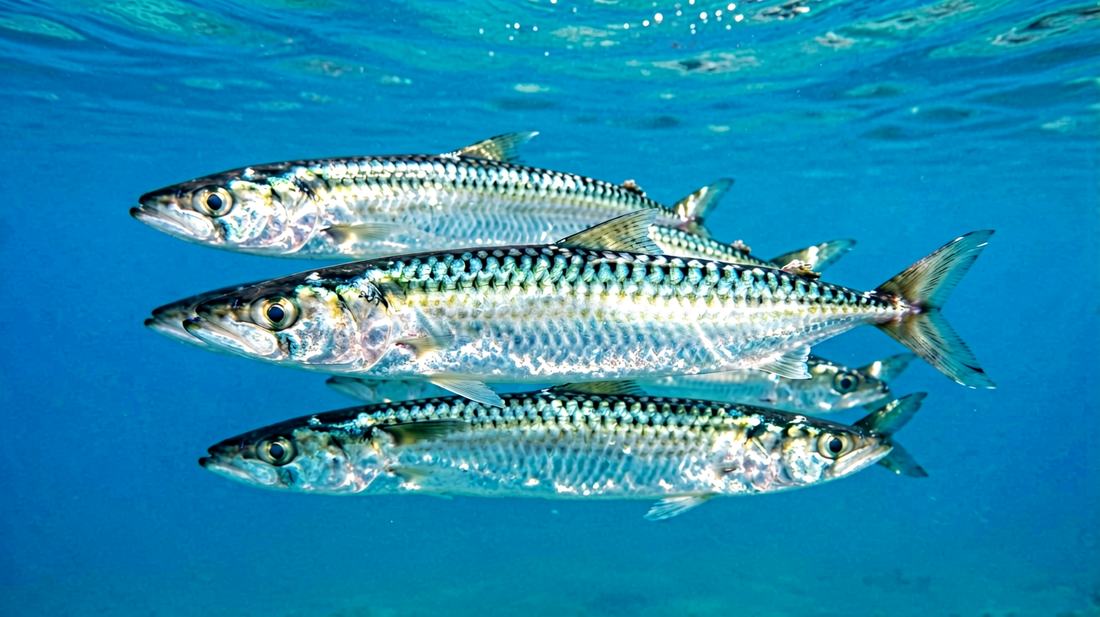
Trachurus trachurus | Atlantic Horse Mackerel
Species Profile · Carangidae
Atlantic Horse Mackerel
A slender shoaling fish of the shelf whose hard keeled flank plates earned it the Greek name for rough-tailed.
IUCN: Least Concern
Range
Length
Weight
Eggs
Depth
Not a mackerel at all
The horse mackerel
The Atlantic horse mackerel is a slim, fast fish that swims in shoals. It lives over the shelf of the sea floor. It looks much like the true mackerel. That is why it has a name it does not really deserve. The two fish are not close kin at all. Several body features set them apart. These are plain on the slab. They are less plain to the casual eye. The fish is very common.
Its shoals can fill tens of metres of water. They may cover many square km of sea. It is one of the main market fishes of the north-east Atlantic. It matters even more in the Mediterranean. There it has been landed in huge amounts for hundreds of years. It has many local market names. Its best field mark gives the genus its name. A single row of big, keeled scales runs the whole length of the flank. It runs from behind the gill cover to the base of the tail.
This gives the side a hard ridge of armour. No true mackerel has anything like it. The genus name joins the Greek words for rough and tail. The species name simply repeats it. The fish hunts small fish, krill and shrimp in mid-water. It moves with the seasons, following heat and food. Its young live among drifting weed and large jellyfish.
Family tree
Trachurus, the rough-tailed
The Atlantic horse mackerel is in the family Carangidae. That family holds about 150 kinds of sea fish. They live in warm and mild seas the world over. Many of them are market fishes. Several are very large. Among them are the true mackerels, such as the Atlantic mackerel. The horse mackerel’s likeness to that fish is only skin deep. Within the family the species sits in the genus Trachurus. That genus holds about 15 species. They live in the Atlantic, the Indian and the Pacific Oceans. All of them share the same odd flank.
Their scales form hard plates along the line. Fish in the genus look much alike. They differ mainly in the number and layout of those plates. The depth of the body and head differs too. Small details count as well. These include the gill rakers and the back bones. So naming them takes care. The Atlantic horse mackerel is easily confused with two kin. One is the Mediterranean horse mackerel. The other is the Cunene horse mackerel of the warm east Atlantic. The three are now treated as true species.
They are told apart by the plates behind the back fin. Reports suggest they cross-breed off West Africa. Gene markers show some flow of genes in the group. Three subspecies of the Atlantic horse mackerel are often named. One is from the north-east Atlantic and the Mediterranean. A second is from South Africa. A third lives in the Indian Ocean. The gaps between them are small. This split has been questioned. Fossils of the genus go back to the Eocene. The family is well kept in the Tertiary rocks of the Mediterranean.
Armour along the flank
How to identify one
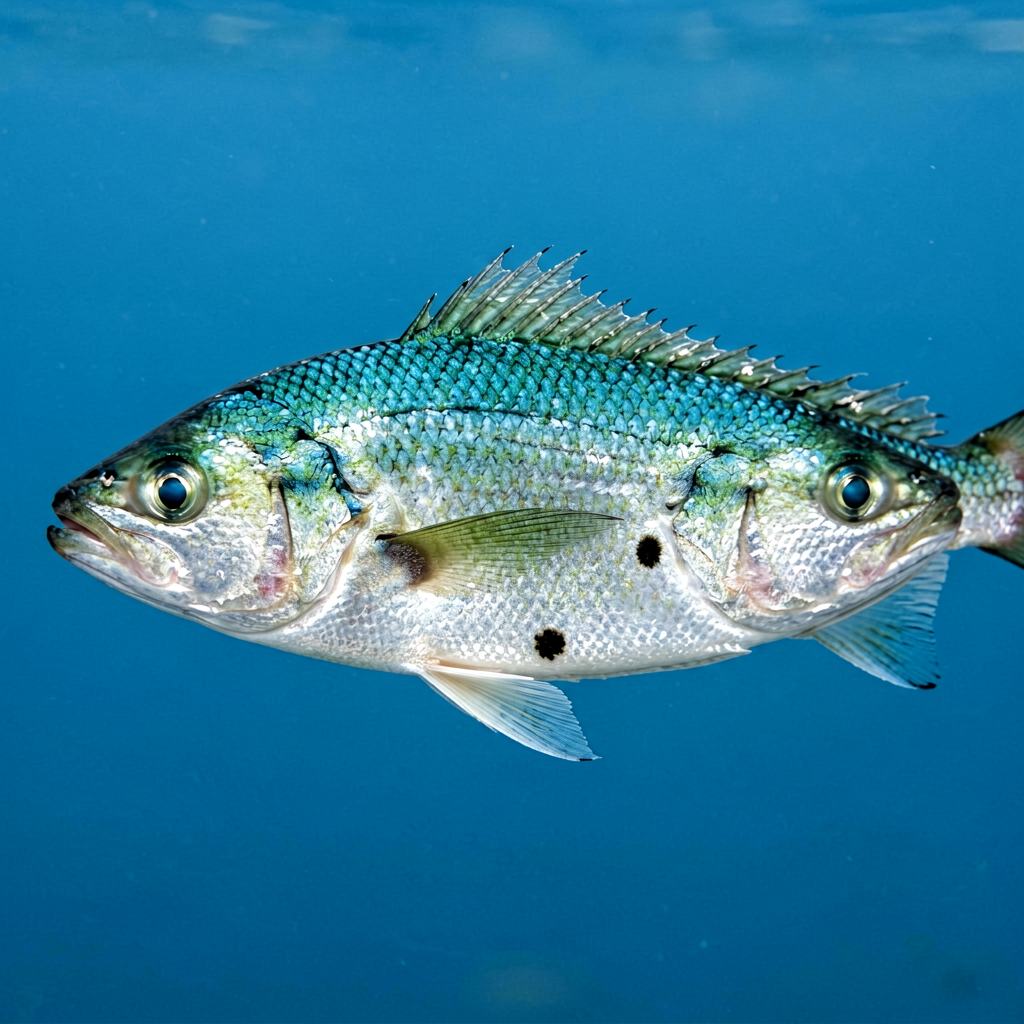
The Atlantic horse mackerel is slim and long. Its body is rounded, more so than the true mackerel’s. It looks thin, especially towards the tail. Its outline has been likened to a spindle and to a cigar. The top length is about 60 to 70 cm. The top weight is a little over 2 kilograms. Most fish taken are much smaller. The usual market size is 20 to 40 cm. The usual weight is 200 to 500 grams. Size shifts with latitude and region. The largest fish come from the Bay of Biscay and Atlantic Iberia. Smaller ones come from the north and east of the range. The head is short and the snout a little pointed.
The mouth is at the front and slanted. The lower jaw juts a little past the upper. The upper jaw bone reaches back to below the front of the pupil. The teeth are small, in a single row on the jaws. There is also a patch on the roof of the mouth. That suits a diet of fairly small prey. The eyes are fairly large and set high. The back fin is very long. It runs almost the whole length of the back. A notch splits it into a spiny front and a soft rear. A row of small single fins follows the soft part. The fin below is built the same way. The side fins are long, slim and much curved.
They reach well past the fin below. They sit high on the flank. The belly fins are small and sit below and a little behind the side fin base. The tail is deeply forked, with a strong lower lobe. The tail gives most of the thrust. The colour is blue-green or grey-green on the back. This fades to silver on the flanks and white on the belly. A small black or dark blue spot sits on the upper gill cover. It lies level with the top of the side fin base. That spot is the single best field mark in a mixed catch. The plates along the line are pale or a little dark. They stand out as a hard ridged band along the fish.
1
2
3
Shelf, slope and open sea
Where it lives
The Atlantic horse mackerel lives across the north-east Atlantic and its nearby seas. Its range runs from Norway and the northern North Sea southwards. It follows the coasts of Britain, Ireland, France, Iberia and West Africa. It reaches as far as southern Africa. It is common across the Mediterranean and the Black Sea. The species is absent from the west Atlantic. There its place is taken by the rough scad and other American kin. It is a fish of the shelf and the upper slope. It occurs from the surface down to about 1,000 metres. It is most common between about 20 and 200 metres. It lives mostly in mid-water, in the open sea.
It forms shoals of very different sizes. Divers in coastal waters see modest groups. Sound surveys over the shelf edge record vast schools. These may lie 20 to 40 metres below the surface. They may stretch for several km across. The species makes large seasonal moves in the north-east Atlantic. It moves inshore and north in spring. It moves offshore and south in late autumn and winter. The mid-water trawl and purse seine fleets take most fish on these moves. The main grounds lie west of the British Isles and off Portugal. Water heat has a strong effect on range.
The fish live mostly between about 8 and 20 degrees Celsius. They appear in the north only in late summer and autumn. The shoals also follow their drifting prey. They rise towards the surface at night and sink through the day. Young fish of 5 to 15 cm act differently. They stay close to drifting weed and floating debris. They also swim beside large jellyfish, sheltering under the bell or near the tentacles. The link seems to give them both cover and a free ride. Some Mediterranean and east Atlantic fleets take these young in large numbers. They are sold as bait.
Krill and small fish
What it eats
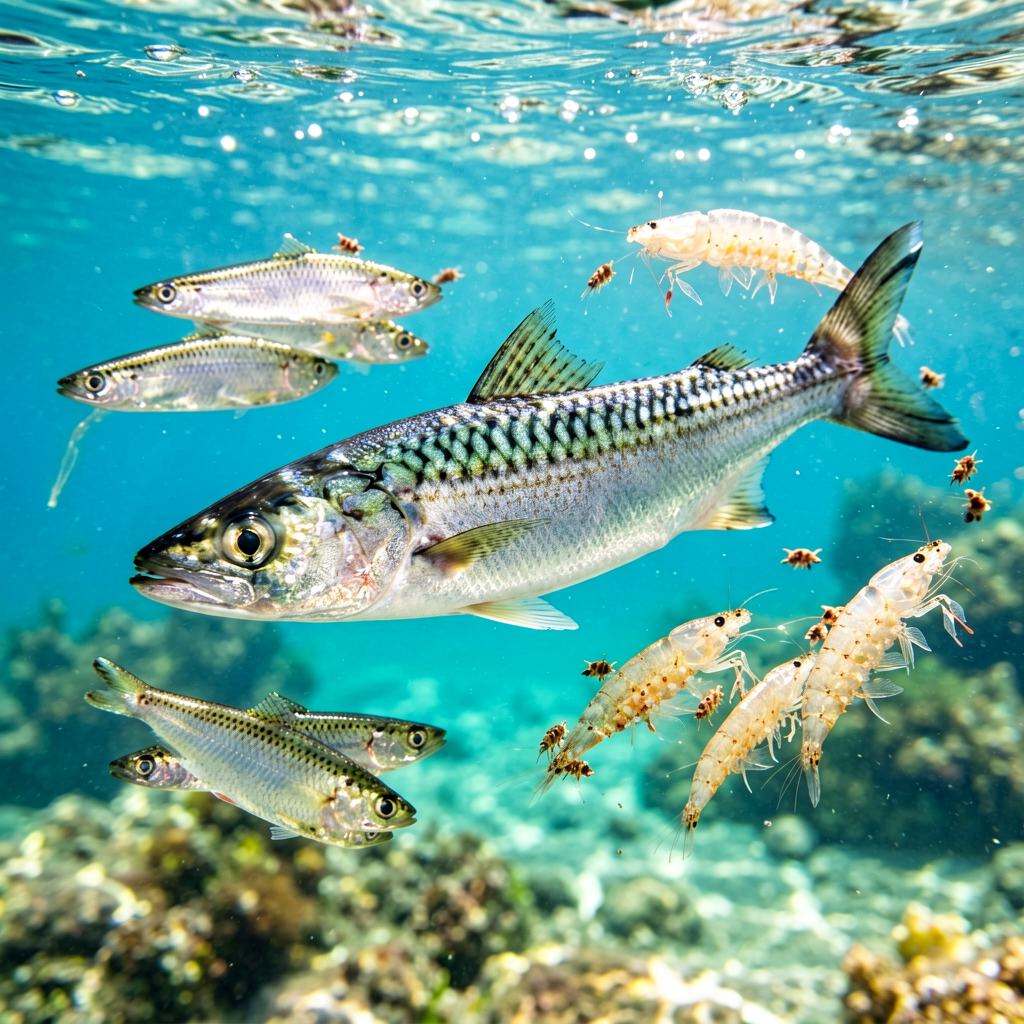
The Atlantic horse mackerel eats drifting life and small swimming animals. Its diet changes a great deal with age and season. Adults feed mainly on small fish of the open sea. They also take krill and other large drifting crustaceans. Shrimps of the open sea and young squid are eaten too. In the Mediterranean the sardine and the anchovy matter most. In the north-east Atlantic the young of blue whiting, Norway pout and sprat matter. So do the young of the horse mackerel itself. Larger fish at times eat smaller ones of their own kind.
Krill are taken in bulk. Shoals work the dense patches of these crustaceans over the shelf edge. The fish also take many other crustaceans. These include the young of shrimps and crabs. They are common in coastal waters at some times of year. Tiny shrimps and sand hoppers are eaten as well. Small fish feed largely on tiny shrimps. This is most true of the young sheltering under jellyfish. They also eat the smaller crustacean young.
The change to larger prey and fish comes slowly with growth. It follows the growth of the swimming organs and of the gape. Because the species hunts in shoals, it feeds as a group. The shoal can focus on patches of prey. A single fish could not work those patches well. So the species can crop dense swarms of krill and small fish very fast. Feeding seems busiest around dawn and dusk. At those times the daily rise of drifting life brings prey within reach. Through the middle of the day the shoal rests in a looser group near the bottom.
A long spawning season
The breeding cycle
The Atlantic horse mackerel spawns in batches over a long season. The season varies a great deal with latitude. In the Mediterranean it runs from about December to June. In the north, around Britain and in the North Sea, it runs from about June to August. Across the north-east Atlantic as a whole the species spawns through most of the year. The fish mature at 2 to 4 years old. In the north-east Atlantic that means a length of about 20 to 25 cm. Spawning fish move to the spawning grounds. These are often in water of 50 to 200 metres over the shelf and shelf edge. In some areas they lie well offshore.
In others they gather in coastal waters. The exact spot varies between stocks and years. Spawning means shedding eggs into the water in a series of batches. The female sheds part of her eggs every few days over several weeks. Egg output is high. A female of 40 cm makes about 100,000 to 500,000 eggs in a season. The larger Mediterranean fish make much more. The eggs are small, clear and light. They are about 1 mm across. They grow in the surface layers.
They hatch after 2 to 4 days, depending on heat. The young drift with the currents. They leave the drifting life at about 3 to 5 cm. They then begin to stay near drifting objects and jellyfish. Growth is fairly quick for a fish of this size. In the north-east Atlantic it reaches about 15 cm at one year. It reaches about 22 cm at two years and about 28 cm at three. Females live about 9 to 11 years. Males live a little less. Growth rate varies with water heat and with how many fish there are.
Fished hard, still numerous
Least Concern but watched
The Atlantic horse mackerel is Least Concern worldwide. The species is in no near danger of dying out. Its range covers the whole north-east Atlantic from Norway to southern Africa. It also has the Mediterranean and the Black Sea. The stock is very large. It has been put at several million tonnes. The species is still among the most heavily fished of the region. Yearly landings in the north-east Atlantic and the Mediterranean have swung a lot. They have at times passed half a million tonnes.
Global checks have found the stock again and again below the level for the best long-term catch. The number killed has been above the target. So the species has been under catch limits. Some areas and seasons have been closed. The horse mackerel is hard to manage. Adults are spread widely over the shelf. They are taken along with mackerel, herring and sardine. So the number killed cannot be set by one direct rule. Young fish crowd into coastal shelf waters.
They are taken in bulk as bait and as factory fish. They also turn up in inshore nets. Cutting this toll on young fish has been named a key aim. There is a wider point. The horse mackerel is a key food fish. It forms a large part of the diet of hunting fishes, seabirds and sea mammals. So shifts in its numbers reach beyond the fishery. Managing the whole open-sea group of the north-east Atlantic is hard. The horse mackerel sits at its centre, linking drifting life to larger hunters.
Quick hits
Five things to remember
- Despite its English name the horse mackerel is not a mackerel at all but a member of the jack family, and the horse part refers to the coarse armour plating along its flank.
- The row of hard keeled plates running the whole length of the flank gives the fish its genus name, which is simply the Greek for rough-tailed.
- Young horse mackerel shelter beneath the bell of large jellyfish and beside drifting weed, gaining both cover and a free ride from the link.
- The shoals follow their drifting prey up towards the surface at night and sink back into deeper water by day, and the fishery tracks this daily move.
- A single large female can shed half a million eggs in a season, casting them out in batches over several weeks rather than all at once.