 By st20113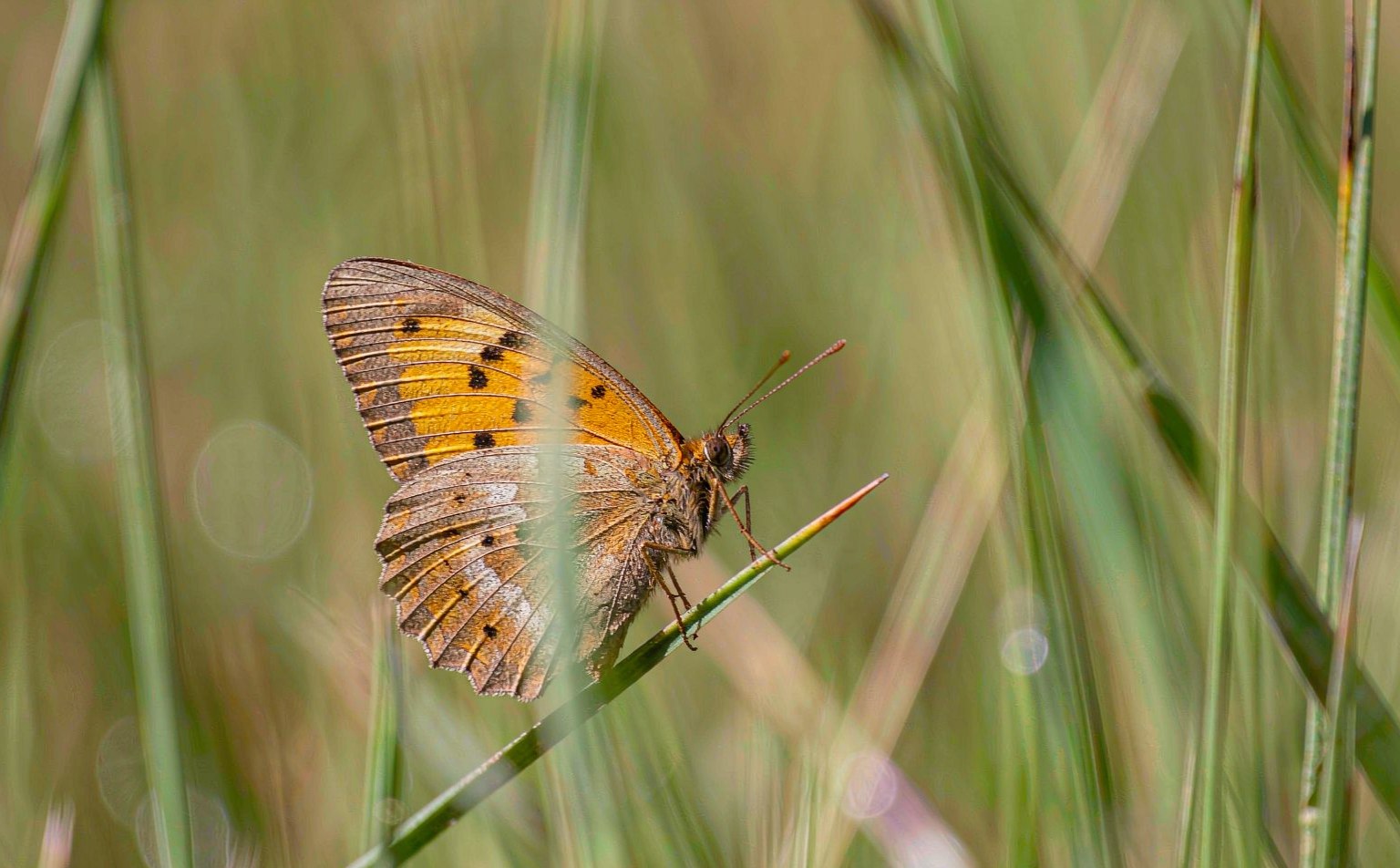
Thymelicus sylvestris | Small Skipper
Introduction
The Small Skipper (Thymelicus sylvestris) is a compact, bright orange grassland butterfly that flits low over tussocky grass from late June to August across southern and central Britain and through much of temperate Europe. With a wingspan of around 25 to 30 millimetres it is noticeably smaller and daintier than its relative the Large Skipper, yet it shares the same restless, bouncing flight that barely lifts above the grass heads.
To the eye it is an almost uniform golden-orange butterfly with slender antennae tipped in black, and it is most often encountered in warm, sheltered grassland where the grass stems themselves provide both food and shelter. Though small and easily overlooked, the Small Skipper can be abundant in a good meadow, dozens of them rising from a single clump of grass as one walks through.
Taxonomy
The Small Skipper was described by the Austrian naturalist Michael Denis and the German entomologist Ignaz Schiffermüller in 1775, and it sits within the skipper family Hesperiidae, subfamily Hesperiinae. It is placed in the genus Thymelicus, a small northern group of slender, grass-feeding skippers that also includes the Essex Skipper. Its life style and grassland niche overlap closely with that of the Pieris rapae and other meadow butterflies that share the same flower-rich swards.
Distinguishing the Small Skipper from the near-identical Essex Skipper in the field rests on the antennae: in the Small Skipper the underside of the club is orange, whereas in the Essex Skipper it is black. This subtle mark is the standard field character used by recordeders across its range.
Physical Characteristics
The upper wings are a clean, bright orange-brown without the strong dark margins seen in many butterflies, and the body is slender and furry with a golden sheen. The underside of the hindwing is a plain straw or olive-yellow, unmarked except for a faint dusting, which helps separate it from the more heavily spotted skippers.
The most reliable identification feature is the antenna: the club is hooked and the underside of that club is orange in the Small Skipper. Males carry a narrow, greyish sexual brand along the forewing, far less obvious than the bold black streak of the Large Skipper, and females are slightly paler and lack the brand. At rest the wings are usually held at a shallow, half-open angle.
Habitat
Small Skippers are butterflies of tall, sunny grassland: hay meadows, roadside verges, railway embankments, hedgerows and the rough margins of fields and gardens. They need stands of fine grasses such as Yorkshire-fog, couch and false brome, and they favour sites that are warm, sheltered and left uncut through mid-summer.
They are essentially a lowland and southern species, thinning out rapidly in the north and at altitude where summers are cooler. Within their range they can be extraordinarily local, absent from one seemingly suitable field yet abundant in the next, a pattern driven by the precise mix of grasses and the timing of cutting.
Diet
The larva feeds on fine grasses, especially Yorkshire-fog (Holcus lanatus), cock’s-foot (Dactylis glomerata) and various bents and fescues, spinning a silken tube among the blades and feeding from within. Eggs are laid on or near these grasses and the young caterpillar establishes itself low in the sward before the summer ends.
Adults are avid nectar feeders and visit a broad palette of shallow flowers. Bramble, thistles, knapweed, ox-eye daisy, bird’s-foot trefoil and lavender are all used, and in gardens the Small Skipper will work lavender spikes and open perennials with restless energy. Like other skippers it prefers accessible blooms that suit its relatively short proboscis.
Reproduction
The Small Skipper is univoltine, producing one brood a year. Females lay their eggs singly on grass blades in July, and the larva hatches, feeds briefly and then spins a hibernaculum in the grass where it passes the winter as a tiny caterpillar. Development resumes in spring and the larva pupates low among the stems.
The pupa is pale green at first, darkening before the adult emerges in early summer. Adults mate soon after emergence, and the short, intense flight season means that nearly all individuals are on the wing together across a few weeks in high summer, a synchrony that makes counts relatively straightforward.
Conservation
In Britain the Small Skipper has expanded its range northward in recent decades, tracking warmer summers, and it is currently regarded as common and not of conservation concern. Across Europe it remains widespread and frequent in appropriate habitat.
Its fortunes are tied directly to grassland management. Early, blanket mowing and heavy grazing remove the tussocks and the uncut litter the larvae need, and such practices have eliminated the species from many amenity grasslands. Leaving roadside verges and field margins uncut until late summer, and allowing fine grasses to persist, is the single most effective action for maintaining healthy populations.
Fun Facts
- The orange underside of the antenna club separates it at a glance from the black-clubbed Essex Skipper.
- Males patrol low over the grass in a looping, bouncing flight searching for females.
- Despite the name, the Small Skipper can be one of the commonest butterflies in a warm meadow.
- The caterpillar spends the winter as a tiny larva, only completing its growth the following spring.
- It has spread northwards in Britain as summers have warmed, a clear response to climate.