 By st20113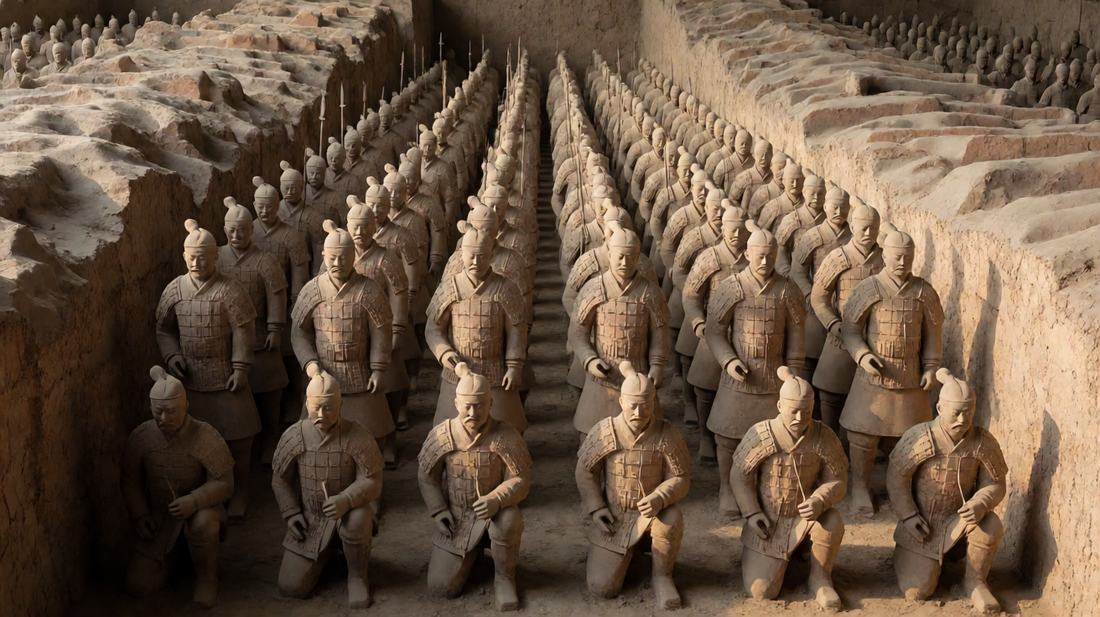
The Terracotta Army | The First Emperor’s Tomb
Historical Profile · Xi’an, China
The Terracotta Army | The First Emperor’s Tomb
Thousands of clay soldiers buried in ranks beside the tomb of China’s first emperor, made to a fixed standard and hidden under the earth for two thousand years.
c. 246-210 BC
Buried
Found
First pit holds
China united
Listed
The big picture
Introduction
The Terracotta Army is a group of clay figures. They were buried near the tomb of Qin Shi Huang. He was the first emperor of a united China. The figures stand in long rows under the ground.
They face east. They were buried in about 210 BC. Then they lay there for 2000 years. Well diggers found them in 1974.
The pits have been dug out with care ever since. No two faces are quite the same.
Setting
Historical Context
The army was made for a ruler who had just won a long war. In the 200s BC China was split among states that fought without pause. The state of Qin lay in the west. In the 300s BC its kings began to rebuild their lands for war. Farms were listed, taxes were fixed and the army drilled hard.
From 230 BC the Qin armies moved east. By 221 BC the king of Qin ruled the whole north plain. He took a new title for himself. He was the first emperor. He made weights, measures and the written script the same everywhere.
He joined up the walls in the north. He built straight roads out from his capital. Some of those roads ran west. They later carried the trade of the Silk Road.
Turning points
Key Events
Work on the tomb began early. He came to the throne of Qin in 246 BC as a boy. The texts say the burial place was started that year. The tomb lies under a mound about 76 m high. The army is only one part of a larger site.
The emperor died in 210 BC. The work was not finished. The pits had been built and filled. Other parts were still under way. The tomb was sealed.
In the years after, the dynasty fell apart. Its enemies broke into the site. Later writers said the tomb was robbed and burned. The pits show damage and traces of fire. Nothing more was known for 2000 years.
1
2
3
Who held power
People and Powers
The tomb shows what the Qin state thought power looked like. The emperor appears nowhere in the pits as a figure. The army stands in for him. The files of clay soldiers face east. That is the direction of the states he had beaten. The whole layout repeats the order of a real camp.
The men who ran the state were officials. The chief minister, Li Si, had risen through the ranks. Below him stood a body of trained clerks. They kept registers of land, people and taxes. The empire was split into commands with appointed governors. The old landed families lost much of their power.
The work was done by a very large body of labour. Some were craftsmen who were paid for their skill. Some were conscripts sent by the state. Each workshop had its own mark.
Everyday world
Daily Life and Society
The figures tell us how soldiers of the time were equipped. The ranks are arranged by type. In the front pits are archers. Some stand and some kneel. Behind them come the spearmen and the halberdiers. In the middle of the line are the chariots.
Each has a driver standing beside it. Officers stand apart from the men. They are taller, and their armour is more ornate. The ordinary soldiers wear a simple tunic. Over it goes a coat of small square plates. Their hair is tied in a knot on the right.
Every figure was modelled with care. Hands, feet and ears came from moulds. The faces were finished by hand. The result is a set of distinct types. No one face is the same as the next.
Craft and ideas
Trade, Technology and Ideas
The army is also a record of what the workshops could do. The bronze weapons were made to the same pattern. A broken spearhead could be replaced from stores. The blades are coated with a thin layer of metal. That is one reason they came out still bright. The crossbow was the standard missile weapon.
Its trigger is a small cast unit. The parts fit together across different weapons. Making the figures was a problem of a different kind. A life sized clay body is heavy. A solid mass would crack as it dried. So the legs were made solid and the rest hollow.
The arms and the head were added later. The figures were fired in kilns near the site. The finished surface was painted. Most of the paint has since come away.
What lasted
Legacy
The pits were listed as a world heritage site in 1987. They are now the main draw of the city of Xi’an. Only part of the first pit stands fully open. The first pit holds more than 6000 figures.
The site matters for two reasons. The first is what it shows about the Qin state. The Qin empire lasted only 15 years. Yet the script, the roads and the idea of one ruler at the centre all survived it.
The second is what it shows about the men who did the work. The figures were never meant to be seen. They were made to be buried. Yet the care taken over them is the same as if they had stood in the open air.
Quick hits
Five Things to Remember
- The Terracotta Army was buried near the tomb of Qin Shi Huang in about 210 BC.
- Well diggers found the figures in 1974, and the first pit holds more than 6000 of them.
- The emperor united China in 221 BC and made the script and the measures the same.
- The figures stand in ranks facing east, with archers, spearmen and chariots.
- The pits became a world heritage site in 1987.