 By Iris
Tetragnatha extensa | Common Stretch Spider
Species Profile · Tetragnathidae
Common Stretch Spider
The spider that turns itself into a grass stem — a long, thin orb weaver that sits stretched out flat along a reed and is almost impossible to see.
Common and not threatened
Range
Body
Web
Legs
Habitat
The spider shaped like a stem
Stretched out and almost invisible
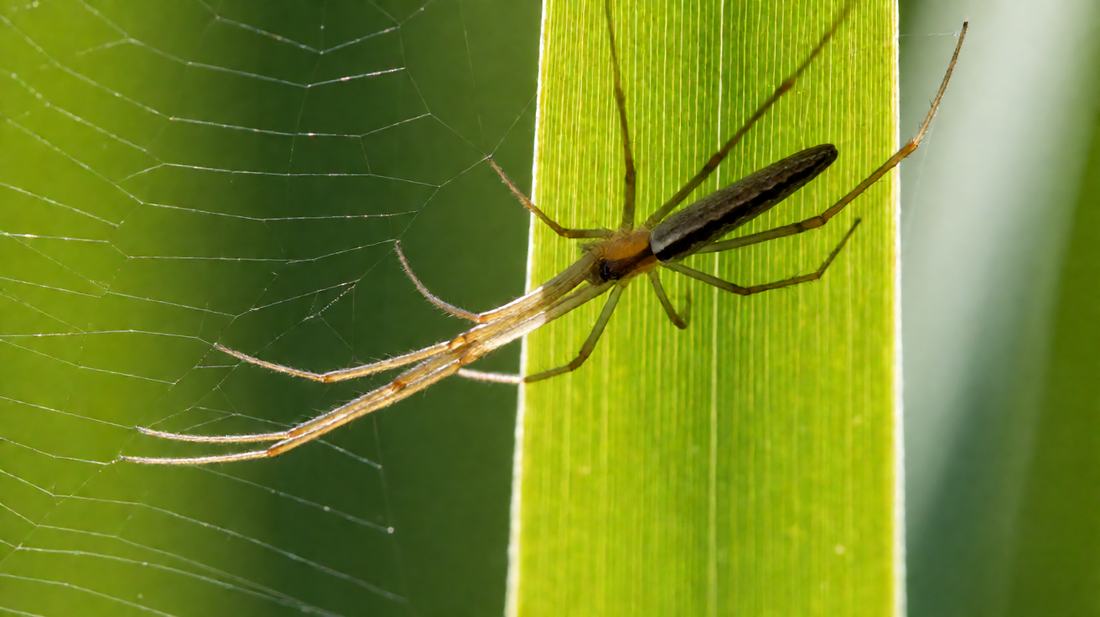
The Common Stretch Spider is one of the easiest spiders in Europe to know. Its whole body and its whole way of life are built around the shape of a grass stem. The animal is extremely long and narrow. It has a slim cylindrical abdomen and 8 very long, thin legs. It almost always sits stretched out flat along a reed or a blade of grass. Its legs are held forward and back in a single line.
In this pose it looks far more like a piece of the plant than like a spider. The disguise works so well that the animal can be almost invisible. It may sit right in front of a person’s eyes. The colours help too. The body is a yellow-brown or greenish shade with a silvery sheen. A dark band runs down the middle of the back.
This matches the tones of the plants around it. The species is small, with females reaching 11 mm and males only 8 mm. It lives in low plants near water all across the northern world. It is a completely harmless animal that almost never bites a person.
Family tree
Tetragnathidae, the long-jawed orb weavers
The Common Stretch Spider sits in the family Tetragnathidae, the long-jawed orb weavers. It belongs to the genus Tetragnatha. It was described by Linnaeus in 1758. The family Tetragnathidae sits within the great group of orb-weaving spiders. It is defined by a set of features that the Common Stretch Spider shows very clearly. The jaws are very long. The body is stretched out.
The legs are unusually long and thin. The family is a large one and it is found all over the world. It is richest in the tropics. Within the family the genus Tetragnatha is a big group of about 300 species. Almost all of them share the same long body and the same habit of stretching out along a stem. The genus is set apart from the other long-jawed orb weavers by the arrangement of the eyes and by the teeth on the jaws. The genus name comes from the Greek words for 4 and jaw.
This refers to the 4 long teeth on the jaws of most species. The species name extensa is Latin for stretched out. This describes both the body and the resting pose. The Common Stretch Spider shares its order with the garden cross spider. That is the big round-bodied spider of every autumn garden. The 2 are set apart by their body shape and by where they build. But they sit in the same order and both spin an orb web.
Long body, long jaws
How to tell one
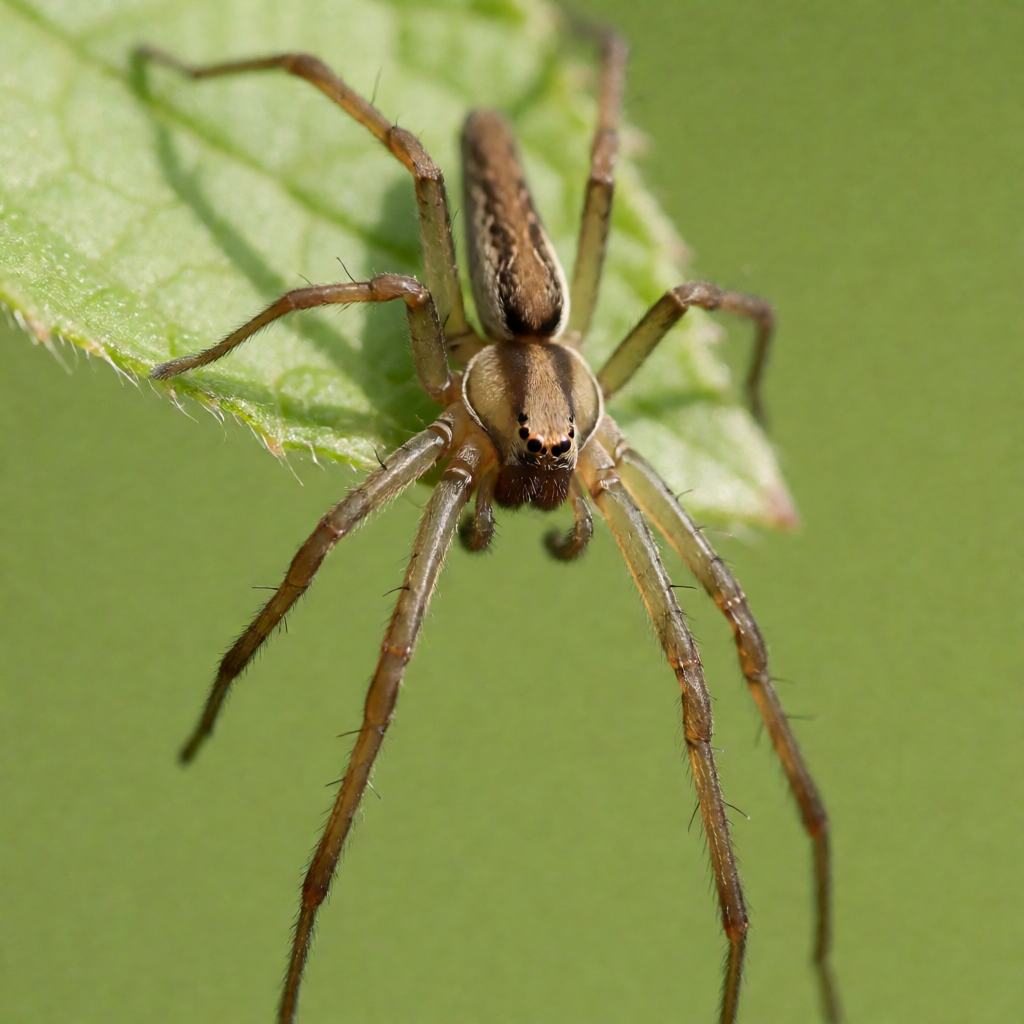
The female of the Common Stretch Spider reaches 8 to 11 mm in body length. The male is smaller at 6 to 8 mm. The body is very long and narrow. The abdomen is cylindrical rather than round, which is unusual among orb weavers. The colour is a pale yellow-brown, olive or greenish. A fine silvery sheen covers the upper surface.
A dark brown or black band runs down the middle of the back. The legs are extremely long, thin and almost free of spines. They are often held completely straight, so the whole animal forms a single line. The jaws are long and prominent. They carry a row of several strong teeth. These jaws are used to hold prey, and they also play a central part in mating.
The eyes number 8. They are arranged in 2 rows of 4 on the front of the head. But they are small, and the animal relies at least as much on vibration as on sight. The female is noticeably larger and heavier than the male. She has a fuller, more rounded abdomen. The front legs are the longest of all.
1
2
3
Waterside grass and reeds
Where it lives
The Common Stretch Spider lives in low, damp plants. It is rarely found far from water. It is common in tall grass, reeds, sedges and rushes. It also lives on the leaves of low bushes and hedgerows. It is found along the edges of ponds, streams and ditches and in wet meadows and marshes.
It also turns up in gardens, on fence posts and among flowers in damp places. Its range covers the whole of Europe and much of Asia and North America. It reaches into northern Africa. This makes it one of the most widely spread spiders in the northern half of the world. It is very common in Britain and Ireland.
A careful search of any patch of waterside plants in summer will usually turn up several. The species builds its web among the stems, usually 20 to 60 cm above the ground. It often builds over water, where the web catches the small flies that swarm above the surface. The spider is at its most numerous in the middle of summer. In Britain adults are mainly seen from May to September.
Small flies in a fine web
What it eats
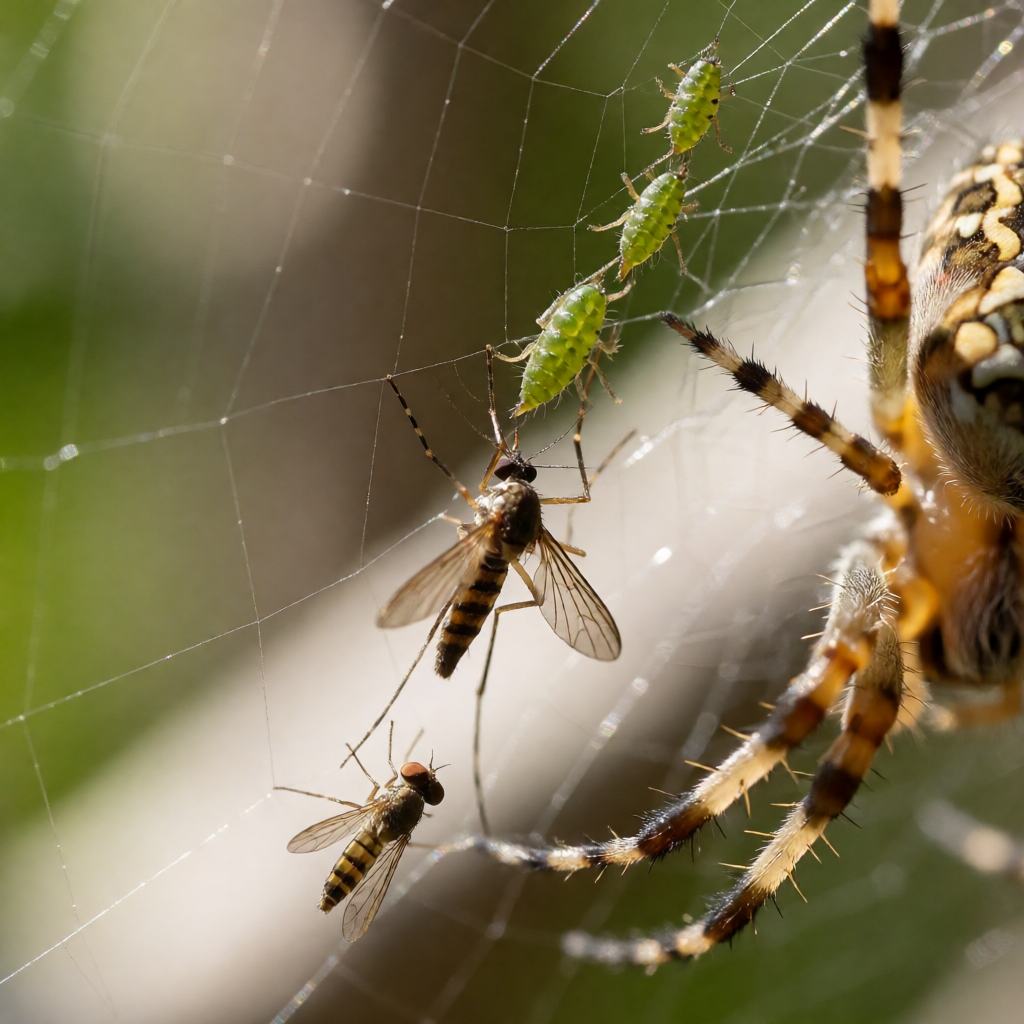
The Common Stretch Spider eats small flying insects. Its web is made to catch exactly that kind of prey. The main food is midges, small flies, mosquitoes, small moths and winged aphids. The size of the web and the strength of the silk set the upper limit on what it can hold. The web is an orb, built on a flat or slightly tilted plane among the plant stems. It has a notable feature.
The centre of the web is left open as a hole rather than being filled with silk. The spider sits at the edge of this hole or stretched along a nearby stem. It holds the web with its long front legs. It feels the vibration when an insect is caught. It then runs across the web, wraps the prey in silk and bites it. The poison is weak and harmless to a person.
But it is quite enough for a midge. The spider feeds mainly at dusk and at night, when the small flies are most active. It may rebuild or repair the web every day or two. It can live several days without food.
Jaws locked, then an egg sac
The breeding cycle
The Common Stretch Spider mates in the summer. The mating itself is unusual because of the animal’s long jaws. The male comes close to the female and uses his own jaws to lock onto hers. He holds them so that she cannot bite him while he passes sperm. The 2 animals may stay locked together in this position for a long time. Sometimes they remain joined for over an hour.
Before mating, the male spins a small web. He puts a drop of sperm on it and takes the sperm up into the tips of his pedipalps. These are the small limbs beside the mouth. After mating, the female builds a flat, oval egg sac of grey or white silk. She fixes it to a leaf or a stem near the web. She guards it until the young spiders come out.
A female may make several egg sacs in one season. The young hatch after a few weeks. They stay near the egg sac for a short time before they move away. In Britain the species spends the winter as a young spider or as an egg. The young grow through the spring and become adults in early summer.
Common and not threatened
Conservation
The Common Stretch Spider is not threatened. It has not been placed on any Red List, and it is common over a very large part of the northern half of the world. There is no evidence of any decline in the species across most of its range. The main risks to it are local and they are linked to water and to plants.
The draining of ponds, ditches and wet meadows removes the habitat the species needs. The heavy cutting or spraying of waterside plants destroys both the web sites and the small flies that make up its food. The species also suffers from the loss of rough, uncut wetland edges on farmland. This is the same change that has affected so many other small animals of damp ground.
On the other hand, the spider is an adaptable animal. It readily uses garden ponds, canal banks, wet corners of fields and even roadside ditches. So it survives well in places that have been changed by people. No special measures are in place for the species, and none are needed at present.
Quick hits
Five things to remember
- The animal almost always sits stretched out flat along a stem with its legs in a single line, and in that pose it looks like part of the plant.
- The web is an orb with a hole left open in the middle, which is unusual among orb-weaving spiders.
- The male locks his long jaws onto the female’s jaws during mating, and the 2 animals may stay joined like that for over an hour.
- The species is completely harmless to people, and its weak poison is only strong enough to deal with a midge.
- Its range covers Europe, much of Asia, North America and northern Africa, which makes it one of the most widely spread spiders of the north.