 By st20113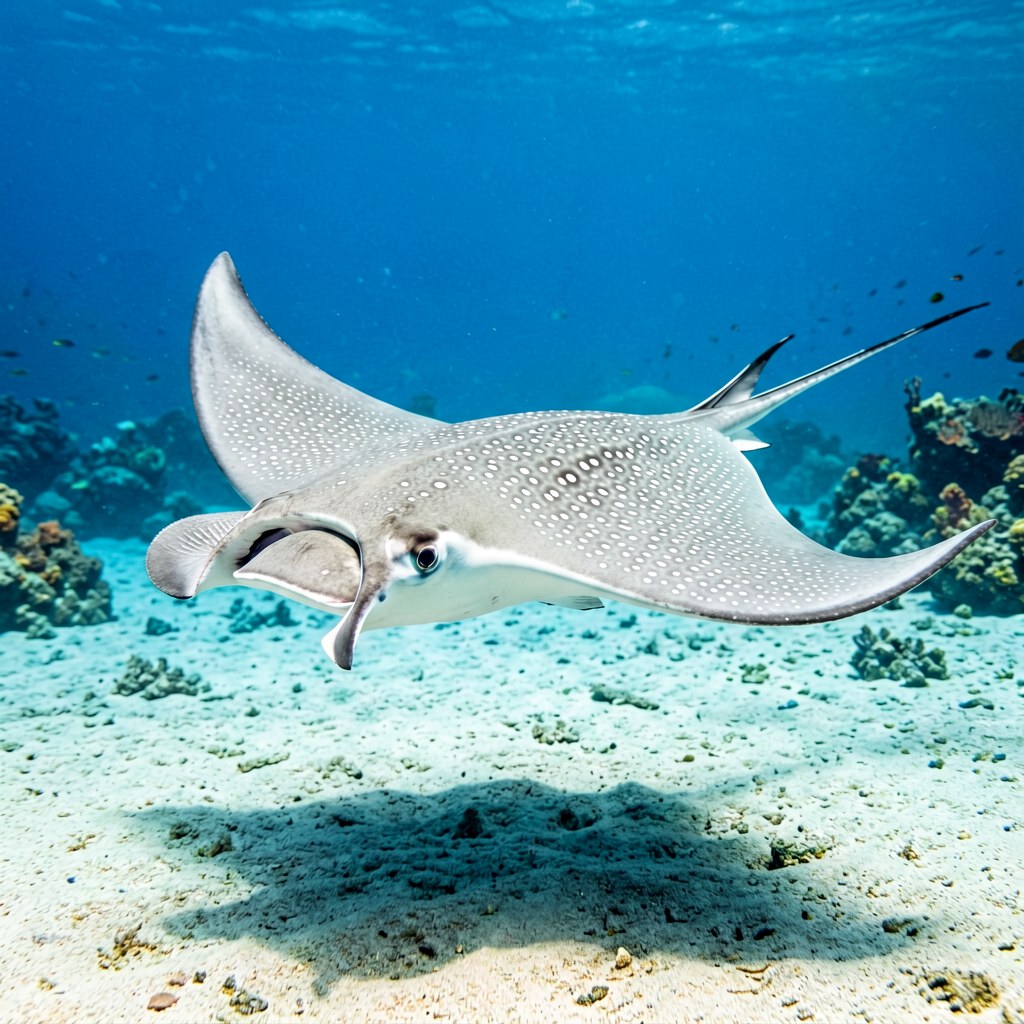
Sphyrna mokchan | Smallspotted Eagle Ray
Introduction
The smallspotted eagle ray, widely recognized in the scientific literature as the spotted eagle ray, is one of the most strikingly patterned batoids in tropical and warm-temperate seas. With its diamond-shaped pectoral disc, long whip-like tail, and dark back adorned with bright white spots, it is a favorite subject for divers and underwater photographers across the Indo-Pacific and western Atlantic. Adults can reach a disc width of nearly three meters and a total length exceeding five meters when the long tail is included, with the largest individuals weighing more than 200 kilograms. Although the ray is capable of sudden bursts of speed and can leap clear of the water when fleeing predators, it is generally a calm, schooling species that forages over sandy flats and coral reefs. Its graceful, wing-like swimming and distinctive coloration make it one of the most recognizable members of the ray fauna.
Taxonomy
The smallspotted eagle ray is placed in the order Myliobatiformes, the eagle rays and their relatives, and in the family Myliobatidae, which also includes manta rays and cownose rays. Its scientific name has been applied as Aetobatus narinari in most regional faunas, though genetic work has revealed several cryptic species across its broad range that were once lumped under one name. As a cartilaginous fish it shares the basic chondrichthyan body plan with sharks, and among living relatives it is distantly connected to swift open-ocean forms such as the [Blue Shark](https://www.gloencyc.com/prionace-glauca-blue-shark/), which also relies on a cartilaginous skeleton and placoid denticles. Unlike sharks, however, eagle rays have flattened bodies, enlarged pectoral fins fused to the head, and a ventrally located mouth adapted for benthic feeding. The genus name Aetobatus derives from Greek words meaning “eagle ray,” a reference to the bird-like beating of the pectoral fins during swimming.
Physical Characteristics
The smallspotted eagle ray has a rhomboidal pectoral disc that is broader than it is long, with pointed, wing-like tips that give the animal its soaring appearance. The dorsal surface is a deep blue-black to olive brown, marked with an irregular scatter of creamy white or yellow spots that are unique to each individual, while the underside is uniformly pale. A short, blunt snout projects forward between two enlarged, paddle-shaped cephalic fins that the ray uses to shovel prey from the substrate. The eyes sit on top of the head and the small gill slits are located on the underside, a layout typical of rays. The tail is slender, whip-like, and far longer than the body, bearing one or more slender venomous spines near its base that deliver a painful defensive wound to predators. Dentition consists of broad, flat, paved teeth arranged in plates, ideal for crushing the shells of mollusks. Males possess claspers formed from the pelvic fins, and mature individuals develop a row of small, thorn-like dermal denticles along the midline of the back.
Habitat
Smallspotted eagle rays inhabit warm coastal waters from the surface down to about 80 meters, favoring coral reefs, sandy lagoons, seagrass beds, and the soft bottoms of bays and estuaries. They are frequently seen gliding over shallow reef flats at high tide and moving into deeper channels and outer reef slopes as the water cools or food becomes scarce. The species ranges across the tropical and subtropical Atlantic, the Indo-Pacific from the Red Sea to Hawaii, and the eastern Pacific, though separate regional stocks show genetic divergence. Seasonal aggregations form in response to breeding and to the movement of prey schools, with some populations undertaking localized migrations along coastlines. Juveniles tend to remain in shallow, sheltered nursery habitats such as mangrove-lined bays where predation pressure is lower. Because they depend on both productive inshore habitats and clear offshore reef systems, the rays are sensitive to coastal degradation, sedimentation, and the loss of seagrass meadows.
Diet
The smallspotted eagle ray is primarily a benthic forager that feeds on a mixed diet of mollusks, crustaceans, and small fishes. Bivalves such as clams, oysters, and mussels make up a substantial portion of the intake, and the ray uses its powerful, plate-like teeth to crush shells before swallowing the soft tissue. Gastropods, squid, and various decapod crustaceans are also eaten, while small bony fish and polychaete worms round out the diet in many regions. Foraging is aided by the cephalic fins, which are used to probe sediment and to direct food toward the mouth, and by electroreceptive ampullae of Lorenzini that detect buried prey. Stomach content studies indicate strong seasonal switching, with mollusks dominant in warmer months and crustaceans more important during cooler periods. Because the ray consumes large numbers of bivalves, it can influence local shellfish communities and, where abundant, may compete with human shellfish fisheries.
Reproduction
Reproduction is ovoviviparous, with internal fertilization delivered by the male’s claspers and the young retained within the mother until they are fully formed. After a gestation period of roughly one year, the female gives birth to a litter of two to six live pups, though litters of up to eight have been recorded in some populations. The developing embryos are nourished initially by yolk and later by uterine secretions, a pattern typical of many myliobatid rays. Newborns measure about 30 to 45 centimeters across the disc and are immediately capable of independent swimming and feeding. Mating often occurs in seasonal aggregations, and courtship can involve the male chasing and biting the female’s pectoral disc before clasping her. There is no parental care after birth, and the young grow rapidly on a diet of small invertebrates. Sexual maturity is reached at several years of age, and like other large rays the species produces relatively few offspring, which limits its ability to recover from population declines.
Conservation
The spotted eagle ray complex is assessed by the IUCN as Near Threatened, with some regional assessments indicating declining trends driven by fishing pressure and habitat loss. The rays are taken intentionally in some artisanal fisheries for their meat and, increasingly, for the aquarium and curio trades, and they are also caught incidentally in gillnets and on longlines. Their habit of forming large, predictable aggregations makes them especially vulnerable to localized depletion, and they are protected in certain jurisdictions such as Florida and parts of Hawaii. Because they are closely tied to healthy coral reef and seagrass ecosystems, their decline is often viewed as an indicator of broader coastal degradation. Recommended measures include bycatch reduction in inshore gillnets, protection of aggregation and nursery sites, and continued genetic work to clarify how many distinct species the complex contains. Public education through dive tourism has also helped build support for local conservation actions.
Fun Facts
- Each smallspotted eagle ray has a unique pattern of white spots, much like a human fingerprint, that scientists use to identify individuals.
- The ray can leap several meters out of the water, possibly to dislodge parasites or escape predators.
- Its long tail carries venomous spines that can inflict a serious wound on any animal that grabs it from behind.
- Spotted eagle rays sometimes swim in large schools of dozens of individuals, gliding in near-perfect unison.
- They use electroreceptor pores on the head to detect the faint electric fields of buried clams and other hidden prey.