 By st20113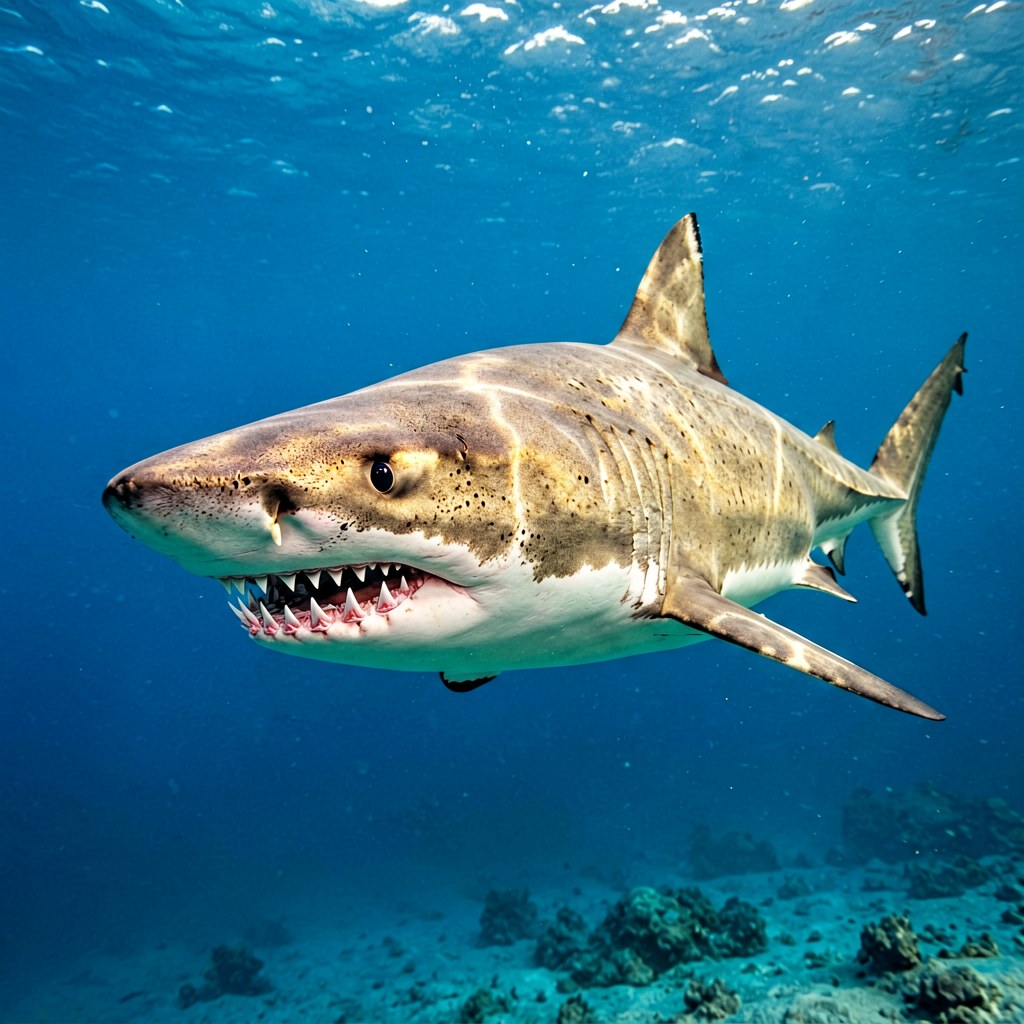
Carcharodon taurus | Sand Tiger Shark
Introduction
The sand tiger shark, known in many regions as the grey nurse shark or ragged-tooth shark, is a large, slow-moving coastal predator that inhabits warm and temperate waters around the globe. Despite its fearsome, gaping row of pointed teeth and shaggy appearance, the species is generally placid toward divers and rarely behaves aggressively unless provoked. Adults typically reach lengths of 2.2 to 3.2 meters and can weigh well over 150 kilograms, making them among the more conspicuous members of the inshore shark fauna. Their broad, flattened snout, bulky body, and sedentary demeanor set them apart from the swift, pelagic mackerel sharks to which they are closely related. Because they frequent shallow reefs, rocky ledges, and shipwrecks close to shore, sand tigers have become one of the most photographed and studied large sharks in the dive-tourism industry.
Taxonomy
The sand tiger shark belongs to the order Lamniformes, the mackerel sharks, and to the family Odontaspididae, a small group of relatively sluggish, sharp-toothed sharks. Its currently accepted scientific name is Carcharias taurus, though older literature and some taxonomic authorities have used Carcharodon taurus, Odontaspis taurus, and Eugomphodus taurus for the same animal. Within Lamniformes it shares a distant ancestry with faster relatives such as the [Blue Shark](https://www.gloencyc.com/prionace-glauca-blue-shark/), the mako, and the great white, all of which share a fusiform body plan and lamnoid gill structure. The genus Carcharias is monospecific, meaning the sand tiger is the only species in its genus, and it is genetically distinct from the true nurse sharks of the family Ginglymostomatidae despite the confusing common name. Historically the species was placed in several genera as morphology-based classification gave way to molecular phylogenetics. Today the three main regional populations, in the western Atlantic, the Indo-Pacific, and the eastern Atlantic and Mediterranean, are recognized as demographically isolated management units rather than separate subspecies.
Physical Characteristics
Adult sand tiger sharks are robust fish with a distinctly blunt, conical snout and a pair of small, dull eyes set far forward. The body is covered in small, rough placoid denticles that give the skin a sandpaper texture, and the overall coloration is a grey to tawny brown dorsally, fading to a pale, almost white underside that provides countershading against both surface light and the dark seabed. Juveniles and some adults display scattered, rust-colored spots along the flanks and back, a pattern that fades with age and gives the species its “sand tiger” epithet. The mouth is large and lined with narrow, sharply pointed teeth that protrude even when the jaw is closed, an arrangement ideal for gripping slippery prey. A unique physiological trait is the shark’s ability to swallow and retain air in its stomach, which it uses as a buoyancy aid to hover almost motionlessly in the water column. The two dorsal fins are roughly equal in size, the caudal fin is asymmetric with a long upper lobe, and the pectoral fins are broad and paddle-like. Males are distinguished from females by longer, recurved claspers and generally bulkier build, while females tend to grow slightly larger.
Habitat
Sand tiger sharks occupy a broad range of coastal and shelf habitats, from the surf zone and estuaries at depths of a few meters to offshore reefs and continental slopes reaching 190 meters. They show a strong preference for structured environments such as rocky reefs, submerged shipwrecks, caves, and drop-offs where they can shelter during daylight hours. In summer months they may move into warmer, shallower bays and along the edges of continental shelves, whereas in cooler seasons individuals often retreat to deeper, more stable water. The species is found circumglobally in warm-temperate and tropical seas, including the western and eastern Atlantic, the Mediterranean, the Indian Ocean, and the western and eastern Pacific, though it is notably absent from the eastern Pacific coastline. Populations along the eastern coast of Australia and around New Zealand are particularly localized and have declined sharply, leading to strong regional protection. They are primarily inshore animals but will make seasonal migrations that track water temperature and prey availability.
Diet
The sand tiger shark is a carnivorous, largely piscivorous predator that hunts both by stealth and by short bursts of speed. Its diet centers on a wide variety of bony fishes, including mackerel, weakfish, flatfish, mullet, and small groupers, supplemented by smaller sharks, skates, and rays. Cephalopods such as squid and cuttlefish are taken regularly, and crustaceans make up a minor component of the intake for some populations. Hunting often occurs at night or in low light, when the shark uses its buoyancy control to drift quietly above the substrate before lunging at prey. Because it consumes weaker and often diseased fish, the species may play a role in maintaining the health of reef fish communities, though its slow reproductive rate limits how quickly populations can recover if prey bases collapse. Stomach-content studies show strong regional variation, with Atlantic animals favoring schooling fish and Indo-Pacific animals taking more elasmobranch and cephalopod prey.
Reproduction
Reproduction in the sand tiger shark is among the most unusual in the cartilaginous fishes because of a process called embryophagy, or intrauterine cannibalism. Females are ovoviviparous and produce eggs that are fertilized internally, after which the developing embryos hatch inside the uterus. The first embryo in each of the two uteri to reach a certain size then consumes the remaining eggs and any smaller siblings, so that typically only one large pup survives per uterus. As a result, a female gives birth to just one or two exceptionally well-developed pups after a gestation of roughly nine to twelve months. Newborn sand tigers measure about one meter in length and are immediately independent, requiring no parental care. Sexual maturity is reached late, at seven to ten years for males and later still for females, and the long interval between successful litters makes the species highly vulnerable to overfishing. Mating and pupping grounds are poorly documented but appear to be coastal nursery areas with relatively shallow, protected water.
Conservation
The International Union for Conservation of Nature lists the sand tiger shark as Near Threatened globally, but several regional populations are assessed as Critically Endangered, including those off eastern Australia, New Zealand, and parts of the eastern Atlantic. The principal threats are incidental catch in gillnets and trawls, targeted capture for the shark-fin and curio trades, and the live-fish trade that supplies public aquaria. Because the species is slow-growing, late-maturing, and produces only one or two offspring per year, it cannot withstand even moderate fishing pressure. It is listed on Appendix I of CITES, which restricts international trade, and receives full protection in countries such as Australia and the United States within certain state waters. Ecotourism centered on dive sites where sand tigers aggregate has created economic incentives for local protection, yet enforcement remains uneven across its range. Continued monitoring of nursery areas and bycatch reduction in inshore fisheries are considered the most urgent conservation measures.
Fun Facts
- Unlike most sharks, the sand tiger shark can gulp air at the surface and hold it in its stomach to hover motionlessly without swimming.
- Only one or two pups are born from a litter because the strongest embryo eats its siblings inside the mother.
- Its teeth remain exposed and visible even when the mouth is fully closed, giving it a permanent “smile.”
- The same species is called grey nurse shark in Australia and ragged-tooth shark in South Africa.
- Sand tiger sharks can live for more than 25 years in the wild and even longer under managed aquarium care.