 By st20113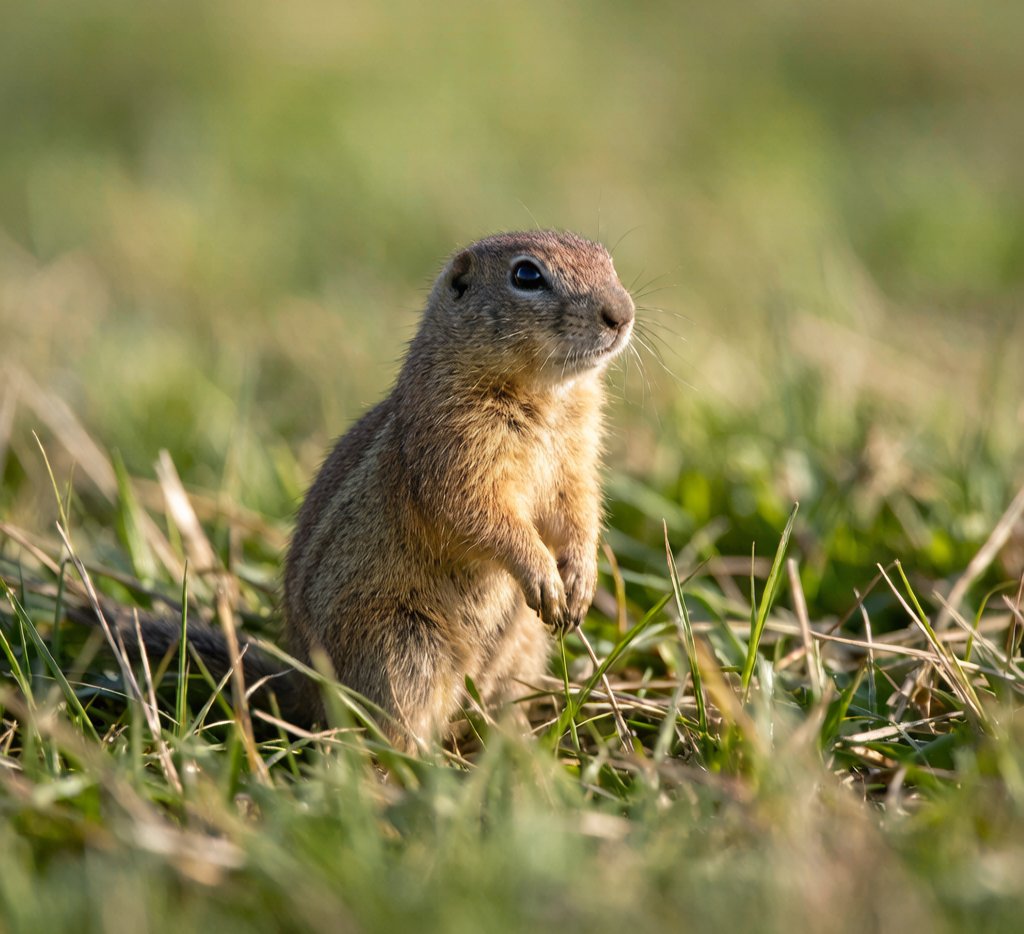
Introduction
The European ground squirrel is a small, gregarious rodent native to the grasslands and steppe meadows of Central and Eastern Europe. Often seen sitting upright at the entrance to its burrow, this animal has become a symbol of open, sunlit landscapes from the Hungarian Puszta to the plains of Ukraine. The European ground squirrel is an ecosystem engineer whose burrowing aerates and cycles nutrients in grassland soils while supporting a network of other species. Populations have declined sharply over the past half-century, making this species a flagship for European grassland conservation.
Taxonomy
The European ground squirrel belongs to the order Rodentia, the family Sciuridae, and the genus Spermophilus. Its scientific name, Spermophilus citellus, reflects the genus’s historic association with seed consumption. The genus Spermophilus comprises approximately 40 species across the Northern Hemisphere, with the European ground squirrel representing one of the few found in Western and Central Europe. Its closest relatives include the speckled ground squirrel and several steppe-dwelling species of Russia and Central Asia. The species was first formally described by Kerr in 1792, and no subspecies are currently recognised.
Physical Characteristics
The European ground squirrel has a compact, cylindrical body adapted for a largely subterranean lifestyle. Its upperparts are covered in short, dense fur ranging from sandy brown to greyish-yellow, with small, irregular light spots that give the species its alternative name of speckled ground squirrel. The underparts are a pale, buffy yellow. Adults measure 20 to 30 centimetres in body length, with a short, flattened tail adding a further 5 to 7 centimetres. Weight varies with season, from approximately 200 grams in spring to over 400 grams in late summer when fat reserves are accumulated. The feet are broad with sturdy claws suited for excavating loose soil, and the eyes are large and positioned laterally for wide-angle vision while foraging above ground.
Habitat
The European ground squirrel inhabits short-grass steppe, alpine meadows, and semi-natural pastures characterised by short, sparse vegetation and well-drained soils. Its historic range extends from the eastern Netherlands across Germany, Austria, and Poland to Hungary, Romania, and Ukraine. Today, the strongest populations persist in the large, intact steppe reserves of Hungary and Romania. The species frequently occurs in man-made grasslands including airfields, golf courses, and roadside verges, provided these areas are not intensively mowed during the active season. Burrow systems include a main entrance, several emergency exits, and a grass-lined nest chamber 0.5 to 1.5 metres below the surface.
Diet
The European ground squirrel is a generalist herbivore whose diet shifts with seasonal availability. In spring it feeds on the young shoots and flowers of grasses, clovers, and legumes. Summer brings seeds, grains, berries, and the occasional insect. Seeds and nuts dominate the late-summer and autumn diet as the animal builds fat reserves for hibernation. The species is an important seed disperser; uneaten seeds cached in burrows frequently germinate, contributing to plant community dynamics. Water is obtained from food and dew, and the species rarely travels far from its burrow to forage, a behaviour that significantly reduces predation risk.
Reproduction
Mating occurs shortly after emergence from hibernation, typically in March or April. After a gestation of approximately 28 days, the female gives birth to a litter of four to nine pups in the underground nest chamber. The young are born naked and blind but develop quickly; eyes open at around three weeks, and they begin emerging above ground by the fifth week. Lactation lasts approximately six weeks, during which daughters from the previous year’s litter often remain in the family group to assist. Dispersal occurs in late summer or autumn of the first year. Badger and red fox are among the most significant predators, and the species relies on its complex alarm-call system to coordinate escape behaviour.
Conservation
The European ground squirrel is classified as Vulnerable on the IUCN Red List, reflecting a sustained decline in both individual numbers and distinct populations. Principal threats are agricultural intensification, which eliminates extensively managed grasslands, and the abandonment of traditional grazing practices. Urbanisation and the conversion of steppe to cropland have destroyed much of the former range in Central Europe, and remaining populations are increasingly isolated. Conservation measures include protecting key sites, maintaining traditional grazing, and targeted reintroduction programmes in areas where the species has already been lost.
Fun Facts
The European ground squirrel’s most endearing habit is its upright sentinel posture—forepaws tucked against the chest, body rigid, head held high—adopted while scanning for danger. This has made the species a favourite subject for wildlife photographers. The species communicates using a complex system of whistles, chirps, and trills that convey information about predator identity, size, and approach speed. One of the most remarkable aspects of its biology is extreme seasonal fattening: individuals can accumulate fat representing more than 50 percent of their body weight in preparation for hibernation periods of up to seven months, during which they do not eat, drink, or defecate.