 By st20113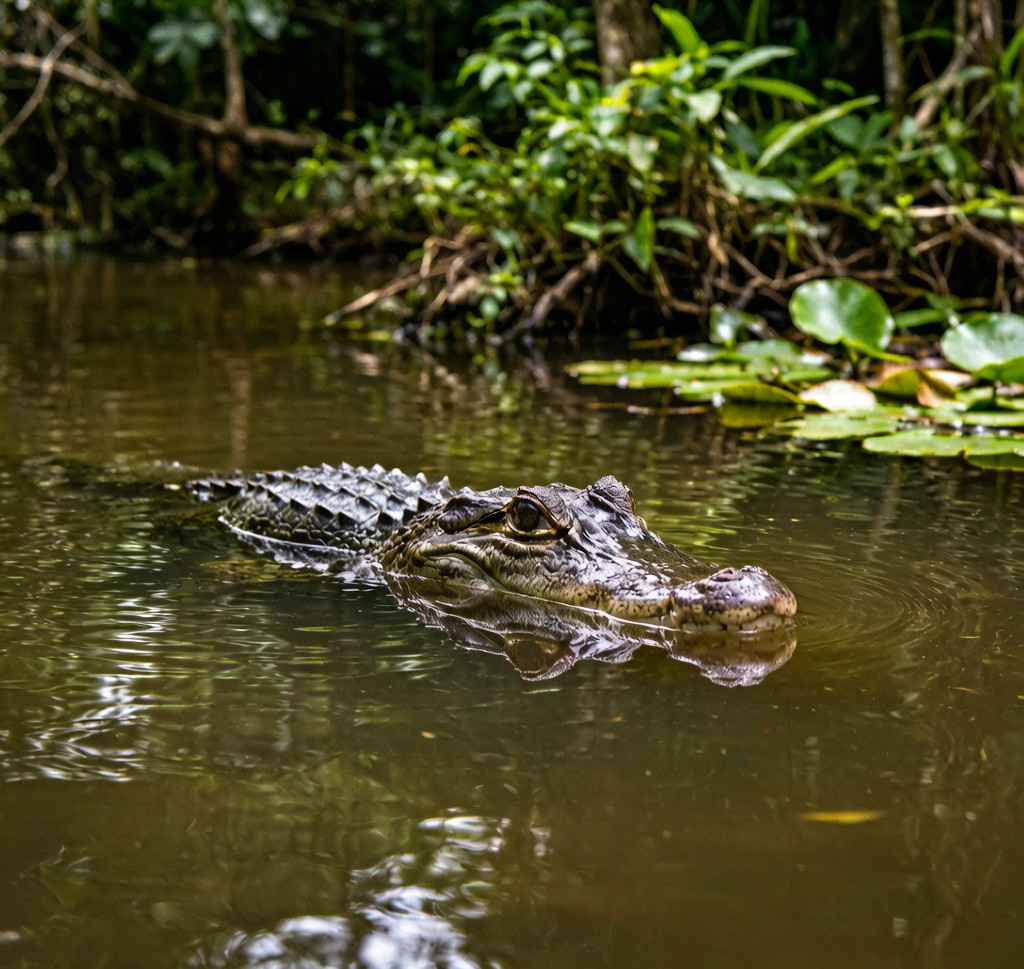
A Spectacled Caiman (Caiman crocodilus) floating in a tropical river with its characteristic bony ridge between the eyes
Overview
The Spectacled Caiman (Caiman crocodilus) is the most abundant and widely distributed crocodilian in the world, found throughout the freshwater wetlands, rivers, and lakes of Central and South America from southern Mexico to Ecuador, Peru, Brazil, Bolivia, and northern Argentina. Named for the distinctive bony transverse ridge between its eyes – which resembles the bridge of a pair of spectacles – the spectacled caiman is a medium-sized crocodilian that plays a critical role as a top predator and ecosystem engineer throughout its vast range.
Spectacled caimans are relatively small crocodilians. Males typically reach 1.5 to 2 meters in length, with exceptional individuals growing to 2.5 meters or slightly more. Females are smaller, rarely exceeding 1.4 meters. They have a relatively long, narrow snout compared to other caimans, and their coloration – olive-green to brown with dark crossbands – provides effective camouflage in their murky aquatic environments. Juveniles are bright yellow with black spots and stripes, which fade as they mature.
Habitat and Distribution
Spectacled caimans are found in an extraordinary variety of freshwater habitats throughout their range, including slow-moving rivers, floodplain lakes (várzea and igapó), oxbows, swamps, marshes, reservoirs, and artificial ponds. They are primarily lowland species but are found up to 800 meters elevation in some regions. Their distribution is limited by their need for water – permanent water bodies are essential, as caimans cannot survive prolonged drought. However, they are remarkably tolerant of seasonal water level fluctuations and can survive in isolated pools during the dry season by burrowing into mud to estivate.
The species’ extraordinary abundance in some regions – densities of over 800 individuals per kilometer of river have been recorded in the Brazilian Pantanal – reflects its remarkable ecological plasticity and its ability to thrive in human-modified landscapes. Spectacled caimans are commonly found in agricultural reservoirs, irrigation canals, and even urban waterways, provided there is sufficient cover and food.
Diet and Ecological Role
Like all crocodilians, spectacled caimans are opportunistic carnivores that will eat almost any animal they can overpower. Young caimans feed primarily on insects, crustaceans, snails, and small fish, while adults target progressively larger prey including fish, frogs, turtles, water birds, snakes, and small mammals. In the Orinoco basin, piranhas and other characiform fish form the majority of their diet, while in the Amazon, a wide variety of fish species are consumed. Adults occasionally take capybaras, coatis, and other medium-sized mammals that come to the water’s edge to drink.
As a top predator, the spectacled caiman is a key regulator of aquatic food webs, controlling fish populations and preying on species that might otherwise become overabundant. Their basking behavior – clustering on mud banks and floating logs to raise their body temperature – creates open water channels in densely vegetated wetlands, and their nesting mounds can alter water flow patterns across the landscape. By creating and maintaining these microhabitats, caimans benefit dozens of other species, including fish, birds, and turtles that use the disturbed areas for feeding and nesting.
Reproduction and Conservation
Spectacled caimans breed during the dry season, when females build mound nests from vegetation and mud near the water’s edge. Clutch size ranges from 14 to 40 eggs, which are incubated for approximately 90 days. Unlike many crocodilians, spectacled caiman mothers do not aggressively guard their nests from large predators, relying instead on the heat generated by the decomposing vegetation mound and the eggs’ deep burial. However, females do return to the nest to assist hatchlings in emerging and may assist them to the water.
Temperature determines hatchling sex in caimans – lower temperatures produce mostly females, higher temperatures produce mostly males – making them particularly vulnerable to climate change. The spectacled caiman was once heavily hunted for its skin, which drove significant population declines across its range in the 1960s to 1980s. However, since the near-collapse of the international crocodilian leather market and the implementation of sustainable management programs, populations have recovered dramatically in many regions. The species is now listed as Least Concern on the IUCN Red List, a conservation success story driven largely by well-regulated ranching and ranching-to-reintroduction programs.