 By st20113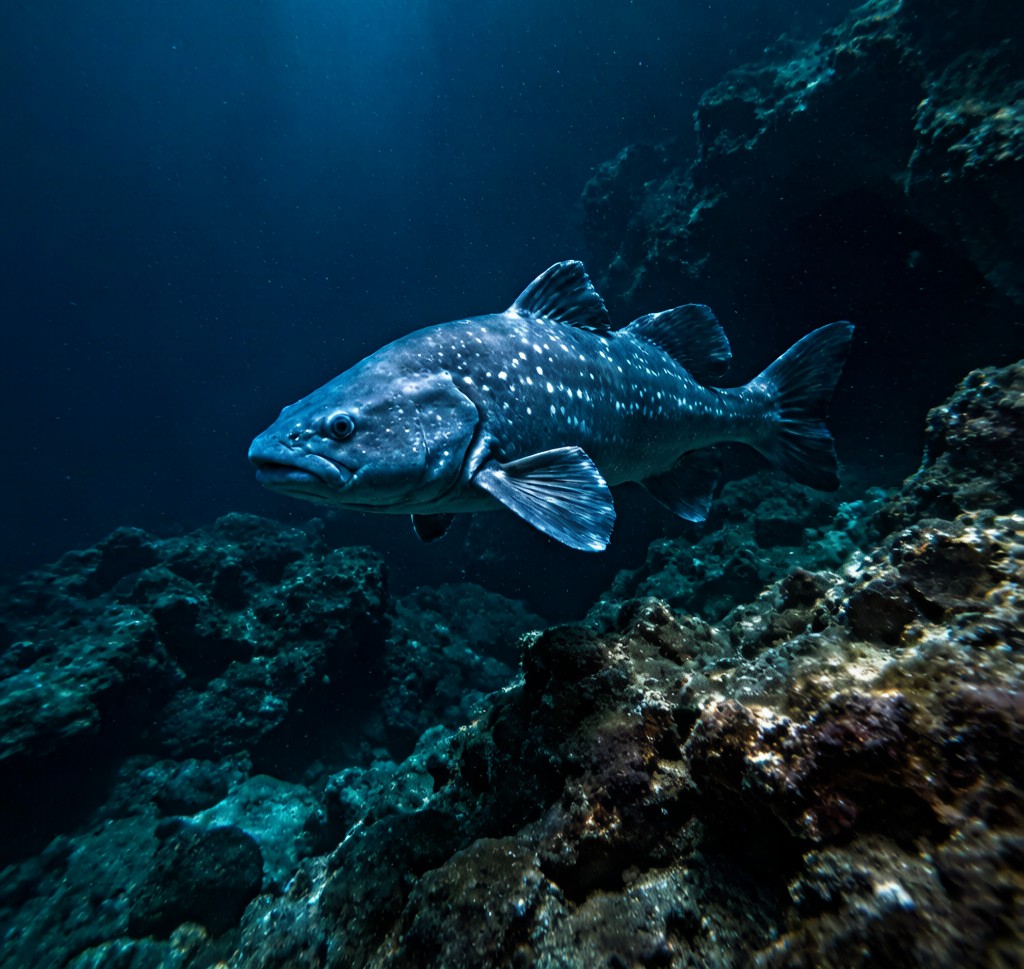
A Coelacanth (Latimeria chalumnae) swimming in the deep ocean, showing its distinctive lobe fins and blue-grey body with white spots
Overview
The Coelacanth (Latimeria chalumnae) is one of the most extraordinary animals ever discovered – a living fossil that represents a lineage of fish that was thought to have been extinct for approximately 66 million years, until a living specimen was discovered by chance in a South African fishing net in 1938. With an evolutionary lineage stretching back approximately 360 to 400 million years, the Coelacanth predates the dinosaurs and represents one of the closest living relatives to the ancestral fish that gave rise to all tetrapods – all animals with backbones that live on land, including humans. Its discovery was one of the most significant zoological events of the 20th century, prompting the biologist J.L.B.S. Smith to famously declare: “I imagine that I shall have to keep this find very quiet, for something as rare and important as this could easily be made the subject of a world-wide search.”
The Coelacanth is a large, deep-dwelling fish that can reach lengths of 1.5 to 2 meters and weigh up to 90 kilograms. Its most distinctive feature is its paired lobe fins – limb-like appendages that articulate on bone in a similar manner to the limbs of land animals. Unlike most fish, which have ray-finned fins made of thin, bony spines, the Coelacanth has muscular, bone-supported fins that are thought to represent an early stage in the evolution of tetrapod limbs. The Coelacanth also has a unique rostral organ in its snout – an electro-sensory organ that may be used to detect prey in the dark depths. Two species are known: L. chalumnae from the waters off East Africa and the Comoros Islands, and L. menadoensis from Indonesian waters.
Habitat and Discovery
The Coelacanth was first discovered by science in 1938 when a specimen was identified by Marjorie Courtenay-Latimer, a curator at the East London Museum in South Africa, in a haul of fish caught by local fisherman Hendrik Goosen. The fish – a strange, cobalt-blue animal approximately 1.5 meters long – was identified by J.L.B. Smith as a Coelacanth, a fish known previously only from the fossil record and thought to have been extinct since the Cretaceous period. The fish was named Latimeria chalumnae in honor of Courtenay-Latimer and the Chalumnae River near which it was caught. This discovery – one of the most dramatic in the history of zoology – proved that a lineage of fish thought extinct for 66 million years had survived in the deep ocean.
Today, the West Indian Ocean Coelacanth (Latimeria chalumnae) is known to occur in deep waters off the coasts of Kenya, Tanzania, Mozambique, South Africa, Madagascar, the Comoros Islands, and perhaps also off Namibia. A second species, the Indonesian Coelacanth (Latimeria menadoensis), was discovered off Sulawesi in 1997. Coelacanths inhabit deep underwater caves and rocky slopes at depths of 150 to 700 meters, occasionally rising to shallower depths at night in a behavior called nycthemeral vertical migration. They are associated with underwater lava洞穴 and rocky submarine terrain, which provide shelter during the day. The species’ extremely limited distribution – with population estimates of only a few hundred to a few thousand individuals – makes it one of the most geographically restricted of all large marine animals.
Biology and Behavior
The Coelacanth’s biology is one of the most fascinating in the marine world, combining ancient anatomical features with surprising physiological specializations. The Coelacanth has a unique method of swimming: rather than undulating its body like most fish, it moves primarily by sweeping its paired lobe fins in an alternating, paddle-like pattern – a movement described as “treading water” that is thought to resemble the gait of early tetrapod ancestors. This fin movement gives the Coelacanth a distinctive, almost lazy, prowling appearance as it moves through the water. The Coelacanth is also one of the few fish species with a functional intracranial joint – a joint in the skull that allows the front part of the head to be raised, enlarging the mouth and allowing the fish to swallow larger prey.
The Coelacanth is a nocturnal predator that feeds primarily on fish, squid, and cuttlefish in the deep ocean. It is a relatively slow-moving, ambush predator that waits in deep-water caves during the day and emerges to hunt at night, following the vertical migration of prey species. The Coelacanth’s electro-sensory rostral organ in its snout may help it detect the weak electrical fields produced by the movement of prey in the darkness. The fish is thought to be opportunistic rather than an active hunter – researchers have found a wide variety of prey items in the stomachs of examined specimens. Coelacanths have an extremely slow metabolism and low reproductive rate, which makes them highly vulnerable to any additional sources of mortality.
Conservation
The Coelacanth is listed as Critically Endangered on the IUCN Red List, with populations estimated at fewer than 1,000 individuals. The species faces several serious threats, most notably incidental capture in deep-sea fisheries. Coelacanths are occasionally caught as bycatch in deep-water trawl, gillnet, and hook-and-line fisheries that operate at the depths where Coelacanths live. Because the species has a very low reproductive rate – females are thought to carry approximately 5 to 26 eggs at a time, and the young are born fully formed after a gestation period estimated at 1 to 3 years – even small numbers of incidental captures can have significant impacts on populations.
Conservation efforts for the Coelacanth focus on reducing bycatch mortality through the establishment of marine protected areas around known Coelacanth habitats, improved fisheries management in the waters where Coelacanths occur, and international coordination among range states to protect the species. In 2013, the Convention on International Trade in Endangered Species (CITES) added the Coelacanth to Appendix II, requiring that international trade in Coelacanth specimens be carefully regulated. Ongoing research using deep-sea submersibles and underwater cameras is providing new insights into the Coelacanth’s behavior, population structure, and habitat requirements, which are essential for developing effective conservation strategies for this remarkable living fossil.