 By st20113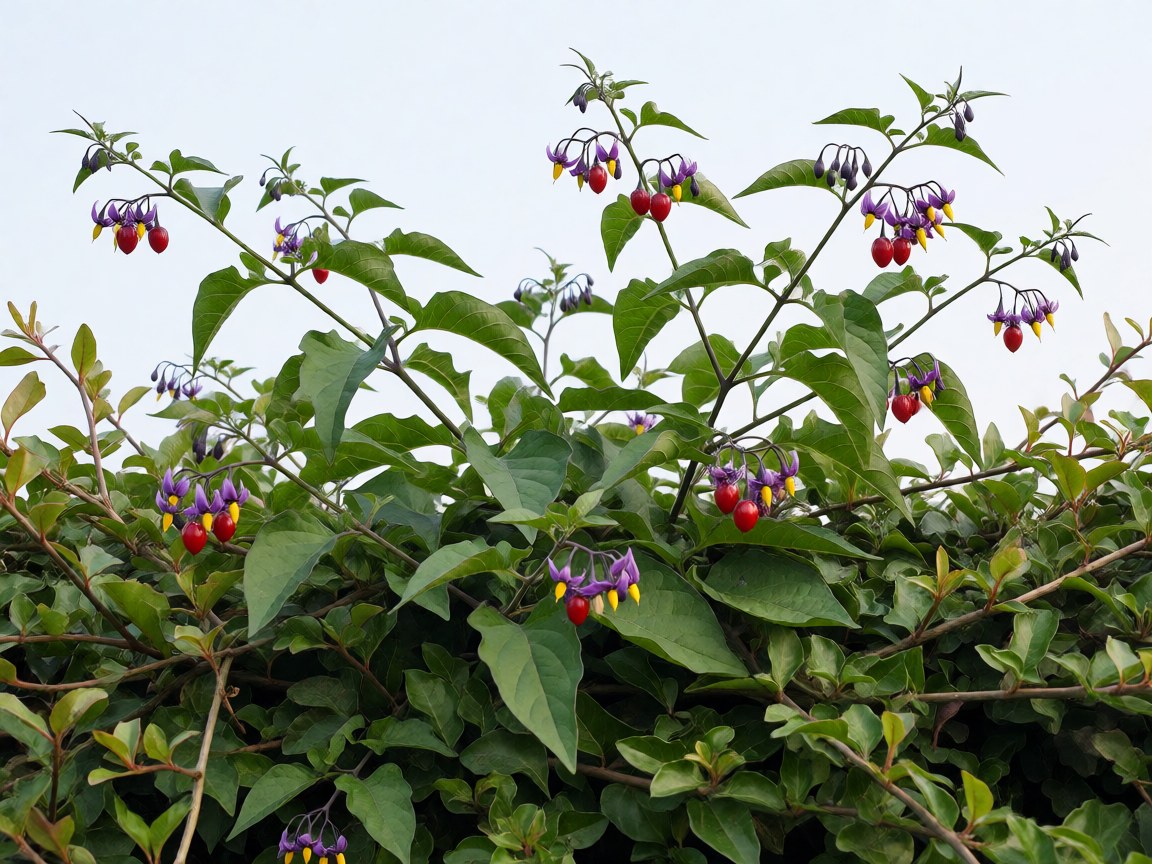
Solanum dulcamara | Bittersweet
Introduction
Bittersweet (Solanum dulcamara) is a scrambling woody nightshade of hedgerows, damp scrub, and riverbanks, best known for its flowers and fruit: small, starry, deep purple blooms with a bright yellow cone of stamens at the centre, followed by glossy berries that turn from green through orange to a clear, shiny scarlet. It is a plant of contradictions, and its common names record them. The stems and leaves smell unpleasant when crushed, yet the name “bittersweet” comes from the old practice of chewing a piece of stem: first bitter, then sweet, an effect produced by the very alkaloids that make the plant poisonous. It is a native of Europe and Asia, naturalised widely elsewhere, and it is a familiar, slightly sinister presence along the damp edges of farmland, where it climbs over fences and hedges with the help of nothing but its own sprawling stems.
Taxonomy
Solanum dulcamara belongs to the family Solanaceae, the nightshade family, one of the most chemically formidable plant families there is. Its relatives include the potato, the tomato, the aubergine, and the chilli, all of which are species of Solanum, as well as tobacco, deadly nightshade, thorn apple, and henbane. It is the only woody, climbing representative of the genus in the European flora, and it differs from the black nightshade and its relatives in being a scrambling perennial rather than an annual herb. The genus name Solanum is of uncertain ancient origin, while the epithet dulcamara is simply Latin for “bitter-sweet”, a translation of the medieval name amara dulcis that referred to the taste of the stem. As a green plant it depends on Photosynthesis, but a large part of what it does with the resulting sugars is to manufacture the steroid alkaloids that make every part of the plant toxic.
Physical Characteristics
The plant is a deciduous, woody-based scrambler, with stems that may be herbaceous at the tips but become woody and brown at the base, reaching one to two metres or more by leaning and twining over whatever support is available. The stems are flexible, angular, and slightly hairy when young, and the bark of older growth is grey-brown and finely fissured; crushed stems and leaves give off a characteristic rank, slightly mousy smell. The leaves are alternate and variable, most commonly oval with a heart-shaped base and one or two small pointed lobes or leaflets at the base, giving the distinctive “hooded” outline that separates it from most other hedgerow climbers. The flowers hang in loose, drooping clusters on stalks arising opposite the leaves; each is about one to one and a half centimetres across, with five narrow, strongly reflexed petals of a deep violet-purple, and, at the centre, a conspicuous erect cone of bright yellow stamens fused around the style. The fruit is an oval, glossy berry, green at first, then yellow, orange, and finally a bright, shiny red, and roughly the size and shape of a small elongated cherry tomato.
Habitat
Bittersweet grows in damp, rough places: hedgerows, riverbanks and stream sides, the edges of marshes, fens and carr, damp woodland and scrub, waste ground, railway embankments, and the rough margins of arable fields. It prefers moist, moderately fertile, often calcareous soils and tolerates a good deal of shade, though it flowers best in the open. It is a characteristic plant of the damp, unmanaged edges where hedgerow meets ditch. Native to Europe and much of Asia, it has been introduced and naturalised in North America, Australia, and New Zealand, where it is often regarded as a weed of damp disturbed ground. Throughout Britain and Ireland it is common in the lowlands and becomes scarcer in the wetter and colder north and west.
Diet
It is an autotrophic, fast-growing climber, and its strategy is to put its leaves up in the light rather than to tolerate shade: the sprawling stems carry the foliage over the top of the surrounding vegetation, where it can photosynthesise at full rate. Its demand for water is high, which is why it is so consistently a plant of damp ground and why it wilts quickly in drought. Nutrients are taken up from moist, moderately fertile soil, and the plant responds vigorously to the enriched conditions of disturbed ground, hedge bottoms, and the margins of cultivated land. A significant share of its resources goes into chemical defence: the stems, leaves, and especially the unripe fruit contain solanine and related glycoalkaloids, which deter most browsing mammals and insects and make the plant unpalatable. The strategy is only partly successful, since a number of specialised insects have adapted to feed on it regardless.
Reproduction
The flowers open from June to September and are unusual among British wild flowers in having poricidal anthers: the yellow cone of stamens does not shed loose pollen but releases it through small pores at the tips when a bee grips the flower and vibrates its flight muscles, a technique known as buzz pollination, which bumblebees use on tomatoes and their relatives. The nectarless flowers therefore reward visitors with pollen alone. Once fertilised, the berries develop through late summer, and the colour change from green to red is a signal to birds, which are the main dispersers: thrushes, blackbirds, warblers, and other species eat the fruit and pass the seeds intact, often depositing them some distance away in a hedge or on a fence line where the seedling will have support. The seeds also pass through mammals. Vegetative spread occurs readily, since trailing stems root where they touch damp soil, and a single plant can make a substantial patch.
Conservation
The species is common, widespread, and not threatened, and it is increasing in places where damp, rough ground and untrimmed hedgerows are left undisturbed. It is regarded as invasive in parts of North America, where it colonises wet woodland and prairie pothole margins, and in New Zealand, where it is classed as an unwanted organism in some regions; control is difficult because the plant resprouts from fragments of root and stem. In its native range the interest lies in what it supports and in its chemistry. Several moths feed on it as larvae, including the dot moth and a range of other noctuid and geometrid species, and the flowers are worked by bumblebees that come to collect pollen by buzz-pollination rather than nectar. All parts, and particularly the attractive red berries, are poisonous to people and to livestock, and poisoning cases are most frequent among children, who are drawn to the shiny fruit.
Fun Facts
- The name comes from chewing the stem: it tastes bitter at first and then distinctly sweet.
- The bright yellow cone in the middle of the flower is a fused column of stamens.
- The flowers give no nectar; bumblebees have to buzz the flower to shake pollen out of tiny pores.
- Green, orange, and red berries can all be found on the same plant at once.
- All parts are poisonous, and the shiny red berries are the usual cause of accidental poisoning.