 By st20113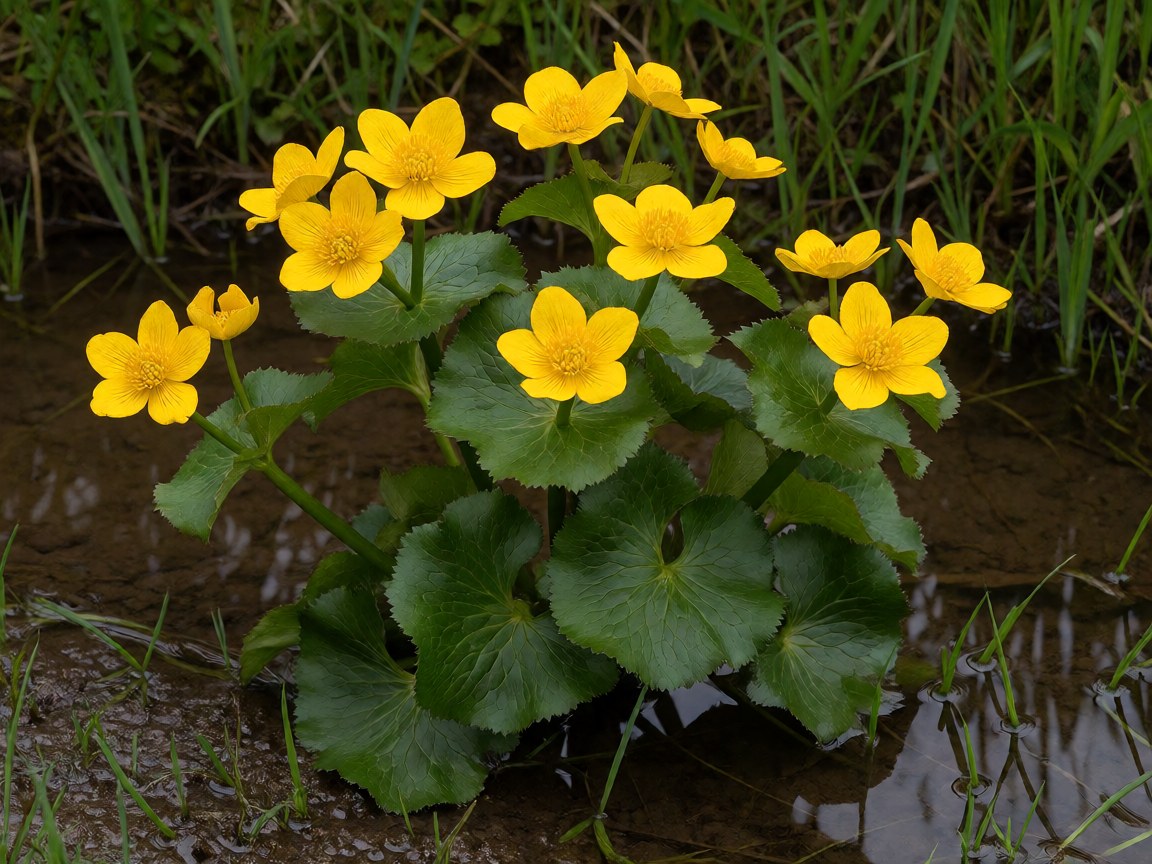
Caltha palustris | Marsh Marigold
Introduction
The marsh marigold (Caltha palustris) is one of the most welcome sights of the wet spring, a sprawling plant of ditches, marshes, and wet woodland that covers itself in large, glossy, golden-yellow flowers from March onwards. Despite the name it is not a marigold at all but a buttercup, and the difference is not academic: the bright yellow “petals” are technically sepals, and the whole plant shares the acrid, blistering chemistry of the rest of its family. It grows where few other showy plants will, with its roots in cold, waterlogged mud, and a good clump on a stream bank in April is one of the clearest signs that a piece of ground has never been drained or improved. Country names such as kingcup, may-blob, and water blobs record how familiar it once was to anyone whose work took them across wet fields.
Taxonomy
Caltha palustris belongs to the family Ranunculaceae, the buttercup family, a large and ancient group that also contains the Buttercups, aconites, hellebores, columbines, and clematis. The genus Caltha is small, with perhaps ten or so species of moisture-loving perennials distributed around the temperate and cold parts of the world, and C. palustris is by far the widest-ranging, occurring across Europe, Asia, and North America. It is sometimes divided into a number of regional varieties. The name Caltha was used in classical Latin for a yellow-flowered plant, possibly the marigold, while palustris simply means “of marshes” — hence the English name, which is a translation of the Latin rather than a botanical judgement, since the true marigolds of the genus Calendula belong to the daisy family and are not closely related at all. As a green plant it depends on Photosynthesis, and like the rest of its family it converts the sugars it makes into a battery of sharp-tasting defensive chemicals rather than into nectar or storage tissue.
Physical Characteristics
The plant is a rather fleshy, sprawling to upright perennial, usually fifteen to sixty centimetres tall, with thick, hollow, succulent stems that often root at the lower nodes where they touch wet mud. The leaves are its most recognisable vegetative feature: large, dark green, glossy, kidney- or heart-shaped, with rounded, bluntly toothed margins and long stalks on the basal leaves, the upper ones almost stalkless and clasping the stem. The flowers are two to five centimetres across and made up of five, or occasionally more, broad, overlapping golden-yellow segments that are petal-like sepals rather than petals; true petals are absent. Inside sits a dense brush of numerous yellow stamens surrounding a cluster of five to ten free carpels, and it is at the base of these carpels that the small nectar glands sit. The fruit is a ring of short, pod-like follicles that split open along one side when ripe, releasing a number of glossy dark seeds. Flowers appear from March to June, and a second, thinner flowering sometimes occurs in autumn.
Habitat
It grows in wet ground of almost every kind: marshes, fens, wet meadows, the edges of ponds and streams, ditches, springs and flushes, wet woodland, and the muddy margins of slow rivers, and it tolerates shallow standing water and periodic flooding well. It favours neutral to base-rich, nutrient-moderate soils, and it does best in open, sunny places, though it flowers reasonably well in light shade. The species has a broad circumpolar distribution across the temperate northern hemisphere, including most of Europe, northern and central Asia, and much of North America, and it is common throughout Britain and Ireland, becoming more local in the driest and most intensively farmed districts. Its presence is a reliable indicator of permanently wet, unimproved ground, and it is typically found alongside rushes, sedges, meadowsweet, and the other plants of undrained wetland.
Diet
Marsh marigold is autotrophic, photosynthesising in its broad, glossy leaves and storing reserves in a short, stout rootstock that carries it through the winter. Growing in waterlogged soil brings a particular problem, since saturated ground holds very little oxygen; the plant copes with internal air spaces in its tissues that channel oxygen down from the leaves to the roots, and with a shallow, spreading root system that stays near the surface where some oxygen is available. It takes up nutrients from mineral-rich water and wet soil, and it responds strongly to enrichment, producing lush growth in the flushed ground below springs and in places where nutrient-rich water seeps out. Its leaves and stems are acrid and poisonous when raw, containing protoanemonin, the same irritant found throughout the buttercup family; this makes the plant distasteful and even harmful to grazing animals, and it is one of the reasons a heavily grazed pasture rarely contains much of it.
Reproduction
The flowers open early in the year, at a time when flying insects are scarce, and they are visited by a wide range of them: early bees and bumblebees, hoverflies, and numerous small flies and beetles that come for pollen as much as for the modest supply of nectar. The plant is largely dependent on insect visits for good seed set, and cross-pollination between neighbouring plants is favoured. Once fertilised, the carpels swell into a cluster of follicles that ripen in early summer and split to release the seeds, which are shed close to the parent plant or washed away by water — the seeds can float, and movement along ditches and streams is an important means of spread. The plant also spreads vegetatively and effectively: the sprawling stems root where they touch wet mud, and the rootstock slowly branches, so that a single plant can become a spreading clump that occupies a metre or more of bank.
Conservation
The species is widespread and abundant and is not threatened at a global level, but it has declined locally wherever wetland has been lost. The drainage of wet meadows, the straightening and deepening of rivers, the infilling of ponds and ditches, and the agricultural improvement of damp pasture have all removed large areas of habitat, and in intensively farmed lowland it is now much scarcer than it once was. It remains a characteristic and easily recognised plant of traditionally managed wet grassland, of fen and of wet woodland, and because it is so easy to identify and so tightly tied to undrained ground, it is a useful indicator species in wetland assessment. In gardens it is popular at the edge of ponds and in bog gardens, and several double-flowered and larger-flowered selections are sold. It should be treated with some caution by livestock keepers, since the acrid sap can be irritant and the plant is avoided by stock except in very poor grazing.
Fun Facts
- It is not a marigold; it is a buttercup, and the true marigolds belong to the daisy family.
- The bright yellow “petals” are actually sepals — the plant has no true petals at all.
- The flower buds were once pickled in vinegar as a substitute for capers, but only after thorough boiling to destroy the acrid principle.
- All parts of the plant taste hot and acrid and can blister the mouth and skin if eaten raw.
- It is one of the earliest wetland plants to flower, often in March, which is why it has so many old country names such as kingcup and may-blob.