 By st20113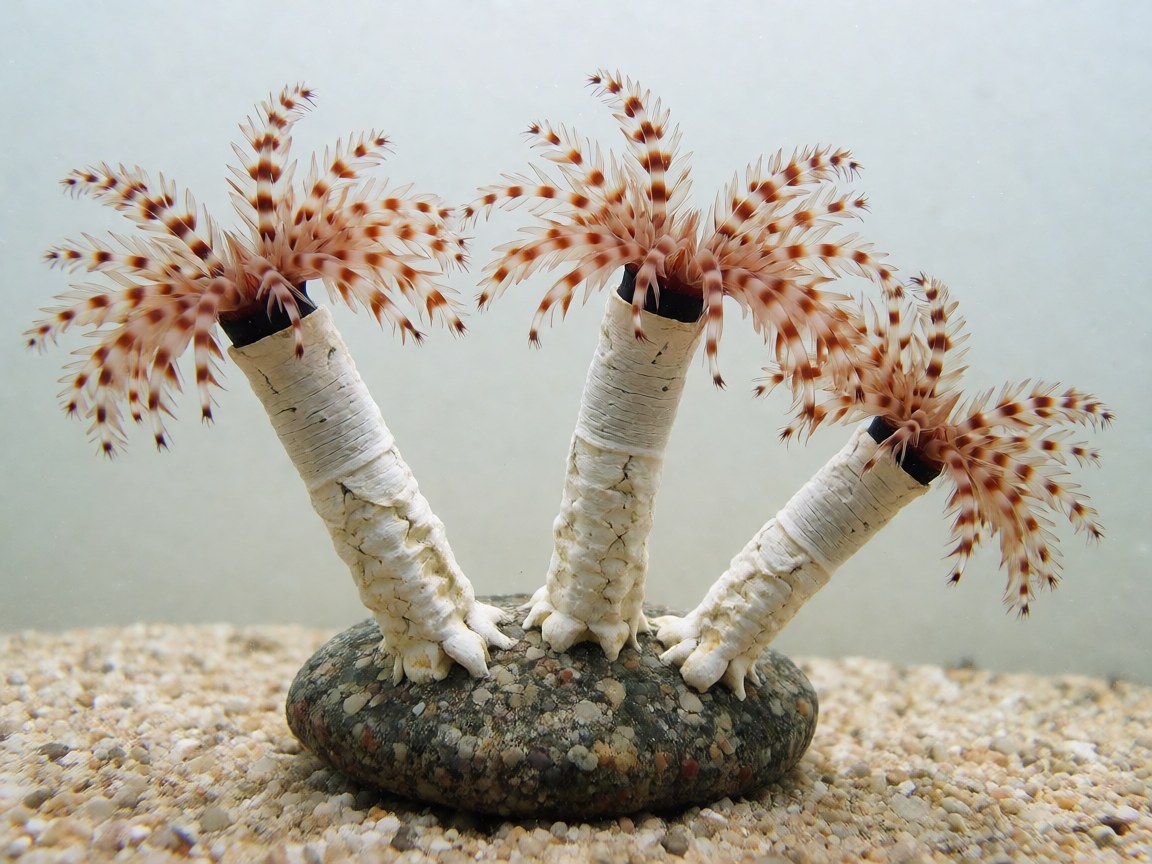
Serpula vermicularis | Calcareous Tube Worm
Introduction
The calcareous tube worm (Serpula vermicularis) is a small marine worm that builds a hard, white, chalky tube shaped like a curling horn, attached to shells, stones, and seaweed. From the mouth of the tube it extends a delicate double fan of banded tentacles—usually red, orange, and white—which it uses both to breathe and to catch food. At the first sign of danger the whole fan vanishes inside the tube in an instant, and a lid closes behind it.
Taxonomy
Serpula vermicularis is a polychaete worm in the family Serpulidae, the calcareous tube worms. It belongs to the same annelid phylum as the earthworm, Lumbricus terrestris, sharing the segmented body and the bristle-bearing appendages that define the group, but instead of burrowing through soil it secretes a hard calcium carbonate shell and lives permanently cemented to a surface, feeding with a fan held out into the water.
Physical Characteristics
The tube is white, hard, and chalky, up to seven centimetres long and about two to three millimetres across, irregularly curved and often tangled with others, with fine ridges and a smooth, round opening. The worm inside is slender and segmented, usually five to seven centimetres long. The visible part is the crown: two spiralling fans of feathered tentacles, one to two centimetres across, banded in red, orange, pink, and white. A fleshy, funnel-shaped plug called an operculum sits on one tentacle and is used to seal the tube.
Habitat
It attaches to shells, stones, rocks, pilings, jetties, and the holdfasts and fronds of large seaweeds, from the low shore down to depths of well over a hundred metres. It is found in seas worldwide, including around Britain and Ireland. It favours sheltered, clean, hard-bottomed ground where currents bring a steady supply of food, and where conditions suit it the worms can form dense, tangled clumps or small reefs.
Diet
It is a suspension feeder. The feathered crown is spread into the water, and fine side branches, or pinnules, trap plankton and suspended organic particles; cilia pass the trapped material along a groove to the mouth, sorted by size, with the finest going to the mouth and the coarsest being used to extend the tube. The same crown serves as the animal’s gills, so feeding and breathing happen with the same structure.
Reproduction
The sexes are usually separate, though some individuals can change sex. Spawning takes place in spring and summer: gametes are released into the water, and fertilisation is external. The larvae drift in the plankton for several weeks before settling, often attracted to surfaces already carrying adults, and then immediately begin to secrete a tiny tube. Once cemented down the worm cannot move, but it can retreat deep into its tube and seal the entrance with its operculum.
Conservation
The species is widespread and not threatened, but the reefs and clumps that dense colonies can build are slow to form and easily damaged by dredging, trawling, and coastal construction. Because the worms need clean, hard, sheltered seabed and a steady flow of food, they are also sensitive to heavy sedimentation and pollution. Where such conditions are undisturbed, Serpula can be one of the most abundant animals on the seabed.
Fun Facts
- Its hard white tube is made of calcium carbonate, the same material as shell and coral.
- The entire delicate fan can be withdrawn into the tube in a fraction of a second.
- A specially modified tentacle forms a funnel-shaped plug, the operculum, used as a door.
- The tangled tubes of dense colonies can build small reefs on the seabed.
- The coloured fan is used for both breathing and catching food at the same time.