 By st20113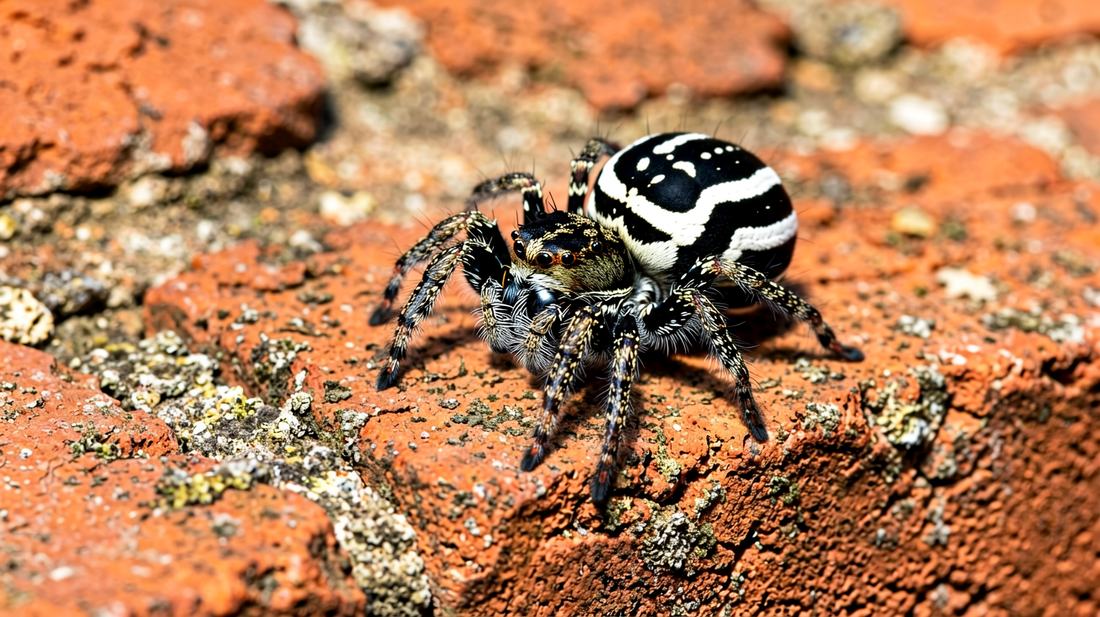
Salticus scenicus | Zebra Jumping Spider
Species Profile · Salticidae
Zebra Jumping Spider
A striped spider with the sharpest eyes of its size, stalking flies on sunny walls and leaping on a silk safety line.
IUCN: Not Evaluated
Range
Size
Eyes
Life
Status
The spider that stares back
The zebra jumping spider
The zebra jumping spider is a small, striped spider. It patrols sunny walls and fence posts. It stares back at anyone who looks closely. It does not wait in a web. It walks, watches, then leaps onto its prey.
It trails a silk safety line behind it. Its front eyes are huge for a spider. They give it the sharpest vision of any animal its size. Black and white bands cross its abdomen and legs. This is why it shares the name of the African zebra.
It is common in gardens, on buildings and around houses across Europe. It is found on both sides of the Atlantic. It is harmless to people. It is one of the most easily watched of all spiders.
Family tree
One of the jumping spiders
The zebra jumping spider belongs to the family Salticidae. This is the family of jumping spiders. It is in the order Araneae. Salticidae is the largest spider family. It has more than 6,000 described species. The group is famous for its vision and its hunting behaviour.
Its closest familiar relative on this site is the Yellow Garden Spider. That spider is also a spider. It belongs to a different family. It uses a different strategy. It sits in a large orb web and waits. The genus Salticus holds several European zebra-patterned species.
These are hard to tell apart. Salticus scenicus is the common one near houses and walls. The species name scenicus comes from a word for the stage. It refers to the male’s courtship display. Jumping spiders do not build prey-catching webs. They do make silk for draglines and retreats.
Eyes, hairs and hydraulics
Built to leap
Adults measure about 5 to 8 millimetres. Females are slightly larger than males. The body is compact. It has short legs and a broad front end. The pattern is bold. A black background carries white bands across the abdomen. The legs are banded. The carapace has white stripes.
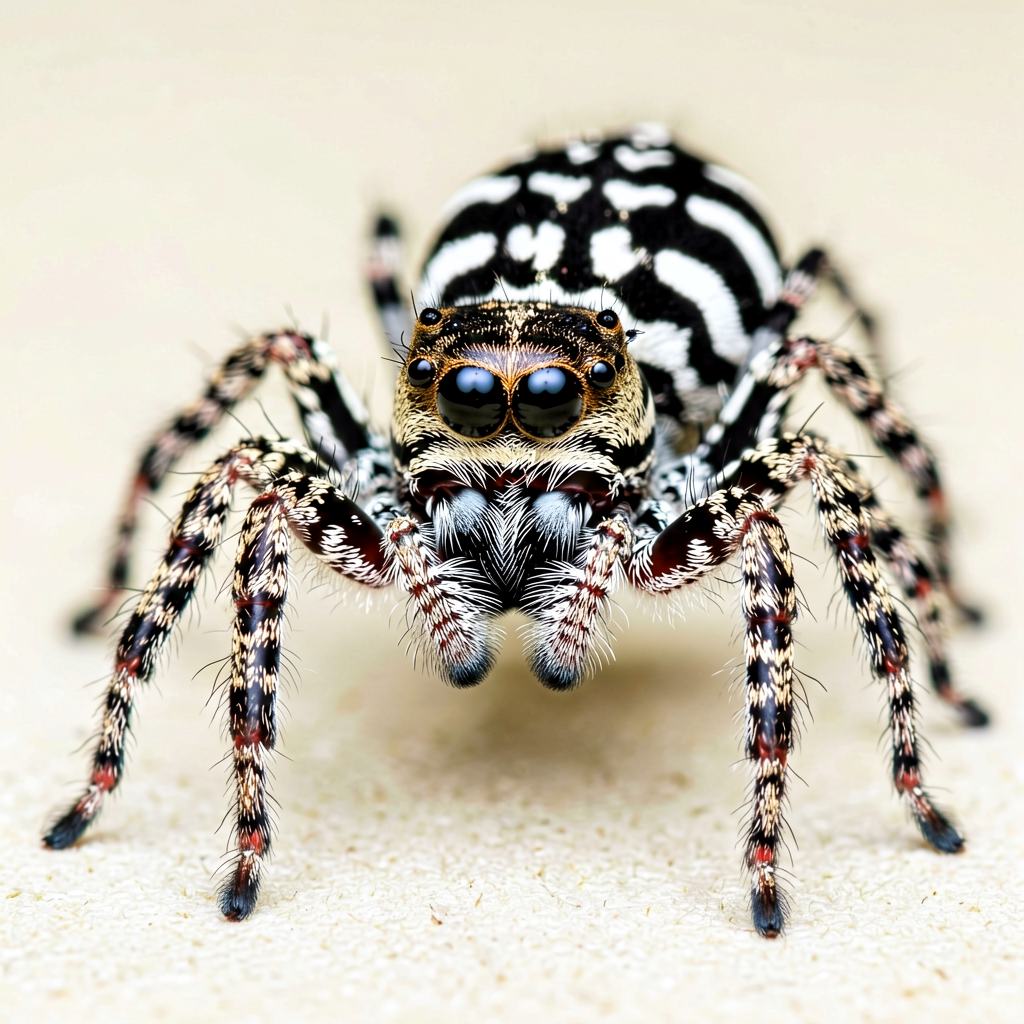
There is a white or pale mark around the eyes. Males have large, dark, forward-pointing fangs. They show these off during courtship. Like all jumping spiders, it has eight eyes in three rows. The two large front eyes are the most important. They work like a telephoto lens. Behind them lies a long, narrow, movable tube. It scans the image across the retina.
This design is unique to this family. The other six eyes cover the sides and rear. They spot movement almost anywhere. The limbs are hydraulic as well as muscular. Jumping spiders extend their legs by a sudden change in blood pressure. This produces a leap far faster than muscle alone. The body is covered in fine hairs. These detect air currents and vibration.
1
2
3
Sunny walls and fences
A spider of buildings
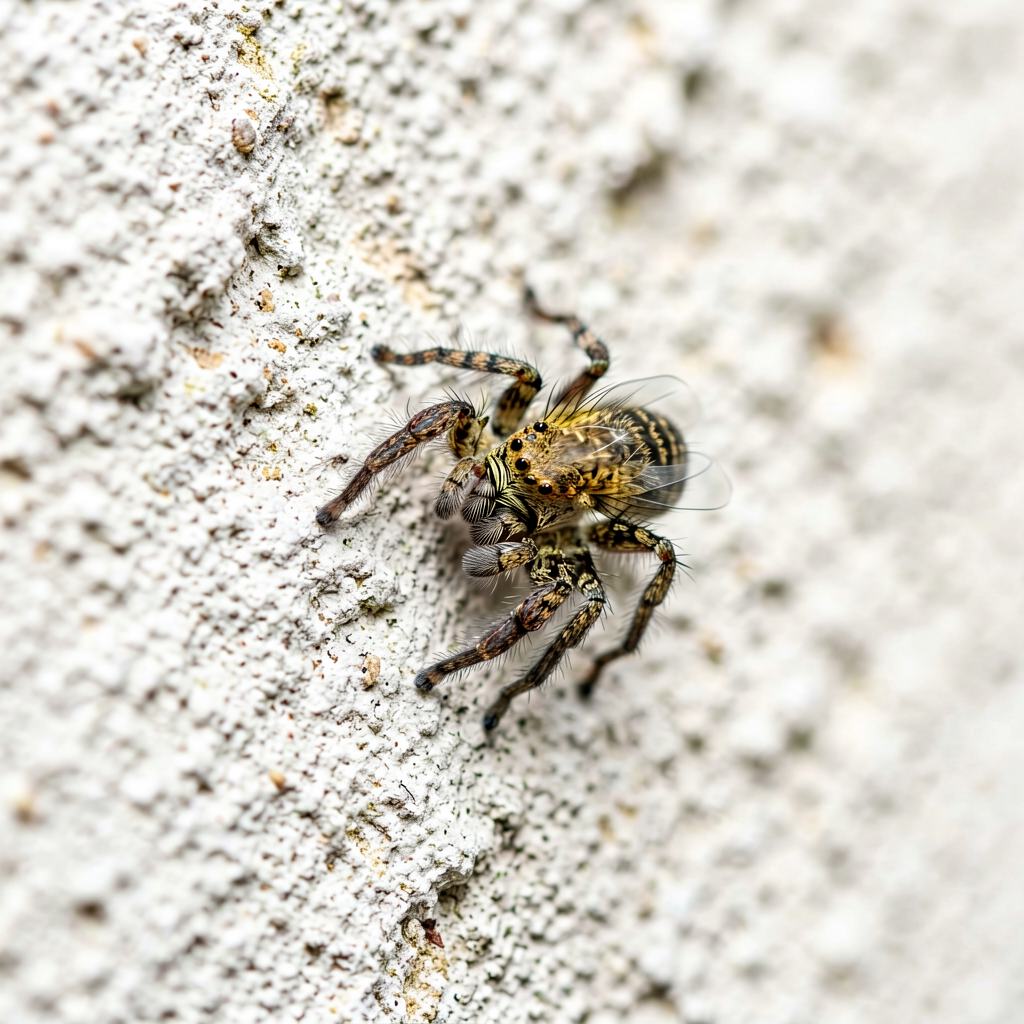
The zebra jumping spider is native to Europe and much of Asia. It is now found across large parts of North America. There it lives mainly around human settlement. It likes dry, sunlit, vertical surfaces. These include walls, fences, gate posts, tree trunks and rock faces. It also likes the edges of windows and doors. Bare stone and weathered wood are ideal.
They have cracks and gaps. The spider needs somewhere to shelter and to moult. It also hunts on low plants and in flower beds. This happens when prey is plentiful. It is common in towns and cities. It survives winter by hiding in crevices. Sometimes it hides inside buildings.
It becomes active again in spring. Because it hunts by sight, it needs light. On dull days and at night it rests in a silken retreat. It is not strictly territorial. Two spiders meeting on a wall will display at each other. Then one retreats.
What it eats
Stalking flies by sight
The zebra jumping spider hunts by day. It stalks its prey on foot. Flies are its main food. It favours small kinds that settle on walls to sun themselves. It also eats gnats, midges and aphids. Ants, small beetles, mosquitoes and tiny moths are eaten too. It spots prey up to about 30 centimetres away. It uses its front eyes.
Then it turns to face the prey. It creeps forward a few millimetres at a time. When close enough it anchors a silk dragline. It jumps and seizes the prey in mid-air. The dragline stops falls. It also helps the spider find its way back. Before a leap it judges distance. Studies show jumping spiders can take off correctly.
This works even when the target is briefly hidden. Venom is injected to subdue the catch. The spider then feeds through its fangs. Bites are harmless to humans. The fangs are small. The venom is not dangerous to people. Birds, larger spiders and spider-hunting wasps prey on jumping spiders.
A dance before mating
Courtship and egg sacs
The zebra jumping spider breeds once a year. This is in spring and early summer. Adults rarely survive the next winter. Courtship is elaborate. A male that finds a female waves his front legs. He raises and lowers his abdomen in a rhythmic display. He may also drum on the surface. He may vibrate his body.
The female watches closely. If she is not ready to mate she may attack. She may eat him. After mating, the female spins a silk retreat in a crevice. She lays a clutch of eggs. She guards them until she dies. The young hatch inside the retreat. They disperse after their first moult.
Often they travel by ballooning. They release a thread of silk into the air. The wind carries them away. This is how the species reached new walls. It even reached new continents. Females live a little longer than males. For both sexes a full life lasts about a year.
Common and unthreatened
A harmless garden hunter
The zebra jumping spider has not been assessed for the IUCN Red List. There is no evidence of decline. It is one of the most familiar spiders of European gardens and buildings. It seems to gain from how people build. Sunny walls and fence posts give it just the habitat it wants.
The main risks are local. The tidying of dry stone walls is one. Old timber is replaced with smooth modern materials. Heavy insecticide use in gardens cuts both shelter and prey. Because it is easily watched and tolerant of people, it is used in schools.
It is used in research on animal vision. It shows that a garden predator need not build a web. A single small hunting spider can clear many flies from a sunny windowsill.
Quick hits
Five things to remember
- The two front eyes give it the sharpest eyesight of any animal of comparable size.
- It always trails a silk safety line before it jumps, so a missed leap is not a fall.
- Jumping spiders extend their legs by a rapid change in blood pressure, not just by muscle.
- The female may eat the male if his courtship display does not convince her.
- Young spiders often travel by ballooning on a thread of silk carried by the wind.